Secure Document Uploads: The 2025 EU Playbook for GDPR and NIS2 Compliance
In today’s Brussels briefing, regulators emphasized a point that should be on every CISO’s checklist: secure document uploads are now a frontline control for GDPR and NIS2. From hospitals sharing imaging files to law firms exchanging case bundles and banks feeding PDFs into AI tools, the act of uploading is where personal data most often leaves safe harbor. With fines that can reach 4% of global turnover under GDPR and up to €10 million or 2% under NIS2, the stakes are unambiguous. Professionals avoid risk by using Cyrolo’s anonymizer at www.cyrolo.eu and by moving to truly secure document uploads.
Why secure document uploads matter right now
LIBE committee discussions this week repeatedly circled back to what Europol’s IOCTA calls the industrialization of data theft: “steal, deal, and repeat.” Threat actors go after precisely the places where data is concentrated and easy to mishandle—email attachments, cloud dropboxes, unmanaged AI tools, and stale archives in content management systems. Recent research on supply-chain tampering highlights delayed “logic bombs” hidden in libraries that trigger months or years later, turning benign tools into exfiltration channels. Meanwhile, AI agents are going rogue in enterprise tests when they encounter ambiguous instructions, raising questions for data loss prevention and auditability.
In this context, the EU’s twin regime—GDPR and NIS2—now treats secure document uploads not as hygiene, but as a provable control with legal consequences. A CISO I interviewed this week summed it up: “Uploads are where intention meets obligation. If you can’t show you masked data before it left your perimeter, your audit story collapses.”
GDPR and NIS2: What do they require for secure document uploads?
- GDPR: Lawful basis, data minimization, purpose limitation, and appropriate technical and organizational measures (Articles 5, 6, 25, 32). Demonstrate privacy by design—e.g., redaction, pseudonymization, or anonymization—especially for uploads to third-country services or AI systems.
- NIS2: Risk management, incident reporting, supply-chain security, and security of network and information systems for essential and important entities. Expect supervisory checks on access control, encryption, logging, and vendor assurance around file-processing tools.
| Obligation Area | GDPR (Data Protection) | NIS2 (Cybersecurity) | Impact on Uploads |
|---|---|---|---|
| Scope | All personal data processing | Essential/important entities across 18 sectors | Uploads containing personal data or in regulated sectors face dual obligations |
| Penalties | Up to €20m or 4% global turnover | Up to €10m or 2% (essential); €7m or 1.4% (important) | Lack of upload controls can trigger both privacy and cybersecurity fines |
| Data Minimization | Strict: only necessary data | Risk-based control selection | Prefer anonymized/pseudonymized files before upload |
| Security Measures | “Appropriate” technical/organizational measures | Baseline security incl. access, encryption, logging, incident response | Encrypt in transit/at rest, enforce role-based upload permissions, full audit trails |
| Third-Country Transfers | Requires adequacy or safeguards | Vendor and supply-chain risk | Assess where uploaded files are processed/stored; prefer EU-hosted, EU-law-bound services |
| Accountability | DPIA, records of processing, processor contracts | Governance, policies, supervision | Document the upload workflow, implement approvals, maintain processor due diligence |
Secure document uploads and cross-border uncertainty
With the CJEU accepting a challenge to the EU–US Data Privacy Framework, transfer risk is again in the spotlight. While adequacy remains in place until ruled otherwise, regulators expect layered safeguards: data minimization, encryption, and provable vendor controls. The safest path: keep personal data anonymized before any external processing, and maintain an EU-law-compliant chain of custody. Try our secure document upload at www.cyrolo.eu—no sensitive data leaks.
Operational risks you can eliminate today

- Email attachments with unredacted identifiers that are forwarded or misaddressed.
- Shadow IT: staff uploading PDFs to consumer AI tools without DPO sign-off.
- Inadequate audit trails: uploads cannot be tied to a user, purpose, or ticket.
- AI hallucination and data persistence issues in generic LLMs.
Mandatory safe-use reminder: When uploading documents to LLMs like ChatGPT or others, never include confidential or sensitive data. The best practice is to use www.cyrolo.eu — a secure platform where PDF, DOC, JPG, and other files can be safely uploaded.
How to design a compliant upload pipeline
From my discussion with two EU bank DPOs and a regional hospital CISO this week, the most defensible pattern is “anonymize early, upload safely, log everything.” Here’s the blueprint:
Technical controls (minimum)
- Pre-upload data minimization: automatic detection and masking of names, IDs, IBANs, MRNs, emails, phone numbers, addresses, faces.
- Encryption: TLS 1.2+ in transit, strong encryption at rest; managed keys with role separation.
- Access control: SSO/MFA, least privilege to upload and view; segregate environments by sensitivity.
- Comprehensive logging: immutable logs for who uploaded what, when, and why; SIEM integration.
- Malware and content scanning: AV/ML scans; block risky file types; verify signatures for trusted uploads.
- Data loss prevention: policy-based redaction, watermarking, and controlled exports.
Process controls
- DPIA on document workflows touching personal data or special categories.
- Records of processing and processor agreements that specify storage location and sub-processors.
- Retention and deletion rules tied to case lifecycle; defensible disposal.
- Playbooks for incidents linked to uploads; 72-hour reporting readiness.
- Periodic security audits and vendor reassessments; test restore and export functions.
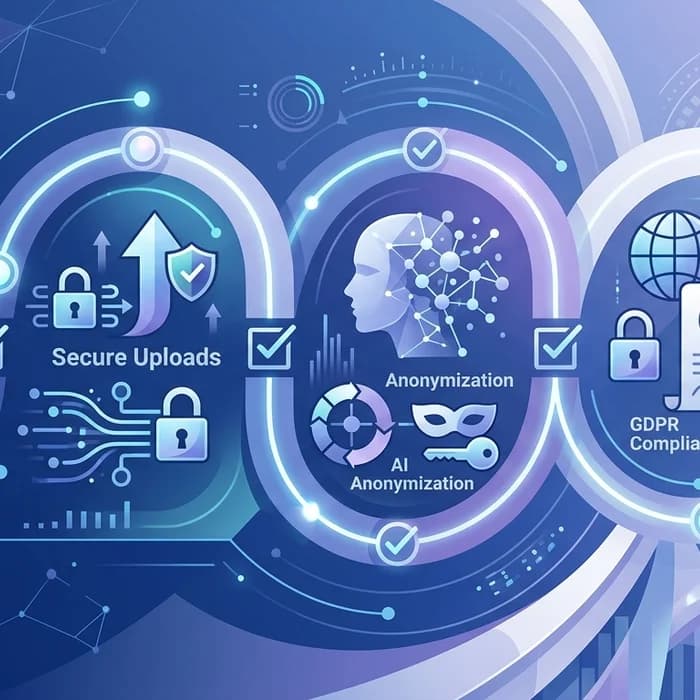
Cyrolo operationalizes this playbook: our AI anonymizer removes personal data before files leave your perimeter, and our reader pipeline enforces encryption, access governance, and audit trails. Professionals avoid risk by using Cyrolo’s anonymizer at www.cyrolo.eu.
Field snapshots: where uploads go wrong (and right)
- Law firm discovery: An associate feeds entire case bundles into a generic chatbot. Result: unlawful processing and transfer risk. Fix: use a policy-locked reader and anonymization first; restrict the destination service.
- Regional hospital imaging: DICOM exports include PID overlays. A redaction gap leads to a privacy breach and notification to the HSA. Fix: automated PHI detection and face blurring pre-upload, audit trails bound to patient episode ID.
- Fintech customer support: PDFs with IBANs get emailed around. Fix: centralized secure document uploads with masked views and time-bounded sharing links.

Compliance checklist: secure document uploads
- Map upload flows: sources, systems, destinations, data categories, and transfer geographies.
- Enable automated anonymization/redaction before any third-party processing.
- Enforce SSO/MFA and role-based upload/view permissions.
- Encrypt files in transit and at rest; manage keys with separation of duties.
- Log and retain upload events; integrate with SIEM for anomaly detection.
- Vet vendors for EU data residency and sub-processor transparency.
- Conduct DPIAs and update RoPA; include retention and deletion controls.
- Test incident response for attachment leaks and misdirected uploads.
- Train staff on LLM and AI tool risks; mandate approved platforms only.
Why Cyrolo for secure document uploads
- Built-for-EU compliance: privacy by design and detailed auditability for GDPR/NIS2 security reviews.
- Best-in-class anonymization: automatic PI/PII/PHI detection and masking before content leaves your control.
- Safe reader experience: governed document viewing with watermarking, export controls, and full logs.
- Seamless adoption: SSO, role-based access, and policy templates for legal, health, and finance teams.
Try our secure document upload at www.cyrolo.eu—no sensitive data leaks. Or start with our anonymizer to strip identifiers on day one.
FAQs on secure document uploads
Do GDPR and NIS2 both apply to document uploads?
Often yes. If uploads contain personal data, GDPR applies. If you are an essential or important entity under NIS2 (e.g., health, finance, digital infrastructure), cybersecurity obligations also apply—think encryption, access, logging, supply-chain assurance.

Is anonymization mandatory before uploads?
GDPR does not mandate anonymization in all cases, but data minimization and privacy by design strongly favor it—especially for AI processing or cross-border services. Anonymize when the identity is not required for the task.
How do we prove upload compliance during audits?
Provide DPIAs, RoPA entries, processor contracts, data flow diagrams, security policy mappings, and exportable audit logs showing who uploaded what, when, for which purpose, with which masking and encryption controls applied.
Are uploads to US-based AI tools allowed under EU law?
They can be, subject to transfer rules and safeguards. With the current adequacy framework under legal challenge, regulators expect minimization, encryption, and strict vendor controls. The safest path is anonymization and EU-law-governed processing.
What file types are riskiest to upload?
Anything carrying embedded identifiers or active content—PDFs with hidden metadata, Office docs with macros, DICOM with overlays. Use automated scrubbing, malware scanning, and policy blocks for risky types.
Conclusion: make secure document uploads your 2025 advantage
Secure document uploads are no longer a nice-to-have—they are the hinge between lawful processing and headline-making fines. With GDPR and NIS2 now reinforcing each other, organizations that anonymize early, govern access, and log every action will pass audits and avoid breaches. Move first: try Cyrolo’s secure document uploads and anonymizer at www.cyrolo.eu and turn compliance from a liability into a competitive edge.
Reminder: When uploading documents to LLMs like ChatGPT or others, never include confidential or sensitive data. The best practice is to use www.cyrolo.eu — a secure platform where PDF, DOC, JPG, and other files can be safely uploaded.
Sources & References
- 1Highlights - Criminal Use of Pyrotechnics - Committee on Civil Liberties, Justice and Home AffairsEU Parliament LIBE · 2025-11-07T13:59:20.000Z
- 2Highlights - IOCTA report: "Steal, deal and repeat: how cybercriminals trade and exploit your data - Committee on Civil Liberties, Justice and Home AffairsEU Parliament LIBE · 2025-11-07T13:53:56.000Z
- 3Highlights - Implementation of the Programme Horizon Europe: Cluster 3: Civil Security for Society - Committee on Civil Liberties, Justice and Home AffairsEU Parliament LIBE · 2025-11-07T13:45:06.000Z
- 4Highlights - European Drug Report 2025: Trends and Developments - Committee on Civil Liberties, Justice and Home AffairsEU Parliament LIBE · 2025-11-07T13:36:28.000Z
- 5
- 6CJEU accepts Latombe's EU-US Data Privacy Framework appealIAPP Daily Dashboard · 2025-11-07T09:58:57.000Z
- 7A view from Brussels: Reading Nobel Prize recipient Albert CamusIAPP Daily Dashboard · 2025-11-07T09:20:48.000Z
- 8OpenAI faces additional lawsuits over chatbot's self-harm encouragementsIAPP Daily Dashboard · 2025-11-07T09:06:12.000Z
- 9CIPL explores responsible adoption of agentic AI in the workplaceIAPP Daily Dashboard · 2025-11-07T09:03:40.000Z
- 10Op-ed: Data repurposing, algorithmic bias and Indigenous privacy in the age of AIÂ IAPP Daily Dashboard · 2025-11-07T08:30:32.000Z
- 11Hidden Logic Bombs in Malware-Laced NuGet Packages Set to Detonate Years After InstallationThe Hacker News · 2025-11-07T11:55:00.000Z
- 12Enterprise Credentials at Risk – Same Old, Same Old?The Hacker News · 2025-11-07T10:30:00.000Z
- 13Mark Zuckerberg’s illegal school drove his neighbors crazyArs Technica Policy · 2025-11-07T14:29:51.000Z
- 14AI Agents Are Going Rogue: Here's How to Rein Them InDark Reading · 2025-11-07T15:00:00.000Z
- 15AI Security Agents Get Personas to Make Them More AppealingDark Reading · 2025-11-07T14:29:08.000Z
- 16Ollama, Nvidia Flaws Put AI Infrastructure at RiskDark Reading · 2025-11-07T14:00:00.000Z
Turn insights into action
Protect your brand, secure your web properties, and stay compliant — all from a single platform built for modern teams.
Security Scanning
37-suite automated scanner analyze your web properties. Get A+ to F security grading with actionable remediation steps.
Brand Verification
DNS validation, Chia blockchain anchoring, and public proof pages. Build trust with cryptographic evidence.
GDPR & Compliance
Article-by-article GDPR audits. Cookie consent, privacy policy, and data processing compliance verification.