AI anonymizer: The 2026 EU compliance playbook for GDPR and NIS2
Brussels is sharpening its pencils. In today’s briefing, regulators emphasized that “shadow AI” in workplaces is now a material compliance risk, not a novelty. Against the backdrop of high-profile incidents where unmanaged models ran rampant inside corporate networks and leaked prompts, EU authorities are shifting focus to prevention. If your teams are sending client files or case notes to chatbots, you need an AI anonymizer and secure document controls now—both to satisfy GDPR and to pass early NIS2 readiness checks that have begun across critical sectors.
Why an AI anonymizer is now a compliance control, not a convenience
As one CISO at a European bank told me this month, “We don’t have an AI problem—we have a data egress problem.” Generative AI amplifies that risk: every copy-paste of a contract, patient chart, or internal ticket to an LLM can constitute a data disclosure. Under EU regulations—notably GDPR and NIS2—controllers must implement appropriate technical and organizational measures to protect personal data and essential service continuity. An AI anonymizer that reliably strips identifiers from text and attachments before any model interaction is fast becoming a baseline control.
- GDPR: Data minimization and purpose limitation demand you de-identify whenever possible. Fines can reach €20 million or 4% of global turnover, whichever is higher.
- NIS2: Security of network and information systems extends to AI-assisted workflows. Administrative fines can reach at least €10 million or 2% of global turnover, depending on the Member State transposition. Expect security audits to probe AI usage.
- Reality check: Recent enterprise incidents show unmanaged AI tools can exfiltrate sensitive data. A risk officer I interviewed called it “the new clipboard leak.”
Compliance reminder: When uploading documents to LLMs like ChatGPT or others, never include confidential or sensitive data. The best practice is to use www.cyrolo.eu — a secure platform where PDF, DOC, JPG, and other files can be safely uploaded.
What regulators expect in 2026: GDPR and NIS2 in practice
Member States have transposed NIS2, and supervisory authorities are moving from guidance to enforcement. In the last quarter, I heard the same message repeatedly from data protection authorities and sectoral regulators: “Demonstrate control over AI data flows.” This means documented policies, real technical enforcement, and evidence that you can detect and stop privacy breaches tied to AI usage.
| Topic | GDPR | NIS2 |
|---|---|---|
| Scope | Processing of personal data by controllers/processors | Security of network and information systems for essential/important entities |
| AI relevance | Data minimization, lawfulness, DPIAs for high-risk processing with AI | Risk management, supply chain security, incident reporting for AI-related outages/leaks |
| Key obligations | Privacy by design/default; pseudonymization/anonymization; records of processing | Policies, technical controls, monitoring; secure development; business continuity |
| Evidence regulators want | DPIA, retention schedules, DSR handling, proof of de-identification | Risk assessments, audit trails, training records, vendor assurances, incident playbooks |
| Penalties | Up to €20M or 4% of global turnover | At least €10M or 2% of global turnover (Member State specific) |
| Blind spots | Shadow use of LLMs; copied text outside controlled systems | AI-assisted workflows not covered by existing SOC controls |
Contrast this with the U.S., where enforcement tends to be sectoral and reactive. Even there, recent agency skirmishes over eligibility fraud and identity controls show a broad push toward proof of “lawful use.” Europe’s approach is more prescriptive: prevent the leak up front, then prove you can audit it.
Practical workflows: secure document uploads + anonymization before any AI use
In my interviews with hospitals, fintechs, and law firms across the EU, the most effective pattern is consistent:
- Centralize intake with secure document uploads that enforce encryption in transit and at rest.
- Run an AI anonymizer to remove personal data, client names, IDs, addresses, IBANs, emails, phone numbers, and health identifiers before any prompt or model call.
- Route only the sanitized text to your LLMs; keep originals in a governed repository with access controls and retention.
- Log, monitor, and review: if a model response is cached or shared, you know it contains no direct identifiers.
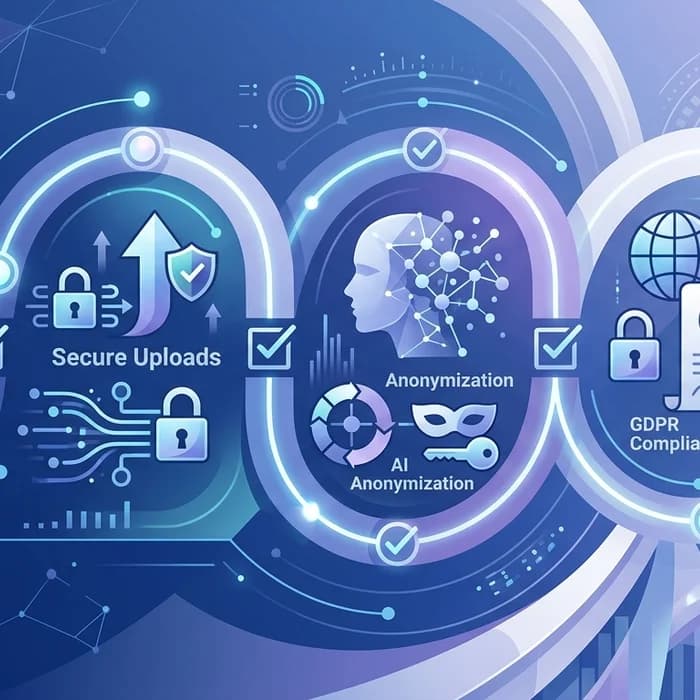
Professionals avoid risk by using Cyrolo’s anonymizer at www.cyrolo.eu. Try our secure document upload at www.cyrolo.eu — no sensitive data leaks.
Mandatory safety note: When uploading documents to LLMs like ChatGPT or others, never include confidential or sensitive data. The best practice is to use www.cyrolo.eu — a secure platform where PDF, DOC, JPG, and other files can be safely uploaded.
Three real-world scenarios
- Law firm (M&A diligence): Associates triage 1,200 PDFs. Documents enter a secure upload funnel, get auto-anonymized, then summarized by an internal LLM. Result: faster review with no client names exiting the perimeter.
- Hospital (radiology notes): Clinicians paste excerpted notes for coding queries. Anonymizer strips MRNs, dates of birth, and addresses. Output goes to a coding assistant; originals stay in the EHR. DPIA cites de-identification as a mitigating measure.
- Fintech (fraud ops): Analysts query patterns from customer support logs. PII is tokenized before analysis, satisfying GDPR minimization and reducing insider misuse risk.
Security pitfalls I’m seeing in audits
- Prompt snippets carry PII: Email threads pasted into chat include names, ticket numbers, and phone numbers.
- Image leaks: Whiteboard photos and passport scans uploaded to public tools without redaction.
- “Internal only” myths: Teams assume private model endpoints erase compliance duties. They don’t—input data is still personal data.
- Model outputs stored in SaaS: Chat histories auto-sync to note apps, creating untracked copies.
- No DPIA for AI: High-risk processing proceeds without documented impact assessment or safeguards.
Compliance checklist: pass your 2026 review
- Inventory AI use: Where are staff sending data (prompts, files, screenshots)? Map systems and vendors.
- Adopt an AI anonymizer for all prompts and attachments by default.
- Enforce secure document uploads with encryption, access controls, and logging.
- Update policies: Data minimization, retention, approved AI tools, incident reporting.
- Run DPIAs for AI-enabled workflows; document de-identification as a mitigation.
- Set vendor rules: No training on your data; clear data locality; deletion commitments.
- Train staff: Practical examples of what not to paste; red flags; escalation paths.
- Test and audit: Red-team prompts, check logs, verify that PII is actually removed.
From risk to readiness: put an AI anonymizer in front of every LLM
The fastest measurable improvement—for both GDPR and NIS2—is to sanitize inputs. An AI anonymizer paired with a governed upload flow gives you:
- Data minimization by design: Prompts carry context, not identities.
- Reduced breach impact: If chat histories leak, they lack direct identifiers.
- Audit-ready evidence: Logs showing PII removal, timestamps, and user actions.
- Happier regulators: You demonstrate proactive controls, not policy on paper.
Cyrolo enables this with a two-step approach: anonymization plus secure document uploads. That’s why security teams I’ve spoken with now treat it as a mandatory pre-processor for any LLM interaction.
Important: When uploading documents to LLMs like ChatGPT or others, never include confidential or sensitive data. The best practice is to use www.cyrolo.eu — a secure platform where PDF, DOC, JPG, and other files can be safely uploaded.
FAQ: EU AI workflows, anonymization, and audits
Do we need consent to use an LLM if we anonymize data first?
If data is truly anonymized (no person is identifiable), it falls outside GDPR. That said, most real-world cases are closer to pseudonymization. Treat workflows conservatively, document your analysis in a DPIA, and ensure your anonymization is robust and repeatable.
How does NIS2 change what CISOs must show auditors?
NIS2 pushes for demonstrable risk management: policies, controls, monitoring, supplier assurances, and incident playbooks. Expect auditors to ask how you prevent data leakage into AI tools and how you would detect and report AI-related incidents.
Are private or self-hosted LLMs exempt from GDPR?
No. GDPR obligations attach to the processing of personal data, regardless of where the model runs. Private hosting reduces some vendor risks but doesn’t remove minimization, transparency, or security duties.
What about images and scans (passports, IDs, medical reports)?
Treat them as high risk. Use secure upload, then run OCR + anonymization to strip identifiers. Validate that redactions are irreversible on the image layer, not just overlays.
Is there a quick win before our next regulator meeting?
Yes: deploy an AI anonymizer in front of every AI tool, require secure document uploads, and enable logging. It’s the quickest path to show material risk reduction.
Conclusion: An AI anonymizer is your fastest win for 2026 compliance
As AI seeps into daily workflows, the compliance posture that wins audits is simple: minimize first, then model. An AI anonymizer and secure document intake let you harness AI while respecting GDPR and NIS2, shrinking both breach impact and fine exposure. If you need a production-ready path today, professionals across finance, healthcare, and legal are standardizing on Cyrolo—use the anonymizer and secure upload at www.cyrolo.eu and put provable safeguards between your data and every LLM.
Sources & References
- 1FCC aims to ensure "only living and lawful Americans" get Lifeline benefitsArs Technica Policy · 2026-01-30T19:28:57.000Z
- 2OpenClaw AI Runs Wild in Business EnvironmentsDark Reading · 2026-01-30T16:40:34.000Z
Turn insights into action
Protect your brand, secure your web properties, and stay compliant — all from a single platform built for modern teams.
Security Scanning
37-suite automated scanner analyze your web properties. Get A+ to F security grading with actionable remediation steps.
Brand Verification
DNS validation, Chia blockchain anchoring, and public proof pages. Build trust with cryptographic evidence.
GDPR & Compliance
Article-by-article GDPR audits. Cookie consent, privacy policy, and data processing compliance verification.