AI Act compliance in 2025: What Brussels is signaling and how to stay audit-ready under GDPR and NIS2
In today’s Brussels briefing, regulators emphasized that AI Act compliance is entering a sharper, more enforceable phase—despite talk of “targeted amendments” to fine-tune obligations. For CISOs, DPOs, and general counsel, the message is consistent: align AI governance with GDPR and NIS2 now, or face compounding exposure from privacy, cybersecurity, and IP risks. The legal climate in Europe is hardening, with fines under the AI Act potentially reaching up to €35 million or 7% of global turnover for prohibited practices, GDPR penalties up to €20 million or 4%, and NIS2 enforcement increasingly visible through 2025.

Brussels briefing: Targeted AI Act amendments won’t soften core duties
European officials acknowledged industry concerns about documentation burden and general-purpose AI (GPAI) obligations, but their intent is calibration—not rollback. From conversations in Brussels and with national regulators, three priorities are clear:
- Make high-risk AI documentation auditable and proportionate, not optional.
- Clarify GPAI model provider vs. deployer responsibilities—especially around training data provenance, risk mitigation, and cybersecurity controls.
- Preserve bans on prohibited AI uses and tighten transparency where models interact with individuals.
Practical takeaway: if you’re waiting for “lighter-touch” reforms, don’t. Supervisory authorities are aligning on how audits will work in practice. A CISO I interviewed last week put it bluntly: “We don’t expect regulators to go easy in 2026 just because the economy is tight.”
Why the litigation drumbeat makes AI Act compliance urgent
Recent court actions across Europe and beyond underline the broader risk perimeter:
- A German court finding of copyright violations against a major AI vendor shows that training-data provenance and output filters are no longer academic debates—they’re litigation vectors.
- In the U.S., court-ordered access to large sets of user chats in an AI case is a wake-up call: prompts, documents, and logs can become discoverable records. If staff upload client material to public LLMs, expect e-discovery risk.
- Threat actors are industrializing phishing and exploiting email infrastructure; when Exchange or identity systems are “under imminent threat,” unredacted document flows into AI tools become a lateral-movement accelerant.
In short: AI workflows without privacy-by-design and security-by-default are not just noncompliant—they’re unsafe.
AI Act compliance timelines and what to operationalize in 2025
- Banned AI practices: already applicable after entry into force—no grace period to experiment.
- GPAI obligations: phased in within roughly 12 months of entry into force, with additional codes of practice expected before full audits bite.
- High-risk AI systems: more extensive technical documentation, risk management, human oversight, logging, and post-market monitoring, with full conformity assessments ramping toward the mid-2026/2027 window.
Meanwhile NIS2 has been applicable since late 2024, with Member State lists of essential and important entities maturing through 2025. If you handle critical services (health, finance, transport, digital infrastructure, and more), expect security audits and incident-reporting drills.
GDPR vs NIS2: where privacy and cybersecurity meet
| Obligation area | GDPR | NIS2 |
|---|---|---|
| Scope | Processing of personal data of individuals in the EU | Cybersecurity risk management for essential and important entities in key sectors |
| Primary focus | Lawful basis, transparency, data minimization, data subject rights | Technical and organizational security, supply-chain resilience, incident reporting |
| Incident reporting | Supervisory authority within 72 hours of becoming aware of a personal data breach | Early warning within 24 hours, more detail within 72 hours, final report within one month |
| Security controls | Appropriate measures (encryption, pseudonymization), DPIAs for high risk | Baseline controls: risk management, access control, crypto, logging, business continuity, testing |
| Fines | Up to €20 million or 4% of global annual turnover | Up to €10 million or 2% for essential entities; up to €7 million or 1.4% for important entities |
| Leadership accountability | Demonstrable accountability, records of processing, DPIA evidence | Management oversight and potential temporary bans from managerial duties for non-compliance (national variations apply) |
AI Act compliance: connecting the dots with GDPR and NIS2
- Data governance: Map training and inference data, legal bases, retention, and cross-border transfers.
- Risk management: Classify AI use cases; if high-risk, implement the AI Act’s risk, testing, and human oversight requirements.
- Security: Align with NIS2 controls and log AI system inputs/outputs to support post-market monitoring and audits.
- Transparency: Inform users when interacting with AI, and ensure meaningful human review where outcomes affect rights.
- Supply chain: Obtain GPAI and SaaS security attestations; verify model cards, training data statements, and vulnerability management.
Practical safeguards for documents and prompts
Most breaches and regulatory findings start with basic mistakes: sensitive PDFs uploaded to public chatbots, unredacted screenshots in tickets, or interns testing code on live client data. Fix the pipe, then fix the model.
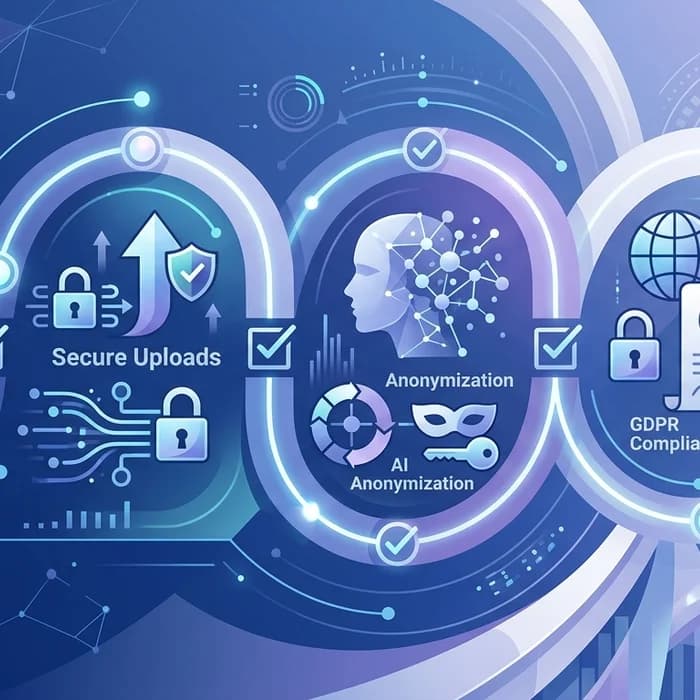
- Default to data minimization: remove direct identifiers and sensitive fields before analysis with an AI anonymizer.
- Use vetted, encrypted workflows for secure document uploads so legal, HR, and clinical teams don’t resort to risky tools.
- Segment environments: production data should never leave secure boundaries; use role-based access and strict egress controls.
- Log everything: prompts, documents, model versions, reviewers, and decisions—your audit trail is your defense.
- Test for leakage: red-team prompts and verify that anonymization resists re-identification attempts.
Professionals avoid risk by using Cyrolo’s anonymizer at www.cyrolo.eu. Try our secure document upload at www.cyrolo.eu — no sensitive data leaks.
"When uploading documents to LLMs like ChatGPT or others, never include confidential or sensitive data. The best practice is to use www.cyrolo.eu — a secure platform where PDF, DOC, JPG, and other files can be safely uploaded."
EU vs US: different enforcement philosophies, same bottom line
- EU: Sector-agnostic privacy law (GDPR), sector-spanning cybersecurity (NIS2), and horizontal AI governance (AI Act). Expect structured audits and fines.
- US: No single federal privacy law; a patchwork of state laws and agency actions (e.g., FTC). Discovery rules can expose AI prompts and documents in litigation.

For global companies, assume EU-grade standards will be requested by customers and auditors—especially around documentation, provenance, and incident readiness.
Real-world scenarios and fixes
Banking and fintech
A payments company wants LLMs to summarize KYC files. Risks: PII exposure, cross-border transfers, and hallucinated sanctions conclusions. Fix: run KYC through an anonymization workflow and only export redacted excerpts to the model; enforce prompt templates and human review; log decisions for explainability audits.
Hospitals and research centers
Clinicians draft discharge notes with AI assistance. Risks: special-category data, re-identification. Fix: pre-process documents via secure document uploads with automated PHI removal; keep model inference in a controlled environment; perform periodic re-identification tests.
Law firms and investigations
Associates ingest evidence bundles into AI tools. Risks: legal privilege loss, discovery exposure. Fix: ring-fenced AI workspace, client-consented workflow, encryption in transit and at rest, strong logging; never upload raw bundles to public LLMs.
Compliance checklist for 2025
- Inventory all AI use cases; tag high-risk and GPAI dependencies.
- Create a data map of personal data flows; confirm legal bases and retention limits.
- Implement role-based access, encryption, key management, and egress controls for AI pipelines.
- Adopt standardized technical documentation for AI systems (risk management, testing, human oversight, logging).
- Run DPIAs for high-risk processing and record outcomes; align with AI Act risk controls.
- Set up NIS2-compliant incident reporting (24h early warning, 72h details, 1-month final report).
- Vendor due diligence: model cards, data statements, security attestations, vulnerability response SLAs.
- Train staff: no uploading client or patient data to public tools; use approved, secure alternatives.
- Operationalize anonymization by default with tools such as www.cyrolo.eu.
- Test and audit quarterly; keep an evidence binder ready for regulators and customers.
Risks regulators are watching (and common blind spots)

- Shadow AI: unapproved tools used by high-performing teams “to move fast.”
- Over-collection: pulling entire repositories into discovery or AI training when a minimal subset would suffice.
- Documentation debt: great controls, poor evidence. If you can’t prove it, it didn’t happen.
- SME burden: smaller firms struggle with model documentation—expect templates and shared services to become a norm.
FAQ
What is AI Act compliance in practice?
It means classifying AI use cases, applying the AI Act’s risk management, human oversight, testing, logging, and transparency rules, and producing audit-ready technical documentation—while staying aligned with GDPR and NIS2.
How does NIS2 intersect with AI systems?
NIS2 requires robust cybersecurity risk management, including access control, encryption, logging, and incident reporting. If AI is used in essential services, those controls and reporting timelines apply to AI components and data flows, too.
Can I upload internal documents to ChatGPT or similar tools?
Avoid uploading confidential material to public LLMs. Use secure, auditable workflows for document uploads and apply anonymization before analysis. Your prompts and files can become discoverable in litigation.
Is anonymization enough to satisfy GDPR?
Proper anonymization can remove personal data from scope, but it must be robust against re-identification. Combine technical de-identification with organizational controls and periodic testing.
What are the fines if we get this wrong?
AI Act: up to €35 million or 7% for prohibited practices (lower tiers for other breaches); GDPR: up to €20 million or 4%; NIS2: up to €10 million or 2% (essential) and €7 million or 1.4% (important).
Conclusion: Make AI Act compliance your 2025 operating principle
AI Act compliance is no longer a future state—it’s the organizing principle for trustworthy AI in Europe, intertwined with GDPR data protection and NIS2 cybersecurity. In a landscape of escalating litigation and advanced threats, the fastest path to resilience is disciplined data minimization, strong security, and audit-ready documentation. Standardize safe workflows today with an AI anonymizer and secure document uploads at www.cyrolo.eu, and meet your regulators—and your customers—on solid ground.
Sources & References
- 1Virkkunen discusses European Commission's 'targeted amendments' to AI ActIAPP Daily Dashboard · 2025-11-12T09:36:00.000Z
- 2German court finds OpenAI guilty of copyright violationsIAPP Daily Dashboard · 2025-11-12T09:21:09.000Z
- 3From CIPP to career: Expanding impact beyond a single organizationIAPP Daily Dashboard · 2025-11-12T09:17:27.000Z
- 4UK bill aims to increase cybersecurity requirements, create steeper penaltiesIAPP Daily Dashboard · 2025-11-12T09:15:56.000Z
- 5Op-ed: AI should be banned in schoolsIAPP Daily Dashboard · 2025-11-12T09:06:37.000Z
- 6OpenAge Initiative offers interoperable age assurance frameworkIAPP Daily Dashboard · 2025-11-12T09:03:57.000Z
- 7Google Sues China-Based Hackers Behind $1 Billion Lighthouse Phishing PlatformThe Hacker News · 2025-11-12T15:48:00.000Z
- 8OpenAI slams court order that lets NYT read 20 million complete user chatsArs Technica Policy · 2025-11-12T18:27:27.000Z
- 9Microsoft Exchange 'Under Imminent Threat', Act NowDark Reading · 2025-11-12T17:24:08.000Z
- 10Phishing Tool Uses Smart Redirects to Bypass DetectionDark Reading · 2025-11-12T15:48:14.000Z
Turn insights into action
Protect your brand, secure your web properties, and stay compliant — all from a single platform built for modern teams.
Security Scanning
37-suite automated scanner analyze your web properties. Get A+ to F security grading with actionable remediation steps.
Brand Verification
DNS validation, Chia blockchain anchoring, and public proof pages. Build trust with cryptographic evidence.
GDPR & Compliance
Article-by-article GDPR audits. Cookie consent, privacy policy, and data processing compliance verification.