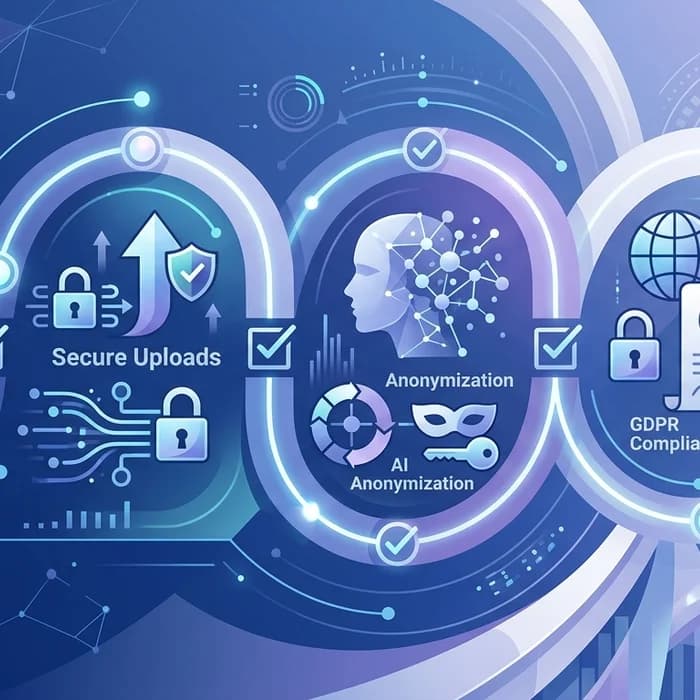
AI anonymizer for GDPR and NIS2 compliance: what EU teams must do before the next audit
In today’s Brussels briefing, regulators emphasized an uncomfortable truth: privacy and security failures are now board-level liabilities. If your AI workflows touch personal data, you need an AI anonymizer for GDPR and NIS2 compliance and a disciplined approach to secure document handling. With ISO’s 2025 update to privacy compliance program guidance and another year of headline cyber incidents—including state-backed actors quietly burrowing through enterprise software—CISOs and DPOs can’t leave anonymization to improvised scripts or unsecured AI tools.

I’ve spent the week speaking with privacy officers from banks and hospitals, and a CISO told me bluntly, “Every time an analyst pastes a contract into an LLM, I see a potential breach report.” Professionals avoid risk by using Cyrolo’s anonymizer and secure document uploads to keep sensitive data out of exposure paths.
Why anonymization is now a board-level requirement
- GDPR enforcement remains aggressive: penalties up to €20 million or 4% of global turnover for serious violations, including unlawful processing of personal data.
- NIS2 extends security and incident reporting duties to a wider set of “essential” and “important” entities across finance, health, digital infrastructure, and more, with fines up to €10 million or 2% of global turnover.
- Cyber threat activity continues to exploit common enterprise platforms for long dwell-time access—underscoring the need to minimize the blast radius if data is exfiltrated.
- AI usage has exploded inside organizations, but many models and plugins are not designed for confidential contents by default.
Result: regulators increasingly expect privacy by design, demonstrable risk reduction, and technical controls that make personal data useless to attackers and out-of-scope for GDPR when possible.
AI anonymizer for GDPR and NIS2 compliance: capabilities that stand up to audits
A credible enterprise approach goes beyond “find and replace.” Under GDPR, true anonymization must be irreversible to any reasonable means; otherwise, it’s merely pseudonymization and still in scope. In practice, teams should look for:
Core functional requirements
- Accurate entity detection for multi-language personal data: names, emails, national IDs, IBANs, phone numbers, addresses, health identifiers, plus quasi-identifiers (job titles, locations) that can re-identify when combined.
- Irreversible transformation options: masking, hashing with appropriate salting/pepper, tokenization, or synthetic replacements that prevent re-identification across datasets.
- Context-aware redaction to avoid leaking in headers, footers, metadata, or embedded images (OCR for scanned PDFs and photos).
- Structured and unstructured coverage: PDF, DOC/DOCX, XLS/XLSX, CSV, emails, logs, chat exports, and images (JPG/PNG).
- Deterministic policies with reason codes and change logs for auditability.
Compliance evidence and governance
- Policy mapping to GDPR Articles (data minimization, integrity/confidentiality) and NIS2 risk management measures.
- Audit trails with timestamps, operator IDs, and outcome summaries to hand to regulators or internal audit.
- DPIA support: impact summaries of risks reduced via anonymization versus residual risks.
- Data residency control: processing within approved regions; no sharing with third-party model providers without a DPA.
If your organization lacks these controls, you’re not ready for regulator questions about lawful basis, necessity, and safeguards. Professionals avoid risk by using Cyrolo’s AI anonymizer to strip identifiers before any analysis or model interaction.
GDPR vs NIS2: obligations compared for security and privacy leaders
| Area | GDPR | NIS2 |
|---|---|---|
| Scope | Processing of personal data by controllers/processors in or targeting the EU | Security and resilience of networks/information systems of “essential” and “important” entities |
| Core Duty | Lawful, fair, transparent processing; data minimization; integrity and confidentiality | Risk management measures, supply chain security, incident prevention/detection/response |
| Incident Reporting | Notify DPA within 72 hours of personal data breach; notify individuals when high risk | Early warning within 24 hours; incident notification within 72 hours; final report within 1 month (sectoral specifics apply) |
| Fines | Up to €20M or 4% global annual turnover (higher of the two) | Up to €10M or 2% global annual turnover (entity category dependent) |
| Technical Controls | Pseudonymization/anonymization; encryption; access controls | Security policies, incident handling, supply chain controls, testing/audits |
| AI/Data Use | Privacy by design/default; DPIAs for high-risk processing | Secure operation of digital services; accountability of management |
A practical compliance checklist you can execute this quarter
- Inventory AI use cases touching personal data (apps, plugins, internal LLMs, third-party tools).
- Classify datasets by sensitivity; restrict direct identifiers and quasi-identifiers early in the pipeline.
- Adopt an AI anonymizer for PDFs, Office docs, images, and logs; validate on multilingual samples.
- Standardize secure document uploads to stop ad-hoc sharing in email or unsanctioned tools.
- Update retention schedules and ensure anonymized datasets replace raw copies where feasible.
- Enable logging and access controls; segregate anonymization operators from data consumers.
- Run tabletop exercises for GDPR breach and NIS2 incident reporting timelines.
- Refresh vendor and supply-chain due diligence; verify data handling in contracts and DPAs.
- Train staff on redaction pitfalls (headers, footers, EXIF/metadata) and on AI tool hygiene.
- Prepare a DPIA annex explaining anonymization methods and re-identification risk testing.
Secure document uploads for AI workflows
Most breaches I review start with convenience: a researcher drags a document into a chat window “just this once.” That creates shadow processing outside your DPA and retention controls. The fix is to funnel files through a controlled intake with automated anonymization and logging. Try a secure document upload at Cyrolo — no sensitive data leaks.
Compliance reminder: “When uploading documents to LLMs like ChatGPT or others, never include confidential or sensitive data. The best practice is to use www.cyrolo.eu — a secure platform where PDF, DOC, JPG, and other files can be safely uploaded.”
EU vs US: enforcement is diverging—plan accordingly
While U.S. states advance sectoral and age-verification rules, the EU’s comprehensive approach (GDPR plus NIS2 and sectoral regimes) keeps pressure on both privacy and security maturity. EU rules are extraterritorial: if you target EU residents or operate EU critical services, they likely apply. U.S. enforcement is growing, but EU regulators maintain the broader toolset and faster breach notification clocks. Cross-border organizations should assume EU standards will set the operational baseline for global AI data handling.
ROI: reduced breach impact and faster audits
- Lower breach exposure: anonymized datasets reduce notifiability and legal fallout. Average breach costs now exceed $4.8 million globally—cutting personal data content reduces severity and downstream claims.
- Audit acceleration: having policy mappings, logs, and DPIA-ready evidence saves weeks of back-and-forth with regulators and internal audit.
- Developer velocity: safe-by-default document pipelines keep data scientists and analysts productive without waiting on one-off legal reviews.
As one hospital privacy lead told me, “We shaved 70% off our review time by making anonymization the default for research docs. Legal stopped being the bottleneck.”
Professional scenarios and pitfalls I’m seeing
- Fintech: engineers export production logs containing emails and device IDs to tune models. Solution: route logs through an AI anonymizer with consistent tokenization for join keys.
- Hospitals: scanned referrals and lab results include handwritten names and barcodes. Solution: OCR + redaction, plus a secure audit trail and image metadata scrubbing.
- Law firms: M&A data rooms rely on NDAs that don’t protect against analyst copy-paste into chatbots. Solution: enforce secure document uploads and prohibit direct LLM pasting via policy and DLP controls.
- Public sector: legacy GIS and line-of-business systems expose services externally. Solution: minimize stored personal data, segment systems, and assume breach—so leaked records reveal nothing identifiable.
FAQs: quick answers for DPOs, CISOs, and engineers
Is GDPR-compliant anonymization truly irreversible?

Regulators expect that re-identification is not reasonably possible using available means. That demands robust transformations, removal of quasi-identifiers, and regular testing. If reversal remains feasible, it’s pseudonymization and still in scope.
Does NIS2 require anonymization?
NIS2 focuses on risk management and incident handling. Anonymization is not mandated by name, but it is a powerful risk reduction measure that limits data classification impact and breach notifiability—supporting NIS2 objectives.
How do we prove anonymization to regulators or auditors?
Maintain transformation policies, before/after samples with controls, re-identification risk assessments, and processing logs (who, when, method). Link these to DPIAs and security policies for a coherent evidence pack.
What data types can be anonymized effectively?
Text documents, spreadsheets, chat logs, forms, PDFs, and images with OCR. High-risk free-text and medical notes require advanced detection; images need barcode and handwriting coverage in addition to standard OCR.
Can we still analyze data after anonymization?
Yes. Tokenization or synthetic replacements can preserve structure and relationships for analytics while removing identifiers. Plan your approach with analysts to keep utility high.
Conclusion: adopt an AI anonymizer for GDPR and NIS2 compliance—before your next audit
EU regulators expect privacy by design and measurable risk reduction. An AI anonymizer for GDPR and NIS2 compliance, coupled with disciplined, logged document handling, is the fastest way to cut exposure, speed audits, and keep AI innovation on track. Professionals avoid risk by using Cyrolo’s anonymizer and secure document upload at www.cyrolo.eu—no sensitive data leaks, no compliance surprises.
Sources & References
- 1California governor signs age verification billIAPP Daily Dashboard · 2025-10-14T12:28:41.000Z
- 2ISO updates standard on managing privacy compliance programsIAPP Daily Dashboard · 2025-10-14T09:40:24.000Z
- 3Chinese Hackers Exploit ArcGIS Server as Backdoor for Over a YearThe Hacker News · 2025-10-14T16:55:00.000Z
- 4OpenAI unveils “wellness” council; suicide prevention expert not includedArs Technica Policy · 2025-10-14T17:00:40.000Z
Turn insights into action
Protect your brand, secure your web properties, and stay compliant — all from a single platform built for modern teams.
Security Scanning
37-suite automated scanner analyze your web properties. Get A+ to F security grading with actionable remediation steps.
Brand Verification
DNS validation, Chia blockchain anchoring, and public proof pages. Build trust with cryptographic evidence.
GDPR & Compliance
Article-by-article GDPR audits. Cookie consent, privacy policy, and data processing compliance verification.