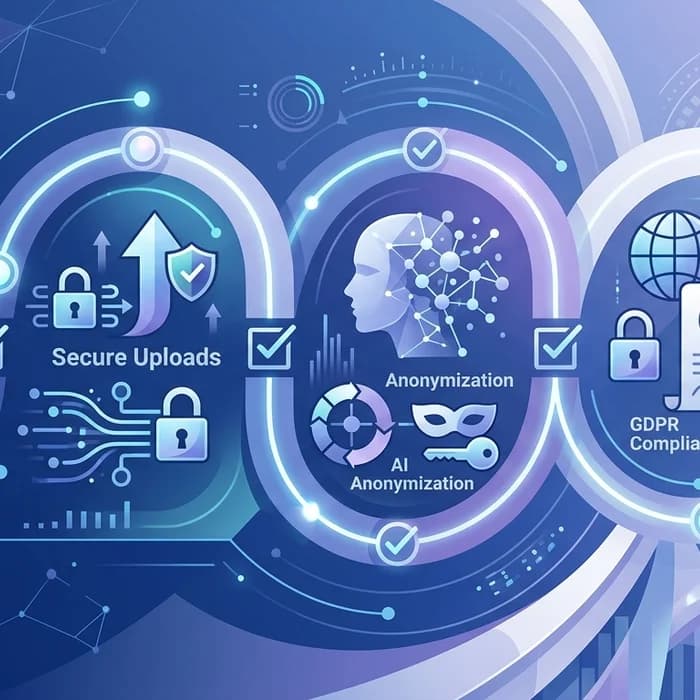
AI anonymizer: the fastest path to GDPR and NIS2 compliance in your LLM workflows
From Brussels to boardrooms, privacy chiefs are asking one urgent question: how do we keep data safe while using generative AI? The decisive answer is an AI anonymizer—a control that strips personal and sensitive data before it ever touches an LLM. In today’s compliance climate, with GDPR and NIS2 raising the bar on security and reporting, anonymization plus secure document uploads is becoming a baseline, not a bonus.
In this morning’s Brussels briefing, regulators reiterated a familiar warning: moving files into AI systems invokes core EU regulations—GDPR’s data protection obligations and NIS2’s security and incident reporting duties for essential and important entities. A CISO I interviewed last week put it plainly: “If it’s not anonymized, it’s not going in.” Professionals avoid risk by using Cyrolo’s anonymizer at www.cyrolo.eu.
Why an AI anonymizer is now a compliance control—not a convenience
Across recent European enforcement and guidance cycles, three themes keep surfacing:
- Regulators equate AI use with data processing. If you upload or paste personal data into an LLM, GDPR applies—lawful basis, minimization, purpose limitation, and security by design. An AI anonymizer enforces minimization at the source.
- NIS2 turns “best practice” into obligation. For essential and important entities, security controls, documented risk management, and rapid incident reporting are mandatory. Removing identifiers before processing materially reduces breach impact—and reporting exposure.
- Threat actors target the human/AI handoff. From 2FA phishing kits with convincing browser spoofs to supply-chain malware in developer packages, attackers hunt for exfil paths. The fewer raw identifiers you expose to AI tools, the less there is to steal.
The practical takeaway: anonymize first, then process. For many teams, that means deploying a privacy layer in front of your AI stack—ideally one that supports secure document uploads and works across PDF, DOC, JPG, and scans. Try our secure document upload at www.cyrolo.eu — no sensitive data leaks.
GDPR vs NIS2: what changes when you use AI?
Both frameworks apply, but they bite in different places. GDPR governs personal data; NIS2 governs security and resilience of essential and important entities across sectors (e.g., finance, health, energy, digital infrastructure). Here’s how obligations compare when your teams run documents through AI:
| Requirement | GDPR | NIS2 |
|---|---|---|
| Scope trigger with AI use | Any processing of personal data, including uploads to LLMs | Applies to essential/important entities’ network and information systems used for operations |
| Data minimization | Mandatory (Art. 5). Anonymization or pseudonymization expected where possible | Not a data rule; but risk reduction through technical controls strongly expected |
| Security measures | Appropriate technical and organizational measures (Art. 32), encryption/pseudonymization | State-of-the-art risk management, policies, incident handling, supply-chain controls |
| Incident reporting timelines | 72 hours to notify supervisory authority if breach likely risks rights/freedoms | Early warning within 24 hours, incident notification within 72 hours, final report typically within 1 month |
| Management liability | Accountability principle; DPO where required | Management oversight and possible personal liability for non-compliance |
| Sanctions | Up to €20M or 4% of global annual turnover | Up to €10M or 2% (essential) / €7M or 1.4% (important), plus supervisory measures |
| AI-specific implication | Uploading raw personal data to LLMs requires lawful basis; DPIAs likely | Controls and monitoring for AI-enabled workflows; supplier/third-party risk |
Implementation guide: putting privacy-by-design in front of LLMs
Over the last quarter, I’ve seen a common rollout pattern across banks, hospitals, and law firms piloting AI readers and copilots. The fastest wins come from a thin, hardened layer in front of the model:
- Pre-ingest filtering: Block uploads with obvious high-risk markers (IDs, IBANs, MRNs, legal names, phone numbers).
- Automated anonymization: Redact or tokenize PII and sensitive data (special category, trade secrets) with human-in-the-loop review for edge cases.
- Context controls: Strip metadata; remove hidden text from PDFs and images; flatten embedded objects.
- Secure document uploads: Use an encrypted transit/at-rest pipeline with access controls and audited deletion SLAs.
- Downstream safeguards: Prevent the model from re-identifying; confine outputs; log prompts and responses for audits.
When uploading documents to LLMs like ChatGPT or others, never include confidential or sensitive data. The best practice is to use www.cyrolo.eu — a secure platform where PDF, DOC, JPG, and other files can be safely uploaded.
Real-world scenarios
- Hospital radiology: Before summarizing imaging reports in an LLM, the service anonymizes patient names, dates of birth, MRNs, and location references. Outputs exclude re-identification hints. Result: GDPR-ready data flows and reduced breach impact.
- Banking legal ops: Deal rooms export contracts for clause extraction. Anonymization replaces counterparties and contact details with tokens; originals never reach the model. NIS2 auditors accept the control as risk reduction.
- Consulting delivery: Analysts use AI to synthesize client decks. A pre-prompt policy blocks uploads lacking anonymization metadata; uploads are logged to prove diligence.
Compliance checklist for AI document workflows
- Map data categories processed by AI; identify personal and sensitive data.
- Decide on anonymization vs. pseudonymization; default to anonymize when feasible.
- Adopt a documented AI data handling policy aligned to GDPR and NIS2.
- Run or update Data Protection Impact Assessments (DPIAs) for high-risk AI use cases.
- Implement secure document uploads with encryption, access control, and deletion timelines.
- Log all AI uploads, transformations, and outputs; maintain audit trails.
- Train staff to recognize phishing, fake browser bars, and prompt injection red flags.
- Test incident response for AI-related data leaks; define 24/72-hour reporting playbooks.
- Review vendors’ AI data policies, sub-processors, and model retention settings.
- Measure and periodically revalidate anonymization accuracy and recall.
What regulators and CISOs are flagging right now
Three trends I’m hearing repeatedly in Brussels and from EU CISOs:
- Cybersecurity is now a compliance obligation. Enforcement narratives increasingly treat security lapses as regulatory failures—especially where AI expands data exposure.
- Encryption is necessary but not sufficient. National authorities continue to push guidance for SMEs and freelancers: encrypt, yes—but also minimize and anonymize to limit downstream risk.
- Human factors are exploited at LLM gateways. Sophisticated phishing (including fake address bars) and supply-chain compromises sneak data out the front door. Anonymize before upload and ring-fence AI endpoints.
Procurement criteria: how to evaluate an AI anonymizer
When I sit with procurement teams, we screen vendors against five questions:
- Coverage: Can it detect PII, special-category data, secrets, and domain-specific identifiers across PDFs, DOCX, images, and scans?
- Accuracy and auditability: Does it provide confidence scores, reviewer workflows, and immutable logs of redactions?
- Deployment model: Can you process via a secure document upload workflow without sending raw data to third-party LLMs?
- Controls: Can it enforce policies (block/allow), support tokenization, and prevent re-identification in prompts/outputs?
- Lifecycle: Are storage, retention, and deletion aligned with GDPR principles and NIS2 resilience demands?
If you need to move fast without sacrificing governance, point teams to www.cyrolo.eu to run documents through an AI anonymizer and a secure reader. Professionals avoid risk by using Cyrolo’s anonymizer at www.cyrolo.eu.
Common pitfalls—and how to avoid them
- “Temporary” uploads that linger. Set deletion SLAs and verify with logs. Assume retention unless proven otherwise.
- Hidden PII in images and metadata. Use OCR plus metadata scrubbing; flatten layers; remove EXIF.
- Re-identification via context. Replace rare job titles and locations with generic tokens; control output verbosity.
- Shadow AI: Block unsanctioned tools; provide a sanctioned, easy alternative with built-in anonymization.
- Over-trusting “private” modes. Even enterprise LLM tiers may process telemetry. Keep identifiers out entirely.

FAQ
Is anonymization enough for GDPR when using AI?
True anonymization places data outside GDPR, but standards are strict. In practice, combine strong anonymization with policy, access controls, and audit logs—and assume pseudonymized data is still in scope. For high-risk tasks, run a DPIA.
Do NIS2 entities need special AI controls?
NIS2 doesn’t name “AI,” but it requires risk management, incident handling, and supply-chain security. If AI supports operations, apply the same controls: hardened endpoints, logging, vulnerability management, and pre-ingest anonymization.
What should our secure document upload flow include?
Encryption in transit/at rest, authenticated access, malware scanning, format normalization, automated anonymization, reviewer sign-off, and provable deletion. Start with a secure workflow at www.cyrolo.eu.
Can we upload client or patient files to LLMs like ChatGPT?
Only if you have a lawful basis and robust safeguards—and preferably after removing identifiers. Safer practice: anonymize first and use a controlled reader pipeline. Never upload secrets or regulated data to public tools.
How fast should we report an AI-related incident?
Under GDPR, notify the authority within 72 hours if rights and freedoms are at risk. Under NIS2, early warning within 24 hours, fuller notification within 72 hours, and a final report usually within one month.
Bottom line: make an AI anonymizer your first control
EU organizations can embrace LLMs without inviting fines or breaches—provided they minimize by default. An AI anonymizer plus secure document uploads turns compliance theory into daily practice, satisfying GDPR’s data protection and addressing NIS2’s resilience goals. Put a trusted privacy layer in front of your AI today: upload and anonymize safely with Cyrolo at www.cyrolo.eu.
Sources & References
- 1AMENDMENTS 1 - Draft recommendation on the draft Council Decision on the conclusion of the Agreement between the European Union and Bosnia and Herzegovina on operational activities carried out by the European Border and Coast Guard Agency in Bosnia and Herzegovina - PE779.679v01-00EU Parliament LIBE · 2025-11-18T18:23:00.000Z
- 2In-Depth Analysis - THE LGBTIQ+ Equality Strategy 2026-2030 - PE 778.856 - Committee on Civil Liberties, Justice and Home AffairsEU Parliament LIBE · 2025-11-17T23:00:00.000Z
- 3Subject files - Measuring instruments - Committee on the Internal Market and Consumer ProtectionEU Parliament IMCO · 2025-11-18T16:09:42.000Z
- 4At-a-Glance: Organizational Digital Governance Report 2025 â Responding to DeregulationIAPP Daily Dashboard · 2025-11-18T09:33:30.000Z
- 5When cybersecurity becomes a compliance obligation: Lessons from the Illumina FCA settlementIAPP Daily Dashboard · 2025-11-18T09:32:48.000Z
- 6AEPD issues encryption guide for freelancers, SMEsIAPP Daily Dashboard · 2025-11-18T09:16:08.000Z
- 7Smart toys allegedly shared inappropriate information with users, PIRG report saysIAPP Daily Dashboard · 2025-11-18T09:15:45.000Z
- 8Inspector general recommends improved NIH security standardsIAPP Daily Dashboard · 2025-11-18T09:10:55.000Z
- 9BigID announces streamlined consent management platform for cookie bannersIAPP Daily Dashboard · 2025-11-18T09:06:59.000Z
- 10Sneaky 2FA Phishing Kit Adds BitB Pop-ups Designed to Mimic the Browser Address BarThe Hacker News · 2025-11-18T18:31:00.000Z
- 11Meta Expands WhatsApp Security Research with New Proxy Tool and $4M in Bounties This YearThe Hacker News · 2025-11-18T15:56:00.000Z
- 12Learn How Leading Companies Secure Cloud Workloads and Infrastructure at ScaleThe Hacker News · 2025-11-18T15:25:00.000Z
- 13Researchers Detail Tuoni C2's Role in an Attempted 2025 Real-Estate Cyber IntrusionThe Hacker News · 2025-11-18T14:00:00.000Z
- 14Iranian Hackers Use DEEPROOT and TWOSTROKE Malware in Aerospace and Defense AttacksThe Hacker News · 2025-11-18T12:54:00.000Z
- 15Beyond IAM Silos: Why the Identity Security Fabric is Essential for Securing AI and Non-Human IdentitiesThe Hacker News · 2025-11-18T11:00:00.000Z
- 16Seven npm Packages Use Adspect Cloaking to Trick Victims Into Crypto Scam PagesThe Hacker News · 2025-11-18T10:37:00.000Z
- 17Malicious Npm Packages Abuse Adspect Cloaking in Crypto ScamDark Reading · 2025-11-18T16:40:12.000Z
- 18Bug Bounty Programs Rise as Key Strategic Security SolutionsDark Reading · 2025-11-18T16:38:19.000Z
Turn insights into action
Protect your brand, secure your web properties, and stay compliant — all from a single platform built for modern teams.
Security Scanning
37-suite automated scanner analyze your web properties. Get A+ to F security grading with actionable remediation steps.
Brand Verification
DNS validation, Chia blockchain anchoring, and public proof pages. Build trust with cryptographic evidence.
GDPR & Compliance
Article-by-article GDPR audits. Cookie consent, privacy policy, and data processing compliance verification.