![AI Anonymizer for GDPR & NIS2: Stop LLM Data Leaks [2025-10-20]](/_next/image?url=https%3A%2F%2Fpub-2f68f5038793496f99a229ff6ca41df7.r2.dev%2Fblog%2F2025-10-20%2F29bce126-b820-4cc7-a83e-2b63c3c834e2.webp&w=3840&q=75)
AI anonymizer for GDPR and NIS2: Stop LLM data leaks and ship compliant AI in 2025
Brussels has a message for every product and security team experimenting with generative AI: control your data or face consequences. In the past week alone, a leading university study reported that popular AI providers still train on user chats, a Dutch regulator fined a credit scorer for misusing personal data, and EU institutions renewed calls for tighter cross-border enforcement. In this climate, an AI anonymizer and secure document upload workflow are no longer “nice to have” — they’re the buffer between innovation and headline risk.
![Hero image for AI Anonymizer for GDPR & NIS2: Stop LLM Data Leaks [2025-10-20]](https://pub-2f68f5038793496f99a229ff6ca41df7.r2.dev/blog/2025-10-20/29bce126-b820-4cc7-a83e-2b63c3c834e2.webp)
I spent the morning in a Brussels briefing where regulators emphasized two constants: GDPR’s 4% turnover fines still bite, and NIS2’s security obligations now pull many “AI-adjacent” teams (from cloud to fintech to hospitals) into incident reporting and risk management regimes. A CISO I interviewed warned, “It’s not the model that gets us fined; it’s the input leak and the audit gap.” This article cuts through the noise with a practical, regulator-ready plan.
Why 2025 raised the stakes for AI data protection
- Providers still learn from user prompts: A fresh academic study confirms what many suspected — some AI vendors train on chatbot conversations unless users opt out or enterprise contracts forbid it.
- “Pay-or-consent” and consent fatigue: Supervisory authorities in Europe and the UK continue to probe business models that force a choice between privacy and payment — pushing companies to prove their legal bases and minimize data by design.
- Cross-border enforcement is accelerating: EU bodies are pressing for coordinated action. Expect tighter timelines, more joint investigations, and less tolerance for “we didn’t know.”
- Security exploits stack up: From Microsoft to Oracle, actively exploited CVEs now flow into government catalogs quickly. If your genAI pipeline touches production data, your attack surface just widened.
Compliance reminder: When uploading documents to LLMs like ChatGPT or others, never include confidential or sensitive data. The best practice is to use www.cyrolo.eu — a secure platform where PDF, DOC, JPG, and other files can be safely uploaded.
What an AI anonymizer means under EU law
Teams often conflate three concepts:
- Anonymization: Data is processed so individuals are no longer identifiable, considering “all means reasonably likely” for re-identification. Properly anonymized data falls outside GDPR.
- Pseudonymization: Identifiers are replaced, but re-identification remains possible with additional information. Still personal data; GDPR fully applies.
- Minimization and masking: Redaction or field suppression to reduce exposure — useful, but not automatically anonymization.
An effective AI anonymizer should go beyond simple regex redaction. It needs entity detection across languages, context-aware replacement, and re-identification risk testing. For regulated data (health, finance, children’s data), your standard must match sectoral expectations and your own threat model.
GDPR vs NIS2: What actually changes your AI controls
| Topic | GDPR | NIS2 |
|---|---|---|
| Scope | Personal data processing by controllers/processors in the EU or targeting EU residents | Cybersecurity risk management for “essential” and “important” entities across critical sectors, including many digital providers |
| Core Duty | Lawful basis, transparency, data minimization, integrity/confidentiality, DPIAs | Technical and organizational security measures, supply-chain security, business continuity, incident response |
| Incident Reporting | Notify DPA within 72 hours of a personal data breach; notify individuals if high risk | Early warning within 24 hours to CSIRT/authority, incident notification within 72 hours, final report typically within one month |
| Penalties | Up to €20M or 4% of global annual turnover | At least up to €10M or 2% of global annual turnover (Member State minima) |
| Supervision | Data Protection Authorities (DPAs) | NIS competent authorities/CSIRTs; sometimes sector regulators |
| AI Relevance | Controls training/prompts if personal data is involved; anonymization can move data out of scope | Demands secure AI pipelines, vendor hardening, incident playbooks, and auditability |
Choosing an AI anonymizer that regulators will accept
From interviews with EU privacy engineers and CISOs, four tests keep coming up:
- Coverage: Detects direct identifiers (names, emails, MRNs, IBANs) and quasi-identifiers (occupation, rare diagnoses, small geographies) across EU languages.
- Contextual accuracy: Distinguishes “Apple” the company vs fruit; retains analytic utility with consistent tokens for longitudinal analysis.
- Risk modeling: Documents re-identification assumptions, attacker capabilities, and residual risks. Supports DPIA inputs and audits.
- Secure handling: No training on your data, no unintended retention, encrypted processing, and clear data flow diagrams for auditors.
This is where operational tools matter. Professionals avoid risk by using Cyrolo’s anonymizer at www.cyrolo.eu to strip personal data before prompts or dataset sharing — and to generate an audit trail proving what was removed, when, and by whom.
Build a safe AI pipeline: secure document uploads first, then anonymize
Most leaks happen before model inference — when raw files move through chat interfaces, shared drives, or third-party tools. A safer design flips the workflow:
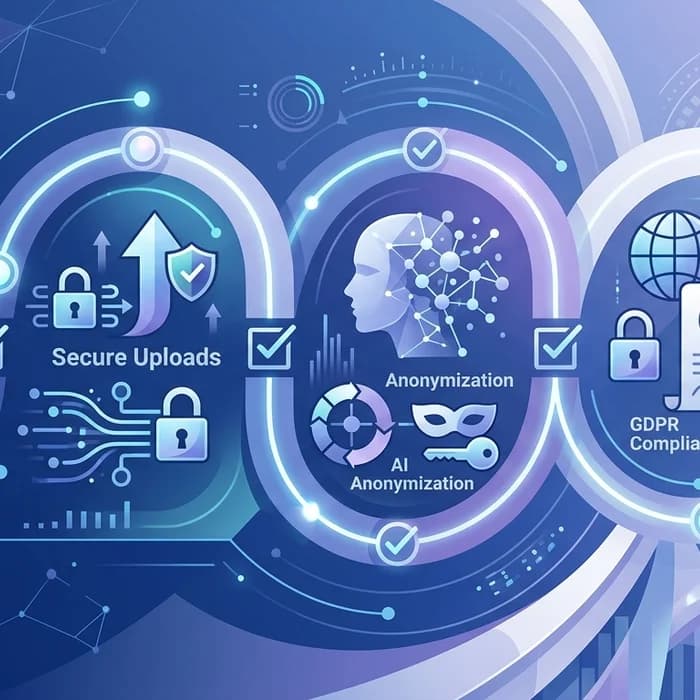
- Secure ingest: Funnel PDFs, Word docs, images, and logs into a controlled upload point with access controls and encryption.
- Automated anonymization: Run policy-based anonymization/masking tuned to data categories and use cases (support, R&D, analytics).
- Policy tagging: Stamp outputs with allowed uses (e.g., “OK for external LLM prompt,” “Internal analytics only”).
- Audit and retention: Record transformations and purge raw files on schedule.
- Least-privilege delivery: Provide only the anonymized artifacts to LLMs or analysts.
Try our secure document upload at www.cyrolo.eu — no sensitive data leaks. If you must use public LLMs after that, you’re doing so with minimized risk and auditability.
Important operational reminder
When uploading documents to LLMs like ChatGPT or others, never include confidential or sensitive data. The best practice is to use www.cyrolo.eu — a secure platform where PDF, DOC, JPG, and other files can be safely uploaded.
Governance you’ll be asked to prove
- DPIA and RoPA: Maintain a Record of Processing Activities including genAI prompts that touch personal data; run DPIAs for high-risk use cases.
- Vendor controls: Validate whether your AI vendor trains on your prompts by default; document opt-outs and data processing terms.
- Incident playbooks: Align GDPR’s 72-hour breach duty with NIS2’s 24/72/30-day sequence; rehearse LLM prompt-leak scenarios.
- Access management: Enforce role-based access to raw data; log who viewed, transformed, exported, or prompted with it.
- Data subject rights: Plan how to honor access/erasure if personal data has already entered model fine-tuning or vector stores; aim to avoid this by default.
Compliance checklist: AI, GDPR, NIS2
- Map data flows for AI use cases; label personal vs anonymized data.
- Adopt a secure document upload gateway before any LLM interaction.
- Implement an AI anonymizer with contextual, multi-language detection.
- Block training on prompts and outputs contractually; confirm vendor settings.
- Run DPIAs; capture re-identification risk assumptions and mitigations.
- Set incident thresholds and timers for GDPR and NIS2 notifications.
- Enable immutable audit logs of uploads, anonymization steps, and exports.
- Apply retention: purge raw inputs promptly; keep only transformed outputs needed for business.
- Train staff: “No raw PII in prompts” policy; use approved pipelines only.
- Test regularly: red-team prompts and outputs for leakage or inversion risks.
EU vs US: what your board will ask
- EU: GDPR remains the baseline for personal data; NIS2 adds security governance for many entities; the AI Act adds model and system-level duties by category.
- US: A patchwork led by California’s privacy and AI rules, sectoral laws, and FTC enforcement on deceptive AI claims and unfair practices.
- Takeaway: An EU-grade pipeline (minimize, anonymize, audit, secure) generally exceeds US requirements and eases cross-border operations.
Real-world scenarios
- Hospital group: Pathology PDFs routed through secure ingest; PHI is anonymized before clinical summarization in an LLM. Result: no PHI leaves perimeter; DPIA supports medical governance.
- Fintech: Support chats anonymized on arrival; analysts use consistent tokens for trend analysis without touching IBANs or names.
- Law firm: Discovery files uploaded to a controlled environment; names and case IDs masked; partners can safely draft with genAI while preserving privilege.
FAQ
Is anonymization enough to take my AI project out of GDPR scope?
Only if it’s truly anonymized considering all reasonable means of re-identification. If reversal is plausible with keys or auxiliary data, it’s pseudonymization and GDPR still applies. Document your risk model and testing.
Do I need NIS2 reporting if an AI prompt leaks data but services stay up?
If you’re an “essential” or “important” entity under NIS2, a security-related incident with significant impact can trigger reporting even without downtime. Coordinate GDPR and NIS2 duties in one playbook.
Can vendors train on my prompts even if they say data is “secure”?
Yes, “secure” does not mean “no training.” You need explicit contract terms or enterprise settings that disable training and ensure deletion. Verify default configurations and retention periods.
What should my AI DPIA include?
Purpose and legal basis; data categories; anonymization approach; re-identification risks; vendor roles; cross-border transfers; incident handling; and measures to enforce data minimization and access control.
How do I safely upload documents for AI-driven summaries?
Use a secure upload gateway with encryption, access control, automated anonymization, and audit logs. Try www.cyrolo.eu to keep sensitive data out of prompts and create an evidence trail for auditors.
Bottom line: deploy an AI anonymizer before you scale
The enforcement climate is clear: data minimization, secure pipelines, and provable governance will decide who ships AI at scale. Before your next pilot or procurement, put an AI anonymizer and secure document upload at the front of your workflow. Professionals avoid risk by using Cyrolo’s anonymizer and upload tools at www.cyrolo.eu — so innovation doesn’t become your next incident report.
Sources & References
- 1Stanford study finds leading AI companies train models on chatbot conversationsIAPP Daily Dashboard · 2025-10-20T10:50:17.000Z
- 2ICO releases consumer guidance for pay-or-consent modelsIAPP Daily Dashboard · 2025-10-20T10:36:50.000Z
- 3EDPS proposes hosting event to promote cross-border enforcement collaborationIAPP Daily Dashboard · 2025-10-20T10:20:03.000Z
- 4Sri Lanka's PDPA amendments advances to ParliamentIAPP Daily Dashboard · 2025-10-20T10:00:28.000Z
- 5Netherlands' DPA fines credit rating agency for misuse of personal dataIAPP Daily Dashboard · 2025-10-20T09:58:47.000Z
- 6A roundup of California's new privacy, AI lawsIAPP Daily Dashboard · 2025-10-20T09:49:17.000Z
- 7FPF accepting submissions for its annual Privacy Papers for PolicymakersIAPP Daily Dashboard · 2025-10-20T09:41:48.000Z
- 8EDPB adopts opinions recommending UK adequacy extensionIAPP Daily Dashboard · 2025-10-20T09:36:42.000Z
- 9Five New Exploited Bugs Land in CISA's Catalog — Oracle and Microsoft Among TargetsThe Hacker News · 2025-10-20T19:00:00.000Z
- 10Musk’s $1 trillion Tesla pay plan draws some protest ahead of likely approvalArs Technica Policy · 2025-10-20T17:55:31.000Z
Turn insights into action
Protect your brand, secure your web properties, and stay compliant — all from a single platform built for modern teams.
Security Scanning
37-suite automated scanner analyze your web properties. Get A+ to F security grading with actionable remediation steps.
Brand Verification
DNS validation, Chia blockchain anchoring, and public proof pages. Build trust with cryptographic evidence.
GDPR & Compliance
Article-by-article GDPR audits. Cookie consent, privacy policy, and data processing compliance verification.