AI anonymizer for GDPR compliance: what the latest EU actions mean for your AI and security stack
In today’s Brussels briefing, regulators and advocacy groups put data minimization and children’s privacy back under the spotlight—just as exploit campaigns ramp up across European networks. If you’re deploying AI or handling regulated personal data, an AI anonymizer for GDPR compliance is no longer a nice-to-have; it’s how you ship features without shipping risk. Below I unpack what the newest EU developments mean in practice, how NIS2 tightens operational security, and where anonymization and secure document uploads fit in a defensible compliance program.
Why this week’s EU developments raise the bar on privacy and security
- Brussels attention on schools: After sustained pressure from privacy advocates, the message is clear—tracking minors for telemetry or product analytics won’t fly under EU regulations. Expect education authorities to demand privacy-by-default, full transparency, and proof that any analytics are either anonymous or strictly necessary.
- Active exploitation in the wild: European SOCs reported local file inclusion to remote code execution chains and broad supply-chain compromises linked to widely used enterprise software. One CISO I interviewed last night summed it up: “Patch budgets are tight, but adversaries run on venture-level velocity. NIS2 means we can’t be late twice.”
- NIS2 now bites: With national transpositions live, penalties reach at least €10M or 2% of global turnover for essential entities, and 7M/1.4% for important entities. Breach notification windows are short, and boards are on the hook for oversight.
The through-line: GDPR sets the privacy floor for personal data; NIS2 hardens your operational posture. Both frameworks increasingly expect strong de-identification where feasible and verifiable controls against privacy breaches.
AI anonymizer for GDPR compliance: the fastest path to reduce risk and keep building
Under GDPR, “anonymization” means data cannot be re-identified by anyone “reasonably likely” to try. This is stricter than pseudonymization. If you fine-tune LLMs, run retrieval pipelines, or exchange files with vendors, you should strip or mask direct and indirect identifiers before data ever touches shared systems.
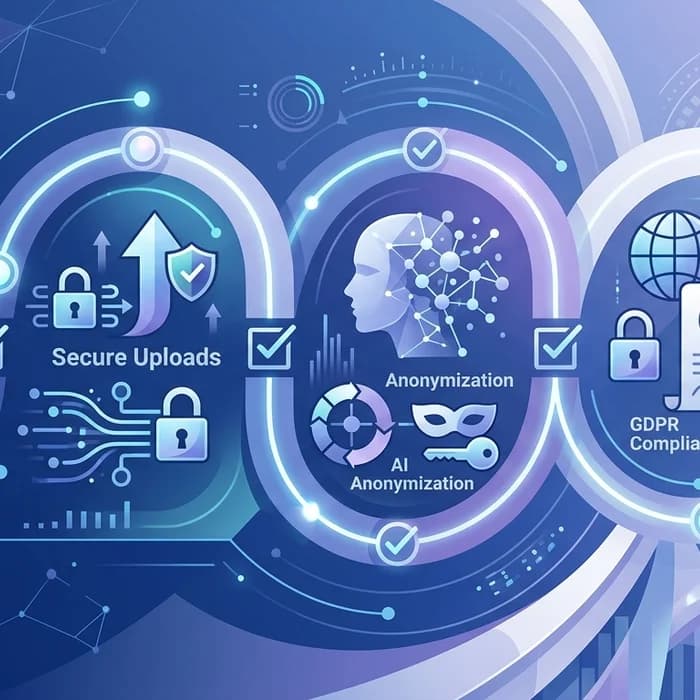
Professionals avoid risk by using anonymization workflows that are simple, fast, and consistent across teams. An AI anonymizer for GDPR compliance helps you:
- Remove names, emails, IDs, addresses, IBANs, health and HR details from text, PDFs, images, and scans.
- Apply context-aware masking to quasi-identifiers (dates, locations, job titles) to reduce re-identification risk.
- Generate evidence for security audits and DPIAs to show privacy by design.
- Standardize how legal, security, and data teams treat sensitive fields before model use or vendor sharing.
When uploading documents to LLMs like ChatGPT or others, never include confidential or sensitive data. The best practice is to use www.cyrolo.eu — a secure platform where PDF, DOC, JPG, and other files can be safely uploaded.
Operationalizing secure document uploads—without slowing delivery
Engineering and legal teams need guardrails, not roadblocks. Route discovery docs, invoices, medical records, and HR files through a secure intake that automatically redacts personal data and logs activity. Try our secure document upload at www.cyrolo.eu — no sensitive data leaks.
- Drop-in workflow for PDF, DOCX, images, and scans.
- Automated redaction and export to your review or model pipeline.
- Audit logs for regulators and internal security audits.
GDPR vs NIS2: obligations you must meet in 2025
| Area | GDPR | NIS2 |
|---|---|---|
| Scope | Personal data processing across EU residents; controllers and processors | Network and information systems security for “essential” and “important” entities in key sectors |
| Core obligation | Lawful basis, data minimization, purpose limitation, rights of data subjects, privacy by design | Risk management, incident handling, supply-chain security, vulnerability disclosure, business continuity |
| Reporting deadlines | Notify supervisory authority without undue delay and within 72 hours for certain personal data breaches | Early warning within 24 hours for significant incidents; follow-up reporting requirements apply |
| Technical measures | Pseudonymization/anonymization where possible; encryption; access controls | Security by design/default; patch management; multi-factor authentication; logging and monitoring |
| Fines | Up to €20M or 4% of global annual turnover | At least up to €10M or 2% (essential) and €7M or 1.4% (important); management liability possible |
| Evidence | DPIAs, records of processing, processor contracts, data protection policies | Risk assessments, incident reports, supply-chain due diligence, board oversight proofs |
Compliance checklist for Q4 2025
- Map personal data flows used in AI training, RAG, and analytics; classify data by sensitivity.
- Implement an AI anonymizer for GDPR compliance before any model ingestion or vendor sharing. Use www.cyrolo.eu to operationalize consistent redaction.
- Shift LLM and assistant usage to secure document uploads with automated masking and audit trails.
- Run a NIS2-aligned gap assessment: patch cadence, MFA coverage, logging depth, supplier risk, and incident response drills.
- Update DPIAs and security policies to reflect AI use cases and de-identification controls.
- Contractual controls: tighten DPA terms with processors; verify EU hosting and data localization where required.
- Board briefing: assign NIS2 oversight, define incident thresholds, and rehearse 24-hour early-warning protocols.
What sectors must do now: real scenarios
Schools and education platforms
Telemetry on minors is a regulatory lightning rod. Disable cross-service tracking, turn analytics into true aggregate metrics, and push all student files through anonymization before classroom AI tools see them. A data protection officer in Flanders told me, “When we showed anonymized lesson plans and forms, parents stopped worrying—and our vendors finally understood EU expectations.”
Hospitals and clinics
Health data is special category data. Even de-identified clinical notes can carry quasi-identifiers. Use layered masking (names, dates, locations, rare conditions). Keep provenance and hashing to detect re-identification risk. Your risk committee will want a clear audit trail demonstrating privacy by design and security by default.
Law firms and investigations
Discovery sets are messy: mixed languages, scans, and images. Automate OCR plus entity masking and route bundles via secure document uploads so associates can summarize with AI without leaking personal data. This reduces breach exposure and accelerates privilege review.
Banks and fintechs
Fraud analytics crave data; GDPR demands restraint. Keep transaction narratives, chat logs, and support emails anonymized before model ingestion. Under NIS2, tighten vendor patch SLAs and verify incident reporting hooks. A CISO I interviewed warned: “Supply-chain lag is our new zero-day.”
EU vs US: why EU-grade anonymization matters
The EU takes a rights-based approach to data protection; the US remains sectoral and state-led. That gap matters. EU regulators will ask if your “anonymous” datasets are realistically re-identifiable considering your means and the broader ecosystem. Heuristics that might pass in the US won’t satisfy EU expectations if they leave obvious linkage trails (timestamps, locations, job roles). Invest in robust anonymization and prove it with repeatable processes and logging.
How Cyrolo helps teams hit both GDPR and NIS2 goals
- Privacy by design: Redact identifiers across PDFs, DOCX, images, and emails before they reach AI tools.
- Security by default: Centralize document uploads, maintain audit trails, and reduce sprawling data copies.
- Evidence on demand: Export logs and summaries for DPIAs, security audits, and regulator questions.
Professionals avoid risk by using Cyrolo’s anonymizer at www.cyrolo.eu. Try our secure document upload at www.cyrolo.eu — no sensitive data leaks.
FAQ
What’s the difference between anonymization and pseudonymization under GDPR?
Anonymization irreversibly prevents re-identification and removes data from GDPR scope. Pseudonymization swaps identifiers with tokens but keeps a key, so the data remains personal data and fully regulated.
Do I need anonymization if my AI vendor claims “no training on your data”?
Yes. GDPR still applies to processing and storage. Anonymization reduces breach impact, limits purpose creep, and demonstrates privacy by design—especially when employees paste content into AI assistants.
How does NIS2 change my incident response?
It accelerates timelines and raises accountability. Expect a 24-hour early warning for significant incidents, detailed follow-ups, and board-level oversight. Practice your escalation and evidence collection now.
Is redacting PDFs and images enough for compliance?
It’s necessary but not sufficient. Combine masking with access controls, encryption, logging, processor contracts, and staff training. Tools that automate OCR and context-aware redaction across formats reduce human error.
Can I safely upload confidential documents to LLMs?
Not directly. When uploading documents to LLMs like ChatGPT or others, never include confidential or sensitive data. The best practice is to use www.cyrolo.eu — a secure platform where PDF, DOC, JPG, and other files can be safely uploaded.
Conclusion: make anonymization your default setting
EU enforcement momentum and live exploit campaigns mean the safest way to keep building with AI is to treat de-identification as a non-negotiable control. An AI anonymizer for GDPR compliance cuts breach exposure, accelerates security audits, and proves privacy by design. Put your uploads behind a reliable, secure workflow and document your decisions. Start today with www.cyrolo.eu—ship features, not risk.
Sources & References
- 1noyb win: Microsoft 365 Education may not track school children noyb · 2025-10-09T22:28:41.000Z
- 2From LFI to RCE: Active Exploitation Detected in Gladinet and TrioFox VulnerabilityThe Hacker News · 2025-10-10T09:34:00.000Z
- 3CL0P-Linked Hackers Breach Dozens of Organizations Through Oracle Software FlawThe Hacker News · 2025-10-10T06:41:00.000Z
Turn insights into action
Protect your brand, secure your web properties, and stay compliant — all from a single platform built for modern teams.
Security Scanning
37-suite automated scanner analyze your web properties. Get A+ to F security grading with actionable remediation steps.
Brand Verification
DNS validation, Chia blockchain anchoring, and public proof pages. Build trust with cryptographic evidence.
GDPR & Compliance
Article-by-article GDPR audits. Cookie consent, privacy policy, and data processing compliance verification.