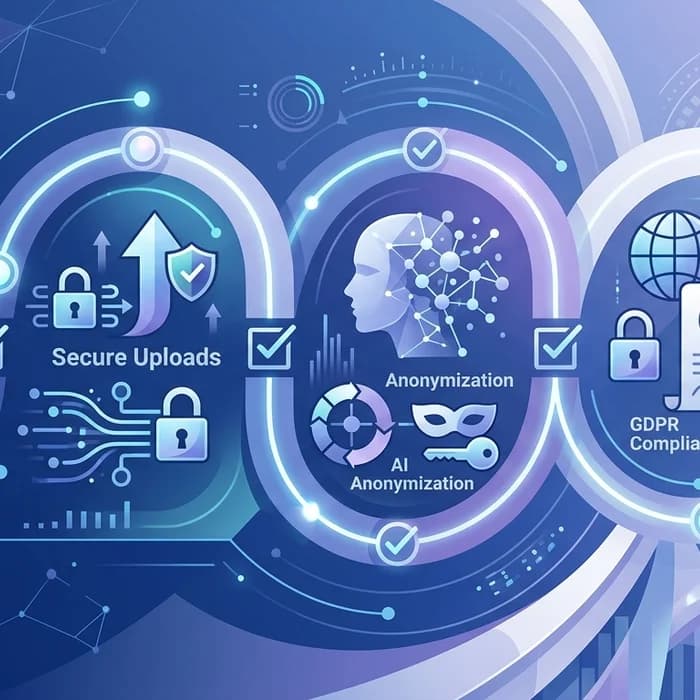
AI anonymizer: the missing control for GDPR, NIS2, and the deepfake era
In today’s Brussels briefing, regulators stressed a simple point: your AI program is only as safe as the data you put into it. An AI anonymizer is no longer “nice to have”—it’s the control that determines whether your model experiments, pilot copilots, and LLM assistants stay compliant with EU regulations like GDPR and NIS2. As governments from the EU to South Korea move to curb deepfakes and AI misuse, companies that fail to protect personal data and trade secrets face accelerating risk, audits, and penalties.

Why an AI anonymizer matters now
Two shifts have converged:
- AI everywhere, data everywhere. Legal, HR, customer service, and SOC teams are feeding models PDFs, screenshots, and ticket logs. Personal data and secrets leak fast.
- Regulators are narrowing tolerance. GDPR enforcement against data misuse continues to surge, and NIS2 brings executive accountability for cybersecurity controls and supply-chain risk. The EU AI Act and national deepfake rules increase scrutiny of model inputs and outputs.
In interviews this quarter, a CISO at a European bank told me: “Our devs didn’t exfiltrate data—our workflows did. Redacting after the fact was too late. We needed pre-flight anonymization.” That’s the gap an AI anonymizer fills: strip or mask personal data and sensitive fields before anything touches an LLM or third-party service.
New legal pressure: EU, South Korea, and beyond
- GDPR: Uploading personal data to an LLM is processing. You need a lawful basis, minimization, DPIAs for high-risk use, processor agreements, and technical measures such as pseudonymization or anonymization.
- NIS2: Critical and important entities must implement risk management, incident reporting, and supply-chain security. Expect audits to question how AI data flows are sanitized and logged.
- Deepfakes: While the EU AI Act introduces transparency duties for synthetic content, other jurisdictions are moving fast too. In Seoul, lawmakers are testing stricter rules targeting deepfake creation and distribution—signal of a global crackdown on deceptive AI media. Even if your HQ is in the EU, cross-border content risks now shape compliance strategy.
- US patchwork: State privacy laws and sector rules (e.g., healthcare, finance) increasingly mirror EU expectations on data minimization and vendor controls, but with uneven enforcement. Multinationals need a baseline that works in both regimes.
Across these frameworks, the common denominator is simple: reduce personal data exposure and keep control of what you upload and share.
Where leaks really happen—and how to prevent them
- Helpdesks and SOCs: Tickets pasted into LLMs include emails, IPs, names, incident details. Solution: route all text through an anonymization layer that masks PII, indicators, and unique business identifiers.
- Legal and HR teams: Contracts and performance files contain signatures, salaries, health data. Solution: batch scrub documents before review; retain reversible mapping safely when you must re-identify internally.
- Customer success and product: Screenshots, logs, and CRM exports are rich with personal data. Solution: enforce secure document uploads to a vetted platform; block direct pasting into external tools.
A hospital I spoke with last month anonymizes 9,000 reports per week before running triage summaries. Their DPO signed off once they could show: consistent masking, audit trails, and zero external training reuse.
Compliance note: When uploading documents to LLMs like ChatGPT or others, never include confidential or sensitive data. The best practice is to use www.cyrolo.eu — a secure platform where PDF, DOC, JPG, and other files can be safely uploaded.
GDPR vs NIS2: what your AI workflows must meet
| Requirement | GDPR | NIS2 |
|---|---|---|
| Scope | Processing of personal data in the EU (or of EU residents) | Cybersecurity risk management for “essential” and “important” entities |
| Focus | Lawfulness, fairness, transparency, minimization; data subject rights | Resilience, incident reporting, supply-chain security, governance |
| AI-specific pressure | DPIAs for high-risk AI, processor agreements, pseudonymization/anonymization | Policies for AI-enabled operations, third-party risk, logging and auditing |
| Evidence expected | Records of processing, retention limits, technical measures, RoPA | Risk assessments, incident drills, vendor due diligence, executive oversight |
| Penalties | Up to €20M or 4% of global turnover, whichever is higher | Member-state fines (often up to €10M or 2% turnover), management liability |
Build a compliant AI data pipeline in 30 minutes (checklist)
- Map AI use cases and data categories (PII, special categories, trade secrets).
- Insert an AI anonymizer before every model call—chat, batch, and API.
- Configure masking rules for names, emails, phone numbers, IBANs, IPs, and free-text PII.
- Block uploads to unvetted tools; enforce secure document upload pathways.
- Log all transformations for audits; retain reversible mappings only when justified.
- Update DPIAs and vendor DPAs; document retention and deletion schedules.
- Run quarterly red-team tests to confirm no personal data escapes.
Selecting an AI anonymizer your DPO will approve

- Accuracy you can prove: Benchmarks for PII detection in PDFs, images (OCR), and multilingual text.
- On-by-default security: Encryption in transit and at rest; regional data residency; clear deletion SLAs.
- No model training on your data: Contractual guarantees and technical isolation.
- Auditability: Detailed logs, role-based access, and exportable reports for regulators.
- Low-friction adoption: Drag-and-drop for non-technical teams and APIs for engineers.
Professionals avoid risk by using Cyrolo’s anonymizer at www.cyrolo.eu. Try our secure document upload at www.cyrolo.eu — no sensitive data leaks.
Real-world playbooks
- Bank/fintech: Mask PII in call transcripts before sending to LLM summarizers; keep reversible tokens only for fraud investigations with strict access controls.
- Hospital: De-identify discharge summaries (names, MRNs, dates) with consistent pseudonyms so clinicians can follow a case across notes without re-identification.
- Law firm: Remove client names, case IDs, and signature blocks from discovery files before contract analysis; keep a local key-value map for authorized re-linking.
AI outputs, deepfakes, and the audit trail
South Korea’s push to curb deepfakes echoes the EU’s direction: provenance, labeling, and accountability. For enterprises, this translates into two controls:
- Input sanitization: Prevent accidental ingestion of personal data or secrets that could leak via prompts or model memory.
- Output governance: Keep records of model prompts and responses, watermark or label synthetic content, and provide human-in-the-loop review for high-impact use.
Anonymization isn’t a silver bullet for misinformation, but it removes the most immediate regulatory tripwires—unlawful processing and preventable privacy breaches.
FAQ: EU compliance, anonymization, and AI rollouts
What’s the difference between anonymization and pseudonymization under GDPR?
Anonymization irreversibly removes identifiers so individuals can’t be re-identified; pseudonymization replaces identifiers with tokens and still counts as personal data. For many AI workflows, pseudonymization with strict access and purpose limits is acceptable—anonymization is stronger where feasible.
Do NIS2 audits look at AI tools even if we’re not “AI companies”?
Yes. NIS2 is about cybersecurity risk, not your business model. If your operations use LLMs or AI copilots, auditors can ask how you control data flows, third-party risk, and incident response related to those tools.
Can we upload contracts and HR files to LLMs if we have a DPA?
A DPA is necessary but not sufficient. You still need minimization, DPIAs for high-risk use, and technical controls like an AI anonymizer to avoid overexposure of personal data and confidential terms.
How do we prove to regulators that our masking worked?
Maintain logs of detections, transformations, false positive/negative review rates, and sampling reports. Pair that with data maps and retention policies for a complete evidence pack.
What about images and scans?
Use OCR plus pattern and context detection for faces, signatures, IDs, barcodes, and forms. Consistent redaction in PDFs and JPGs is critical for legal, healthcare, and public-sector teams.
Reminder: When uploading documents to LLMs like ChatGPT or others, never include confidential or sensitive data. The best practice is to use www.cyrolo.eu — a secure platform where PDF, DOC, JPG, and other files can be safely uploaded.
Conclusion: Make the AI anonymizer your first control, not your last resort
The regulatory tide—from GDPR and NIS2 in the EU to emerging deepfake laws in Asia—demands discipline in what you feed AI systems. An AI anonymizer turns risky uploads into compliant workflows, shrinks breach impact, and builds an audit trail your DPO can stand behind. Start today: run your next batch through Cyrolo’s anonymizer and keep teams productive with secure document uploads at www.cyrolo.eu.
Sources & References
- 1Can Laws Stop Deepfakes? South Korea Aims to Find OutDark Reading · 2026-05-18T01:00:00.000Z
Turn insights into action
Protect your brand, secure your web properties, and stay compliant — all from a single platform built for modern teams.
Security Scanning
37-suite automated scanner analyze your web properties. Get A+ to F security grading with actionable remediation steps.
Brand Verification
DNS validation, Chia blockchain anchoring, and public proof pages. Build trust with cryptographic evidence.
GDPR & Compliance
Article-by-article GDPR audits. Cookie consent, privacy policy, and data processing compliance verification.