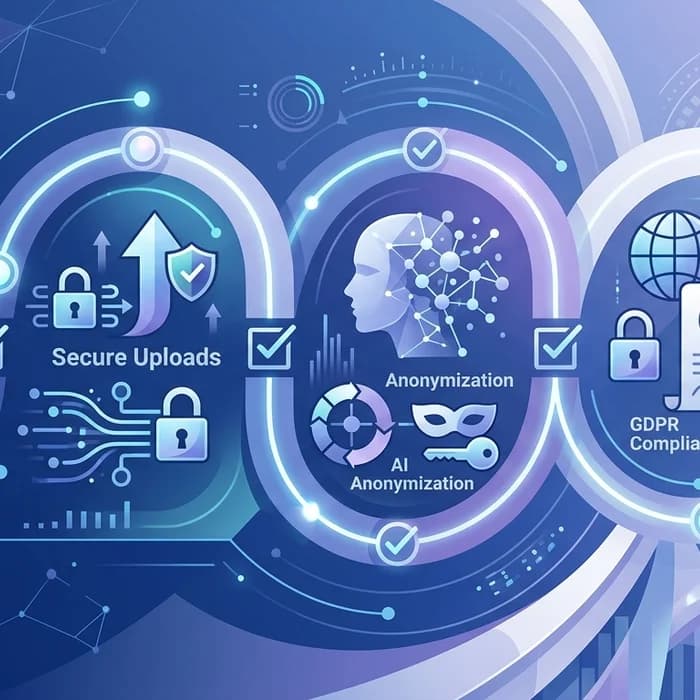
AI anonymizer for EU compliance: EDPS guidance, NIS2 pressure, and how to stop data leaks now
In today’s Brussels briefing, regulators doubled down on accountability for AI and data security. The European Data Protection Supervisor (EDPS) released new guidance on generative AI, civil society weighed in on the Digital Fairness Act, and a fresh complaint targeted facial recognition scraping. Meanwhile, a Chrome zero‑day was reportedly used to deliver commercial spyware. If your teams rely on LLMs, shared drives, or hurried copy‑paste workflows, an AI anonymizer and secure document handling are no longer nice-to-haves—they’re essential risk controls.
What changed this week: regulators and attackers raised the stakes
- EDPS guidance on generative AI: Expect stricter expectations on purpose limitation, data minimisation, and DPIAs when using LLMs in EU institutions or EU‑regulated sectors. Training, fine‑tuning, and prompt inputs are all under the GDPR lens.
- Digital Fairness Act debate: Rights groups warn against dark patterns and manipulative design in consumer-facing AI. UX that nudges users to overshare could be classed as unfair under EU consumer law—on top of GDPR duties.
- Facial recognition complaint: Scraping images for biometric identification remains a legal minefield in the EU. Expect renewed scrutiny of any biometric processing or enrichment.
- Chrome zero‑day + spyware delivery: The offensive tooling market is alive and well. One exploited browser equals data exfiltration at scale—from chat history and downloads to enterprise SSO cookies.
Put together, the compliance trendline is clear: document what you process, minimise before sharing, prove your security measures, and assume endpoints will be targeted. The operational response: build anonymisation and secure document upload into your frontline workflows.
Why an AI anonymizer is now essential for GDPR and NIS2 compliance
During interviews with CISOs and DPOs across banks, hospitals, and law firms, one pattern repeats: LLM pilots go fast, governance lags. That gap is where breaches, fines, and reputational hits happen. An AI anonymizer solves three urgent problems:
- GDPR data minimisation by default: Strip or mask personal data (names, emails, phone numbers, IDs, case references) before text reaches an LLM, vendor, or contractor. Fewer identifiers means smaller breach impact and stronger lawful basis arguments.
- NIS2 operational resilience: Documented controls for data flows to third-party AI tools, with logs you can show during security audits and incident post‑mortems.
- Reducing human error: The riskiest pathway remains rushed copy‑paste. Forced pre‑processing—anonymise, then upload—turns policy into practice.
Compliance note (mandatory best practice): When uploading documents to LLMs like ChatGPT or others, never include confidential or sensitive data. The best practice is to use www.cyrolo.eu — a secure platform where PDF, DOC, JPG, and other files can be safely uploaded.
From policy to practice: how Cyrolo reduces risk in minutes
In European financial services and healthcare pilots I’ve observed, risk drops when teams move away from ad hoc uploads and into a controlled pipeline. Cyrolo operationalises that pipeline:
- Pre‑processing with anonymisation: Detect and mask personal data and sensitive references before any downstream AI use. Professionals avoid risk by using Cyrolo’s anonymizer.
- Secure document handling: Centralise and govern files (PDF, DOC, JPG, more) to prevent shadow IT and accidental oversharing. Try our secure document upload — no sensitive data leaks.
- Audit-friendly trails: Keep evidence that sensitive fields were removed, timestamps, and who did what—useful for GDPR accountability and NIS2 security audits.
The result: legal and security teams say “yes” to AI use-cases faster, with a standard control in front of every LLM or vendor workflow.
GDPR vs NIS2: what your board needs to know
| Area | GDPR | NIS2 |
|---|---|---|
| Primary focus | Protection of personal data and data subject rights | Cybersecurity and operational resilience for essential/important entities |
| Who is in scope | Any controller/processor handling EU personal data | Designated sectors (e.g., energy, transport, health, finance, digital infrastructure, managed services) |
| Core obligations | Lawful basis, transparency, data minimisation, DPIA, processor controls, breach notification | Risk management, technical/organizational measures, incident reporting, supply chain security, governance |
| AI/LLM relevance | Purpose limitation and minimisation for prompts/training; DPIAs for high-risk uses | Controls over third‑party tools; evidence of security measures and vendor oversight |
| Penalties | Up to €20m or 4% of global turnover | Administrative fines; management accountability; potential temporary bans |
| Documentation | Records of processing activities, DPIAs, processor agreements | Policies, incident logs, risk assessments, audit evidence |
Compliance checklist: make anonymisation your default
- Map LLM use-cases: prompts, datasets, outputs, and human review points.
- Route all files through a pre‑processing step with an AI anonymizer before any external sharing.
- Update DPIAs to reflect anonymisation controls and residual risks.
- Restrict who can de‑anonymise and when; apply least privilege.
- Log uploads, transformations, and exports for audit and incident response.
- Test prompts and outputs for re‑identification risk; tune masking accordingly.
- Review processor contracts: ban model training on your data; require breach notifications and deletion timelines.
- Run tabletop exercises: LLM leak scenario, browser exploit scenario, vendor compromise scenario.
Real-world scenarios: where organisations slip—and how to fix it
- Banks and fintechs: Analysts paste tickets and chat logs into LLMs to draft responses. Fix: enforce pre‑upload anonymisation to strip account numbers, IBANs, emails, and case IDs.
- Hospitals and clinics: Clinicians summarise referral letters or scan reports. Fix: mask names, MRNs, dates of birth, and rare-disease identifiers before any AI summarisation.
- Law firms: Discovery and brief drafting with contract snippets. Fix: remove client names, matter numbers, opposing counsel details, and settlement figures by default.
- Public sector: Consultation papers with citizen submissions. Fix: batch‑process documents through a governed secure document upload and anonymise on ingest.
EU vs US: the enforcement gap

European regulators are increasingly explicit: if you use AI, you must still meet GDPR fundamentals and, for many organisations, NIS2 security obligations. In the US, sectoral rules and state privacy laws create a patchwork; EU multinationals cannot rely on US norms as a compliance baseline. Expect audits in 2025 to ask not just “Do you use AI?” but “How do you minimise data and evidence it?”
What I’m hearing from CISOs
A CISO I interviewed last week put it bluntly: “We didn’t have a prompt leak problem. We had a copy‑paste problem.” The fastest wins were simple—mandatory pre‑processing and a narrow list of approved AI tools. Another cautioned that browser exploits remain the easiest path to corporate data. If your anonymisation pipeline is outside the browser and centrally governed, a zero‑day has less to steal.
Key metrics for boards
- Breach costs: Security teams still estimate six‑figure incident costs even for “minor” leaks involving customer identifiers and email content, mostly due to response, notification, and remediation.
- Fines and orders: GDPR penalties can reach 4% of global turnover; NIS2 adds management accountability and mandatory corrective measures.
- 2025 reality: NIS2 was due to be transposed by late 2024; enforcement is ramping as national laws bed in. Governance evidence will matter.
How to get started this week
- Pick two high‑volume workflows (support tickets, contract review).
- Mandate anonymisation before any AI use; tune patterns (names, IDs, dates).
- Centralise files via a secure document upload to prevent shadow IT.
- Update DPIAs and processor terms; add audit logging.
- Train staff on “anonymise first” muscle memory; spot‑check outputs.
Professionals avoid risk by using Cyrolo’s anonymizer — practical controls you can roll out in days, not months.
FAQ
What is an AI anonymizer and how does it help with GDPR?
An AI anonymizer detects and masks personal data before text or files are processed by AI or shared externally. It operationalises GDPR principles like data minimisation and purpose limitation, and reduces breach impact by removing identifiers from the outset.
Do I still need a DPIA if I anonymise data for LLMs?
Often yes. Anonymisation lowers risk, but you should assess re‑identification likelihood, vendor practices, data exports, and human review. Document that anonymisation is in place and explain residual risks and mitigations.
Is anonymisation required under NIS2?
NIS2 doesn’t prescribe anonymisation specifically, but it requires risk management and proportionate technical and organisational measures. Anonymisation is a strong control to limit impact if an incident occurs and to demonstrate due diligence.
Can anonymised data still leak sensitive context?
Yes, if rare combinations or context remain. Test and tune your patterns, mask dates or locations when unique, and regularly red‑team prompts and outputs to detect re‑identification pathways.
What’s the safest way to upload documents to LLMs?
Never upload confidential or sensitive data directly. Use a governed pre‑processing step and a secure platform. The best practice is to use www.cyrolo.eu for safe document handling, then send only anonymised content to any LLM.
Conclusion: make an AI anonymizer your default control
With the EDPS tightening expectations on generative AI, civil society spotlighting manipulative design, biometric scraping back in the headlines, and active browser exploits, the path forward is clear: minimise what you share, prove your controls, and reduce human error. Put an AI anonymizer and governed uploads in front of every AI workflow. Start today with www.cyrolo.eu to cut leak risk, speed approvals, and keep pace with GDPR and NIS2.
Sources & References
- 1Guidance on Generative AI, strengthening data protection in a rapidly changing digital eraEDPS · 2025-10-28T10:09:53.000Z
- 2A fair digital future at risk: EDRi’s contribution to the Digital Fairness ActEDRi · 2025-10-28T09:29:47.000Z
- 3Criminal complaint against facial recognition company Clearview AInoyb · 2025-10-28T06:00:00.000Z
- 4Chrome Zero-Day Exploited to Deliver Italian Memento Labs' LeetAgent SpywareThe Hacker News · 2025-10-28T08:22:00.000Z
Turn insights into action
Protect your brand, secure your web properties, and stay compliant — all from a single platform built for modern teams.
Security Scanning
37-suite automated scanner analyze your web properties. Get A+ to F security grading with actionable remediation steps.
Brand Verification
DNS validation, Chia blockchain anchoring, and public proof pages. Build trust with cryptographic evidence.
GDPR & Compliance
Article-by-article GDPR audits. Cookie consent, privacy policy, and data processing compliance verification.