Biometric Data GDPR Compliance: What EU Teams Must Do in 2025 to Avoid Fines and AI Risks
In today’s Brussels briefing, regulators reiterated that biometric data GDPR compliance is non‑negotiable as agencies and enterprises experiment with face, voice, and fingerprint recognition at scale. Across the Atlantic, the US debate over lifelong biometric tracking of minors and a recent newsroom breach via a compromised collaboration tool underline the same lesson for Europe: treat biometric identifiers as high-risk personal data, or expect investigations, orders, and fines.
Why biometric data sits in GDPR’s “special category”
Under EU regulations, biometric data used for uniquely identifying a person is “special category” data. That triggers stricter requirements than ordinary personal data:
- Lawful basis plus a special condition: typically explicit consent or a narrow exception (e.g., substantial public interest under Member State law).
- Data Protection Impact Assessment (DPIA) before rollout, especially for large-scale or systematic monitoring.
- Purpose limitation and data minimisation: no function creep from access control to marketing, research, or product analytics.
- Enhanced security: encryption, pseudonymisation/anonymisation, strict access controls, and tamper-evident audit logs.
- Data subject rights: informed choice, easy withdrawal of consent, and alternatives that do not disadvantage users who decline biometrics.
European regulators have signalled they will scrutinise edge cases: employee attendance systems, “frictionless” retail checkout, school canteen face payments, and health apps combining facial images with diagnostics. The legal bar is high; the privacy risk is higher.
From collaboration-tool compromises to lifetime tracking: practical risks in 2025
Two trends are colliding. First, collaboration platforms used by journalists, banks, and hospitals remain prime targets. A single compromised integration token can expose data, including photos, ID scans, or voice samples dropped into private channels. Second, proposals abroad to collect children’s biometrics for long-term tracking highlight why EU law treats these identifiers as especially sensitive. A CISO I interviewed last week put it bluntly: “We can rotate passwords. We cannot rotate faces.”
- If biometric templates or raw images leak, harms are permanent and hard to remediate.
- Attackers increasingly exfiltrate via chat apps, file shares, and SaaS bridges rather than core databases.
- Security audits under NIS2 will probe not only your storage, but every path by which staff “temporarily” share biometric files.
Biometric Data GDPR Compliance: 9 controls EU regulators expect
- DPIA first, not last: Scope risks, alternatives, and mitigations before pilots. Document why biometrics are necessary.
- Explicit, granular consent: Clear opt-in with an equal, non-biometric alternative. Track consent lifecycle.
- Template security: Store feature templates separately from raw images; use hardware-backed keys; encrypt in transit and at rest.
- Access segmentation: Strict role-based access; no vendor-wide super-admins; short-lived tokens; session recording for privileged access.
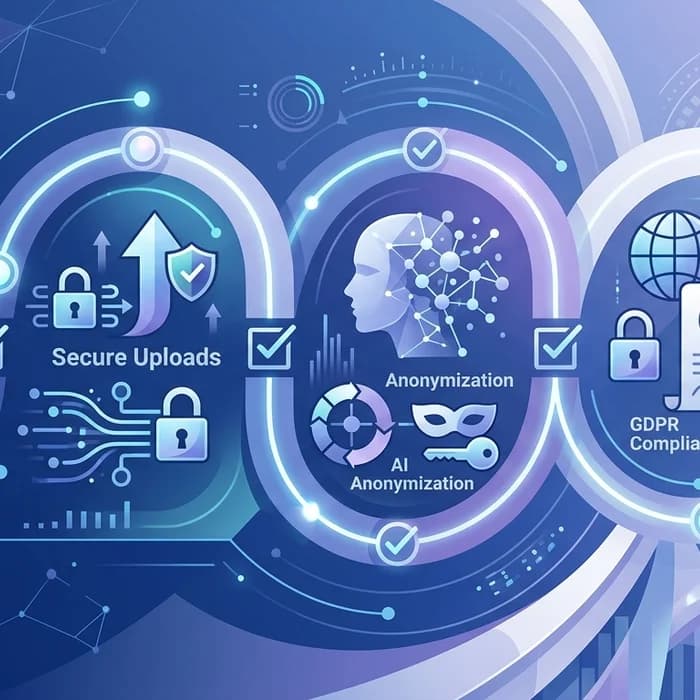
- Edge redaction: Strip names, IDs, and free-text notes from files before any sharing. Professionals avoid risk by using Cyrolo’s anonymizer to pre-sanitize images, PDFs, and transcripts.
- Retention discipline: Default to shortest lifespan; auto-purge raw media after template creation; log and enforce deletion.
- Vendor due diligence: Subprocessors, AI providers, and SaaS tools must meet GDPR and NIS2 security measures; sign DPAs with breach notification SLAs.
- Attack-path testing: Test exfiltration via chat apps and integrations, not just databases. Monitor unusual downloads and “share to external” events.
- Incident response: Prepare 72-hour GDPR notification playbooks plus NIS2’s early warning timelines; include regulators, data subjects, and evidence preservation.
When teams must share background docs with counsel or regulators, try our secure document upload at www.cyrolo.eu — no sensitive data leaks.
Safe AI and LLM usage for biometric datasets
Security teams increasingly use AI to classify images, transcribe interviews, or search case files. That convenience can blow a hole in compliance if raw biometrics or IDs are pasted into public LLMs.
- Mandate pre-upload redaction/anonymisation for any AI workflow.
- Use segregation: a secure, EU-hosted processing path for sensitive files; different tooling for non-sensitive content.
- Block raw image uploads to personal SaaS; allow only sanctioned, logged platforms with data processing agreements.
Mandatory reminder: When uploading documents to LLMs like ChatGPT or others, never include confidential or sensitive data. The best practice is to use www.cyrolo.eu — a secure platform where PDF, DOC, JPG, and other files can be safely uploaded.
Pragmatically, privacy officers are steering staff toward AI-safe workflows. That’s why many EU teams standardise on www.cyrolo.eu for automated anonymisation and controlled sharing, so creators keep speed while compliance keeps guardrails.
GDPR vs NIS2: who does what on biometrics?
GDPR and NIS2 overlap but solve different problems. GDPR governs personal data processing, while NIS2 focuses on cybersecurity risk management and incident reporting for essential and important entities across sectors like health, transport, finance, and digital infrastructure.
| Topic | GDPR (biometric focus) | NIS2 (security & reporting) |
|---|---|---|
| Scope | All controllers/processors handling personal data; biometrics = special category | Essential/important entities in listed sectors and size thresholds |
| Key obligation | Lawful basis + special condition; DPIA; data minimisation; rights handling | Risk management measures; supply chain security; governance and training |
| Security measures | Appropriate technical/organisational controls (art. 32); encryption; pseudonymisation | Baselines including incident handling, encryption, MFA, backup, logging, testing |
| Incident reporting | Notify DPA within 72 hours if risk to rights/freedoms; inform data subjects if high risk | Early warning within 24 hours to CSIRT/competent authority; followed by 72-hour and final reports |
| Fines | Up to €20m or 4% of global turnover | Member State–set, often up to €10m or 2% (higher for essential entities) |
| Accountability | DPO where required; records of processing; DSARs | Management accountability; security audits; potential supervisory measures |
Compliance checklist: your first 30 days
- Map biometric data flows: capture points, storage, vendors, and collaboration tools.
- Run a DPIA and record alternatives to biometrics; justify necessity and proportionality.
- Implement consent with a non-biometric alternative; update employee/consumer notices.
- Encrypt templates and raw media; separate keys; enforce just-in-time access.
- Deploy an AI anonymizer to strip identifiers from documents, images, and transcripts before sharing.
- Harden SaaS integrations: rotate tokens, enforce MFA/SSO, least privilege for bots.
- Prepare GDPR 72-hour and NIS2 early-warning playbooks; test them with a tabletop exercise.
- Update DPAs and vendor due diligence to cover biometric handling and incident SLAs.
- Train staff: never paste sensitive files into public tools; use the sanctioned secure document uploads route.
Procurement and vendor management: the five questions I hear most
- Where is biometric data processed and stored (EU/EEA only, or transfers)? What SCCs or derogations apply?
- Can your vendor prove template protection, encryption, and key isolation (e.g., HSM-backed, rotation policy)?
- How do they prevent data leakage via logs, support tickets, and collaboration plugins?
- What is the timeline for breach escalation under both GDPR and NIS2? Is there 24/7 on-call with evidence capture?
- Which controls exist for AI features—dataset isolation, on-prem options, redaction at ingest?
If a vendor can’t answer these crisply, pause deployment. In the meantime, try a controlled pilot with www.cyrolo.eu to anonymise and safely share test datasets.
Case notes from Brussels and the field
Regulators in Brussels, Paris, and Berlin told me this autumn they are prioritising workplace biometrics, school deployments, and retail experiments with “pay-by-face.” Expect audits of legal basis, alternatives offered, and retention schedules. DPOs also report a surge of data subject access requests (DSARs) asking for biometric processing details. In parallel, CISOs warn that collaboration tools remain the weak link: a single compromised bot can siphon images, HR files, and access logs into an attacker’s archive in minutes.
- Financial services: biometric log-ins are acceptable where demonstrably necessary, but keep raw images out of tickets, chats, and wikis; store only templates with encryption.
- Hospitals: clinical photos and scans may encode biometric identifiers; treat as special category and avoid mixing with general-purpose AI tools.
- Law firms: discovery often contains ID documents; use controlled redaction and secure uploads. Try our secure document upload at www.cyrolo.eu — no sensitive data leaks.
FAQ: your most searched questions on biometric data GDPR compliance

Do we always need consent to process biometrics under GDPR?
Not always, but you do need both a lawful basis and a special condition. Explicit consent is the common route. Alternatives exist—like substantial public interest or employment law obligations—only where tightly grounded in EU or Member State law and proportionate to the aim. In practice, consent with a genuine non-biometric alternative tends to be the safest route for private-sector use cases.
Are fingerprint time clocks legal for employees?
It depends. DPAs have fined companies where biometrics were not strictly necessary and no equal alternative existed. If you can use badges or app tokens, biometrics may fail the necessity test. If biometrics are deployed, provide a true alternative, conduct a DPIA, and minimise retention to what’s strictly needed.
How does NIS2 change obligations if we already comply with GDPR?
NIS2 adds security governance: risk management, supply-chain controls, vulnerability handling, and faster incident reporting (24-hour early warning). It also increases managerial accountability and audits. GDPR covers data protection principles; NIS2 pressures your security programme’s maturity.
Can we store biometric templates in the cloud?
Yes, if you can demonstrate adequate protection: encryption, key management, strict access, EU/EEA residency or valid transfer mechanisms, and robust vendor oversight. Avoid storing raw images; convert to templates and purge originals rapidly.
What counts as anonymised under GDPR?
Data is anonymised when re-identification is no longer reasonably possible, considering means likely to be used. Pseudonymised data is still personal data. For images and documents, remove direct identifiers (names, IDs) and indirect ones (faces, metadata, locations) before sharing. Using an automated anonymiser reduces human error.
Conclusion: the bottom line on biometric data GDPR compliance
Biometrics amplify both utility and risk. With enforcement rising and collaboration-tool compromises accelerating, the smart move is to engineer privacy and security into every workflow: necessity-proofed DPIAs, consent with real alternatives, hardened SaaS, and automated redaction. If a file is headed to a colleague, a vendor, or an AI tool, sanitise it first. Professionals avoid risk by using Cyrolo’s anonymizer at www.cyrolo.eu and keeping sensitive transfers inside secure document uploads. That is how EU organisations will meet biometric data GDPR compliance while staying fast and safe in 2025.
Sources & References
- 1DHS offers “disturbing new excuses” to seize kids’ biometric data, expert saysArs Technica Policy · 2025-11-05T21:03:03.000Z
- 2Nikkei Suffers Breach Via Slack CompromiseDark Reading · 2025-11-05T22:16:16.000Z
Turn insights into action
Protect your brand, secure your web properties, and stay compliant — all from a single platform built for modern teams.
Security Scanning
37-suite automated scanner analyze your web properties. Get A+ to F security grading with actionable remediation steps.
Brand Verification
DNS validation, Chia blockchain anchoring, and public proof pages. Build trust with cryptographic evidence.
GDPR & Compliance
Article-by-article GDPR audits. Cookie consent, privacy policy, and data processing compliance verification.