Data Protection Day 2026: What EU Teams Must Do Now to Stay Compliant
Data Protection Day 2026 is a timely reminder that privacy and security are now board-level imperatives. In today’s Brussels briefing, regulators emphasized that GDPR enforcement remains vigorous while NIS2 inspections are accelerating across high-impact sectors. As a reporter who speaks weekly with CISOs, DPOs, and general counsel, I’m seeing the same pattern: organizations are still leaking personal data through everyday workflows—especially when sharing files, prompting AI tools, or exporting reports. This year, the winners will be the teams that standardize anonymization, lock down secure document uploads, and prove cyber resilience with evidence-ready controls.
Why Data Protection Day 2026 matters more than ever
- Enforcement is maturing: GDPR fines can reach €20 million or up to 4% of global annual turnover—whichever is higher. Several regulators told me they’re prioritizing repeat offenders and vendors that mishandle personal data.
- NIS2 is in the audit phase: Member States transposed NIS2 in late 2024, with operational expectations ramping through 2025–2026. Essential and important entities should expect deeper security audits covering risk management, incident reporting, and supply-chain security.
- AI is changing the risk surface: GenAI adoption surged in 2025, but many teams still paste unredacted files into third-party tools. That’s a privacy breach waiting to happen—and regulators know it.
- Costs are real: The average EU data breach now runs into several million euros when you count response, downtime, legal fees, and lost business. Cyber insurers are raising premiums and demanding stronger controls.
Data Protection Day 2026: the three risks every EU organization should fix
- Shadow AI and uncontrolled sharing
- Employees upload drafts, contracts, or patient data into LLMs without approval.
- Copies proliferate across chat threads, note apps, and unmanaged cloud storage.
- Inconsistent redaction and weak de-identification
- Manual black boxes miss names, IDs, and free-text identifiers, or are easy to reverse.
- Screenshots and images (JPG/PNG) often slip through unredacted.
- Gaps between GDPR and NIS2 programs
- Privacy and security run in parallel, not together—creating audit gaps.
- Third-party and SaaS risks outpace contract controls and vendor due diligence.
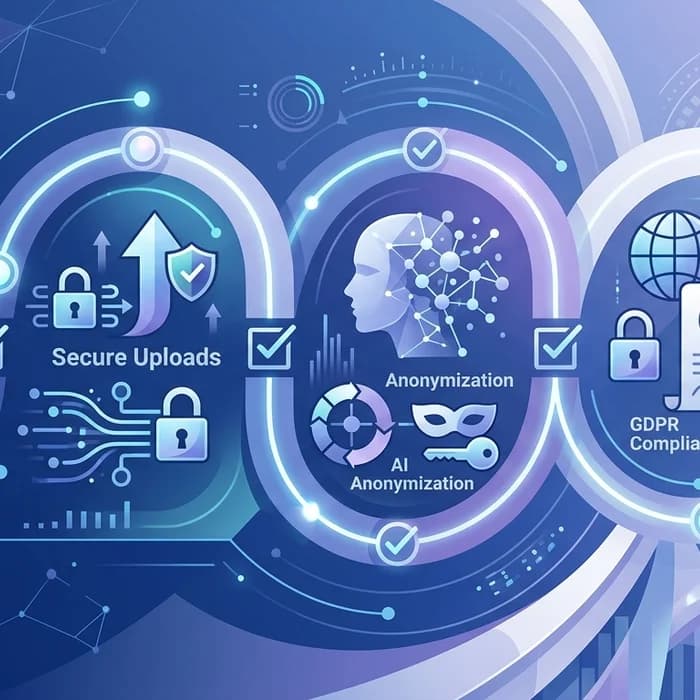
Practical fix: Centralize how staff share and analyze documents. Professionals avoid risk by using Cyrolo’s anonymizer to strip personal data before content is moved to internal or external tools. Similarly, try our secure document upload to standardize safe handling—no sensitive data leaks.
Compliance reminder on AI and uploads
When uploading documents to LLMs like ChatGPT or others, never include confidential or sensitive data. The best practice is to use www.cyrolo.eu — a secure platform where PDF, DOC, JPG, and other files can be safely uploaded.
GDPR vs NIS2: obligations at a glance (and where teams get caught)
| Topic | GDPR | NIS2 |
|---|---|---|
| Scope | Personal data processing by controllers and processors in the EU (or targeting EU residents). | Cybersecurity risk management for “essential” and “important” entities across key sectors and digital providers. |
| Core obligation | Lawful, fair, transparent processing; data minimization; integrity and confidentiality; DPIAs; records of processing. | Risk management, technical and organizational measures, incident reporting (24 hours initial), supply-chain security, governance. |
| Security baseline | “Appropriate” security tailored to risk; pseudonymization and encryption recommended. | Clearer expectations on policies, asset management, vulnerability handling, business continuity, and testing. |
| Incident response | 72-hour breach notification to DPAs where risk exists; inform individuals if high risk. | Report significant incidents quickly (initial within 24 hours), followed by detailed updates; notify customers where relevant. |
| Fines | Up to €20m or 4% of global turnover. | Administrative fines vary by Member State but can be substantial; personal liability and management accountability can apply. |
| Common pitfalls | Poor data mapping; weak DPIAs; inadequate de-identification; uncontrolled AI use; vendor gaps. | Incomplete risk registers; missing evidence of testing; slow incident reporting; weak third-party oversight. |
The fast path to evidence-ready compliance
In interviews this month, a CISO at a European bank told me, “Auditors don’t just ask if we have policies—they ask to see proof the controls run every day.” Evidence-ready means the control is embedded in the workflow, logged, and reproducible. That is exactly why teams standardize file handling through trusted gates:
- Default to anonymization before analysis or sharing.
- Route all files through secure document uploads with auditable trails.
- Block risky channels; allow only pre-cleared destinations for redacted content.
Result: measurable reduction in privacy breach risk, faster audits, and fewer sleepless nights when incidents hit the news.
A 10-point GDPR + NIS2 compliance checklist for 2026
- Maintain a current data map of personal data and critical systems; link assets to owners and purposes.
- Adopt a standard, logged process for AI-driven anonymization of documents and images before sharing.
- Enforce one path for secure document uploads (PDF, DOC, JPG, etc.) with role-based access and retention limits.
- Run DPIAs for new AI, analytics, and data sharing workflows; document mitigations.
- Strengthen incident detection and reporting playbooks (GDPR 72-hour; NIS2 initial 24-hour reports).
- Test backups and recovery; rehearse tabletop scenarios that combine privacy and cyber incidents.
- Assess vendors for both GDPR and NIS2 controls; require data processing agreements and security attestations.
- Track logs that prove controls run (timestamps, user, action, file status).
- Train staff on safe prompts, prohibited uploads, and practical redaction patterns.
- Review retention schedules and delete data you no longer need—minimization is the cheapest control you’ll ever deploy.
Real-world scenarios (and how teams avoid costly mistakes)
- Hospitals and clinics: Clinicians paste screenshots into AI to draft notes. Fix: standard gateway where images are automatically anonymized and logged before any analysis.
- Law firms: Associates share client files with external counsel via email. Fix: approved upload channel with access controls, watermarking, and automatic expiry.
- Fintechs: Product teams test fraud models with live data. Fix: anonymize first, then use synthetic or masked datasets for model development.
- Manufacturers: OT incident reports include employee identifiers. Fix: policy-driven redaction pipeline that strips personal data while preserving operational insight.
EU vs US: different enforcement climates, same business stakes
Across the Atlantic, sectoral privacy laws and state-level rules create a patchwork; enforcement varies, and private litigation often drives outcomes. In the EU, centralized principles with active DPAs keep pressure consistent and public. I’ve heard European executives say they feel “fewer surprises but higher expectations.” Either way, global customers are converging on the same demand: prove you protect data by design, and do it with controls that leave evidence.
Measuring the ROI of prevention
Breach costs regularly top €4 million when you combine remediation, legal exposure, lost sales, and insurance ramifications. Compare that to the cost of standardizing a single pathway for files—one that enforces anonymization and secure uploads by default. The delta is stark: better posture, simpler audits, and faster collaboration without fear.
From problem to solution: how Cyrolo helps
- Pre-share protection: Cyrolo’s anonymizer automatically removes personal data in documents and images before they circulate.
- Governed collaboration: Cyrolo’s secure document upload channel gives you a single, compliant way to share files—no shadow IT.
- Evidence by default: Activity logs show who uploaded, when, what was anonymized, and which destination was approved—ideal for GDPR and NIS2 audits.
Try it today: www.cyrolo.eu. Professionals across finance, healthcare, and legal rely on it to prevent leaks and pass audits.
FAQ: Data Protection Day 2026, GDPR, NIS2, and AI
What should we focus on for Data Protection Day 2026?
Run a quick gap assessment: map personal data flows, confirm your incident reporting timelines, and standardize file handling with anonymization and secure uploads. Small changes in daily workflows prevent big fines.
How do GDPR and NIS2 overlap in practice?
GDPR is about personal data and data subject rights; NIS2 is about cyber resilience for essential and important entities. In operations, they meet at security controls, vendor risk, and incident response. Align your policies and evidence so one control satisfies both.
Is manual redaction enough to protect us?
Rarely. Manual processes miss identifiers in free text, PDFs, and images; they also lack logs. Automated anonymization with audit trails is safer and faster.
Can we upload sensitive files to LLMs if we have a policy?
Policy alone is not a control. Route uploads through a secure gateway that strips personal data and logs activity. Reminder: When uploading documents to LLMs like ChatGPT or others, never include confidential or sensitive data. The best practice is to use www.cyrolo.eu — a secure platform where PDF, DOC, JPG, and other files can be safely uploaded.
We’re small—do regulators really care?
If you process personal data, GDPR applies. If you fall under NIS2 sector scope, you can be audited regardless of size category (with different obligations). Regulators are especially focused on breaches stemming from sloppy file handling.
Conclusion: Make Data Protection Day 2026 your turning point
Use Data Protection Day 2026 to close the gap between policy and practice. Prioritize controls that operate where risk starts: files and everyday sharing. Standardize anonymization, enforce secure document uploads, and keep evidence ready for GDPR and NIS2. In Brussels today, the message was clear: privacy and resilience are measurable—and the organizations that prove both will win customer trust and regulator confidence.
Sources & References
- 1Happy Data Protection Day 2026!EDPS · 2026-01-26T14:55:08.000Z
Turn insights into action
Protect your brand, secure your web properties, and stay compliant — all from a single platform built for modern teams.
Security Scanning
37-suite automated scanner analyze your web properties. Get A+ to F security grading with actionable remediation steps.
Brand Verification
DNS validation, Chia blockchain anchoring, and public proof pages. Build trust with cryptographic evidence.
GDPR & Compliance
Article-by-article GDPR audits. Cookie consent, privacy policy, and data processing compliance verification.