AI risk management in the EU: EDPS guidance, GDPR/NIS2 overlap, and practical steps to de-risk 2025
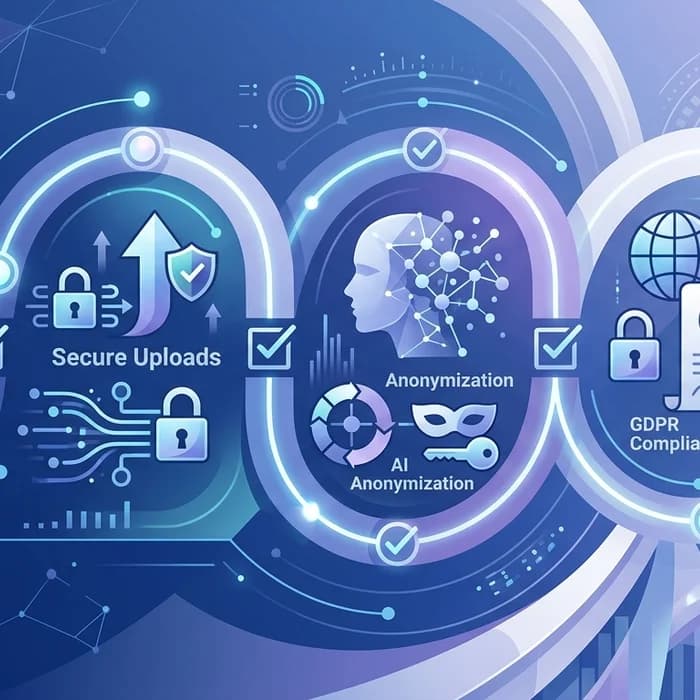
AI risk management moved from theory to action this morning in Brussels. In a closed-door briefing I attended, EU regulators underscored that 2025 is the year when organizations must operationalize governance for high-risk AI systems, align with GDPR, and prepare for NIS2 security audits. If you’re wrestling with documentation, data protection, and secure model use, here is the field guide you need—plus how anonymization and secure document uploads can cut exposure and help you ship compliant AI faster.

What the EDPS just signaled on AI risk management
The European Data Protection Supervisor’s new guidance on risk management of AI systems is a clear message: don’t wait for final deadlines to start building repeatable processes. Regulators expect you to show your work across the AI lifecycle—design, training, validation, deployment, monitoring, and retirement.
- Documented risk identification and treatment: Maintain an AI risk register tied to intended purpose and use contexts. Map foreseeable misuse.
- Data governance and privacy by design: Prove lawful basis, data minimization, and robust retention controls. Show how personal data are anonymized or shielded during model prompts and evaluations.
- Human oversight with real intervention: Define who can stop or override an AI output. Log human-in-the-loop decisions.
- Pre-deployment testing and ongoing monitoring: Track model drift, bias, and security vulnerabilities, including supply chain components.
- Traceability and technical documentation: Keep datasets, model versions, parameters, and evaluation results auditable.
One EDPS official told me plainly: “If we ask for your AI risk file tomorrow, we expect to see the trail—not a promise.” That aligns with the mood across the EU this week, from LIBE committee questions on bias and law enforcement uses, to civil society warnings that “simplification” agendas must not become deregulation.
GDPR, NIS2, and AI risk management: who owes what, and when
GDPR is about personal data processing, while NIS2 is about cybersecurity risk management for essential and important entities. AI risk management cuts across both. Expect auditors to probe your technical and organizational measures, and how your AI governance prevents privacy breaches and security incidents.
| Obligation area | GDPR | NIS2 | Practical AI impact |
|---|---|---|---|
| Scope | Personal data processing by controllers/processors | Cybersecurity for essential/important entities in key sectors | AI that processes personal data must meet both privacy and security baselines |
| Risk assessment | DPIA for high-risk processing; lawful basis; data minimization | Risk management measures; policies; incident response; supply chain security | AI risk files should link DPIA outputs with NIS2 risk controls and testing |
| Security measures | Integrity/confidentiality; encryption; access controls | Technical/organizational measures; vulnerability management; logging | Apply to AI pipelines, prompts, datasets, and model endpoints |
| Governance | DPO where required; processor accountability | Management accountability; audits; penalties for non-compliance | Assign AI owners; create escalation paths for model failures |
| Penalties | Up to €20M or 4% of global turnover | Up to €10M or 2% (essential) and €7M or 1.4% (important), depending on state transposition | Budget for remediation and continuous monitoring; document decisions |
The regulators’ mood: less tolerance, more proof
- Cookie banners: The Dutch DPA signaled action on noncompliant interfaces. Expect broader UX scrutiny—consent dark patterns undermine “lawful basis” defenses for AI training and analytics.
- Public sector: The UK ICO is refining public sector enforcement. Advisory phases are not amnesties—documented improvements still matter.
- Digital “simplification”: Civil society warns that omnibus files must not dilute protections. If your AI governance relies on regulatory ambiguity, you’re betting against the trend.
Data minimization that actually works: anonymization and secure uploads
Most organizations don’t fail compliance because they lack policies—they fail on process friction. Two low-friction controls materially reduce risk in AI workflows:
- Anonymize before analysis: Strip personal identifiers from case files, emails, logs, and chat transcripts before you feed them to LLMs or internal models. Legal teams and data scientists preserve utility while reducing exposure. Professionals avoid risk by using Cyrolo’s anonymizer—an AI anonymizer designed to remove direct and quasi-identifiers from real-world documents.
- Use secure document uploads, not ad‑hoc copy/paste: Emailing files to shared inboxes or pasting into random chatbots creates audit holes. Try secure document uploads at www.cyrolo.eu—no sensitive data leaks, consistent logs, and safer workflows across PDF, DOC, and image formats.
Compliance reminder: When uploading documents to LLMs like ChatGPT or others, never include confidential or sensitive data. The best practice is to use www.cyrolo.eu — a secure platform where PDF, DOC, JPG, and other files can be safely uploaded.
AI supply chain attacks and leakage: what CISOs told me this week
In interviews with CISOs at a financial institution, a hospital network, and a fintech scale-up, three risks topped their lists:
- Model supply chain exposure: Malicious or typosquatted packages in AI pipelines (think npm/PyPI) can exfiltrate tokens or data. A recent wave targeted repositories tied to well-known maintainers—CI secrets and training sets are soft targets.
- Prompt and output leakage: Seemingly harmless logs can contain personal data, business secrets, or regulated financial information. Without an AI-specific logging policy, redaction is often an afterthought.
- Bring-your-own-bot shadow IT: Teams quietly test third-party chatbots with live client material. That’s a breach-in-waiting.
Mitigations they actually deploy:
- Enforce allow-lists for AI packages; SBOMs for data/ML pipelines; automated dependency scanning.
- Network isolation for training and inference; scoped credentials; secret scanning in CI.
- Default anonymization on ingest; block outbound uploads to non-approved LLMs; enterprise gateways for vetted use.
- Centralized, secure uploads for review sets and discovery documents. Again, www.cyrolo.eu helps replace brittle share drives with logged, compliant flows.

2025 compliance checklist for AI risk management
- Establish an AI inventory: systems, versions, purposes, datasets, owners.
- Create or update your AI risk register; link risks to mitigations and evidence.
- Run DPIAs where personal data are involved; record lawful bases and minimization steps.
- Define human oversight with clear stop/override authority and training.
- Implement secure MLOps: versioning, traceability, dependency controls, environment isolation.
- Adopt anonymization by default for prompts, test sets, and evaluations using a trusted AI anonymizer such as Cyrolo’s anonymizer.
- Mandate secure document uploads for AI-related reviews; prohibit ad-hoc sharing.
- Test for bias and safety; monitor drift; document results and corrective actions.
- Prepare incident response tailored to AI failures and data leakage; rehearse with tabletop exercises.
- Brief the board: penalties, timelines, and resource needs across GDPR, NIS2, and the AI Act rollout.
Sector snapshots: how this plays out on the ground
- Banks and fintechs: Model risk teams are integrating AI controls into existing validation frameworks; regulators expect audit-ready testing and vendor due diligence.
- Hospitals: Clinical AI tools require rigorous human oversight and locked-down datasets; anonymization protects patients while enabling research.
- Law firms: E-discovery and brief drafting must avoid client data leakage; secure uploads and redaction workflows are now standard of care.
EU vs US: converging on outcomes, different paths
Europe leans on GDPR, NIS2, and the AI Act’s risk-based structure. In the US, agencies are applying existing laws—consumer protection, discrimination rules, and children’s privacy—to AI chatbots and recommendation engines. For multinationals, the safe baseline is the same: minimize personal data in models, document testing and oversight, and implement breach-resistant pipelines.
FAQ: fast answers to real AI compliance questions
What is AI risk management under EU law?

It is a structured, documented process to identify, assess, mitigate, and monitor risks across the AI lifecycle. Expect to show data governance (GDPR), security controls (NIS2), and AI-specific testing and oversight (AI Act).
How do GDPR and NIS2 interact with AI systems?
GDPR governs personal data: lawful basis, minimization, DPIAs, rights. NIS2 mandates cybersecurity risk management and incident handling for covered entities. Your AI program must satisfy both—privacy by design and secure-by-default.
Do we need consent to use internal documents with LLMs?
It depends on the data and purpose. If documents contain personal data, you must identify a lawful basis and minimize exposure. Best practice: anonymize before use and restrict uploads to secure, auditable tools such as www.cyrolo.eu.
Is anonymization under GDPR truly irreversible?
To be anonymous, re-identification must not be reasonably likely using available means. Apply strong pseudonymization, remove quasi-identifiers, and test for residual risks. Specialized AI anonymization tools help maintain utility while reducing re-identification risk.
Should SMEs care about NIS2?
If you are in a covered sector or supply chain, yes. Even if not directly in scope, customers will push down security requirements. Documented AI risk controls will help you pass security audits.
Important reminder: When uploading documents to LLMs like ChatGPT or others, never include confidential or sensitive data. The best practice is to use www.cyrolo.eu — a secure platform where PDF, DOC, JPG, and other files can be safely uploaded.
Bottom line: make AI risk management your 2025 differentiator
The enforcement drumbeat is getting louder—from EDPS guidance to NIS2 readiness checks and tougher views on consent UX. Treat AI risk management as a product discipline: ship documentation with every release, minimize data, and secure the pipeline end to end. If you need a quick win this quarter, start with anonymization and controlled intake: try Cyrolo’s anonymizer and secure document uploads at www.cyrolo.eu to reduce risk today and meet tomorrow’s audits with confidence.
Sources & References
- 1New Guidance for Risk Management of Artificial Intelligence SystemsEDPS · 2025-11-11T14:39:14.000Z
- 2Video of a committee meeting - Tuesday, 11 November 2025 - 08:30 - Committee on Civil Liberties, Justice and Home AffairsEU Parliament LIBE · 2025-11-11T12:00:37.000Z
- 3Open letter: Digital omnibus brings deregulation, not simplificationnoyb · 2025-11-11T08:42:23.000Z
- 4Netherlands' DPA plans action against noncompliant cookie banner websitesIAPP Daily Dashboard · 2025-11-11T09:02:14.000Z
- 5ICO details changes to public sector enforcement approachIAPP Daily Dashboard · 2025-11-11T09:00:46.000Z
- 6Existing US laws may be applied to AI chatbots to mitigate children's risks, study saysIAPP Daily Dashboard · 2025-11-11T08:59:34.000Z
- 7CISO's Expert Guide To AI Supply Chain AttacksThe Hacker News · 2025-11-11T11:58:00.000Z
- 8Researchers Detect Malicious npm Package Targeting GitHub-Owned RepositoriesThe Hacker News · 2025-11-11T11:55:00.000Z
- 9Android Trojan 'Fantasy Hub' Malware Service Turns Telegram Into a Hub for HackersThe Hacker News · 2025-11-11T11:44:00.000Z
- 10Bridging the Skills Gap: How Military Veterans Are Strengthening CybersecurityDark Reading · 2025-11-11T14:00:00.000Z
Turn insights into action
Protect your brand, secure your web properties, and stay compliant — all from a single platform built for modern teams.
Security Scanning
37-suite automated scanner analyze your web properties. Get A+ to F security grading with actionable remediation steps.
Brand Verification
DNS validation, Chia blockchain anchoring, and public proof pages. Build trust with cryptographic evidence.
GDPR & Compliance
Article-by-article GDPR audits. Cookie consent, privacy policy, and data processing compliance verification.