AI anonymizer in 2025: your EU-grade playbook for GDPR, NIS2 and safe document uploads
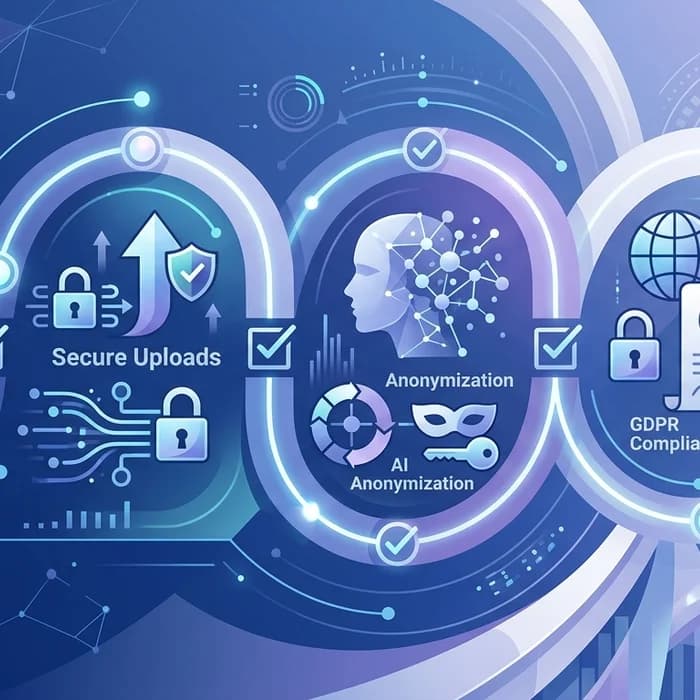
From Brussels to boardrooms, the case for an AI anonymizer has shifted from “nice-to-have” to a compliance control. In today’s Brussels briefing, regulators emphasized that fundamental rights must anchor AI deployments, while NIS2 inspections step up and GDPR fines keep breaking records. Add LLM-fuelled workflows and rising phishing/backdoor campaigns, and one thing is clear: organizations need defensible anonymization and secure document uploads to stay within EU regulations and avoid privacy breaches.
What changed in 2025—and why an AI anonymizer is now essential
Three currents converged this year, according to DPAs and CISOs I interviewed:
- Policy hardening: Parliament’s LIBE committee reiterated that AI use must respect the EU Charter—data minimization and purpose limitation are not optional. Several member states are eyeing deepfake and likeness-protection rules (Denmark’s proposal is a bellwether), raising the bar on personal data handling.
- Security reality check: New attack chains—from trojanized installers to firewall exploits—underscore that perimeter controls alone won’t save sensitive files once they enter AI workflows. If personal data leaks into prompts or logs, GDPR liability follows.
- AI at scale: Chatbots’ confusion around election misinformation showed how fast content can spiral. For regulated sectors, this is a reminder: if you can’t remove or mask identifiers before the model sees them, you’re gambling with enforcement.
That is why privacy-by-design today means a reliable AI anonymizer upstream of model ingestion and a secure pipeline for document uploads—with auditability for GDPR and operational resilience for NIS2.
GDPR vs NIS2 in practice: responsibilities your teams must map
GDPR and NIS2 overlap but are not duplicates. GDPR protects personal data; NIS2 hardens operational security across “essential” and “important” entities. Together, they impact your AI and file-processing stack.
| Obligation | GDPR | NIS2 | Practical impact on AI/document flows |
|---|---|---|---|
| Scope | Personal data processing by controllers/processors in the EU (and extra-EU if targeting EU residents). | Cybersecurity risk management for essential/important entities across sectors (energy, health, finance, digital infra, etc.). | GDPR governs identifiable information in prompts/files; NIS2 governs the security of the systems handling them. |
| Legal basis & minimization | Requires lawful basis; minimization and purpose limitation are mandatory. | Requires policies and controls proportionate to risk. | Justify AI use cases, strip identifiers with an anonymizer, and log decisions. |
| Security measures | “Appropriate” technical and organizational measures; encryption/pseudonymization encouraged. | Risk management, supply-chain security, vulnerability handling, MFA, logging, training. | Harden upload endpoints, segment AI services, and monitor model I/O like any critical system. |
| Incident reporting | Notify DPA within 72 hours of a personal-data breach. | Early-warning (24h), notification (72h), final report (1 month) for significant incidents. | Treat AI prompt/file leaks as reportable if personal data is exposed; prepare joint GDPR/NIS2 playbooks. |
| Penalties | Up to €20M or 4% of global turnover. | Administrative fines and binding remediation; management liability in serious cases. | Fines stack with remediation costs; executives expect measurable risk reduction. |
Where teams stumble: LLMs, prompts and document uploads
- Shadow AI usage: Staff paste client PDFs into public models; logs retain personal data. Under GDPR, that’s unlawful disclosure.
- Pseudonymization ≠ anonymization: Reversible masking still counts as personal data; regulators scrutinize this when models can re-identify via context.
- Uncontrolled file readers: “Quick” document tools with unknown vendors or unclear data residency create NIS2 supplier risk and GDPR uncertainty.
Compliance reminder: When uploading documents to LLMs like ChatGPT or others, never include confidential or sensitive data. The best practice is to use www.cyrolo.eu — a secure platform where PDF, DOC, JPG, and other files can be safely uploaded.
How an AI anonymizer and secure document uploads reduce risk end-to-end
From interviews with a CISO at a European bank and a DPO at a university hospital, four controls consistently deliver ROI:
- Automated redaction: Detect and remove names, emails, IDs, faces, voiceprints and free-text identifiers before any AI processing.
- Policy-aware uploads: Route files through a hardened ingress with malware scanning, format normalization and least-privilege storage.
- Auditability: Keep immutable logs of what was removed, by which model, and under which policy—vital for GDPR accountability and NIS2 audits.
- Onward sharing controls: Prevent uploads to public LLMs unless data is fully anonymized; enforce allow-lists and client-side warnings.
Field notes from Brussels: regulators’ mood music
In off-record huddles this week, EU officials repeated three themes:
- “Anonymize by default” for AI pilots: If personal data is unnecessary, don’t process it. If it’s necessary, minimize and protect—expect to demonstrate both.
- Operational resilience counts: NIS2 inspections now ask how AI and document readers connect to your core network and how you mitigate third-party model risks.
- Rights beyond data: With deepfake laws surfacing, likeness and voice are “personal data plus.” Media, adtech and fintech should prepare for tighter scrutiny.

A practical compliance checklist (GDPR + NIS2)
- Map AI and document-reader data flows; maintain a Record of Processing Activities (RoPA).
- Deploy an AI anonymizer before any model ingestion; target direct and indirect identifiers.
- Enforce secure document uploads with malware scanning, content inspection and access controls.
- Differentiate anonymization (irreversible) from pseudonymization (reversible); document method and residual risk.
- Run Data Protection Impact Assessments (DPIAs) for high-risk AI uses; tie mitigations to technical controls.
- Harden the supplier chain: vet LLM and document-processing vendors for EU data residency and security certifications.
- Implement centralized logging and retention policies aligned to GDPR and NIS2 reporting windows.
- Train staff on prompt hygiene and file-sharing do’s/don’ts; test with real-world phishing/LLM misuse scenarios.
- Prepare incident runbooks for personal-data breaches in AI contexts; rehearse joint GDPR/NIS2 notifications.
Solutions that pass the “audit-room test”
Professionals avoid risk by using Cyrolo’s anonymizer at www.cyrolo.eu. It removes personal data across PDFs, Word files, images and scans—before any model ever sees them. For frontline teams, this means fewer privacy breaches; for leadership, it means demonstrable compliance.
Try our secure document upload at www.cyrolo.eu — no sensitive data leaks. Files are processed in a controlled environment with policy-based redaction and traceable outputs.
Industry snapshots
- Law firms: Due diligence bundles often contain national IDs and bank details. Anonymize exhibits before eDiscovery or AI summarization to avoid accidental disclosure.
- Hospitals: Radiology images and discharge letters include identifiers. Automated PHI redaction helps maintain confidentiality and speeds research workflows.
- Banks/fintechs: Chat-based support tools risk capturing account data. A redaction layer on transcripts and logs reduces GDPR exposure.
FAQs: GDPR, NIS2 and AI anonymizers
What is an AI anonymizer and how is it different from pseudonymization?

An AI anonymizer removes or irreversibly transforms identifiers so individuals cannot be re-identified, even with additional context. Pseudonymization replaces identifiers with tokens but remains reversible—still “personal data” under GDPR.
Does NIS2 require anonymization?
NIS2 doesn’t prescribe anonymization itself; it requires proportionate cybersecurity risk management. In AI workflows, anonymization is a practical control that reduces impact and likelihood, supporting NIS2 compliance.
Can we safely upload client documents to LLMs?
Not without safeguards. Use a secure upload gateway, strip personal data first, and keep logs. When uploading documents to LLMs like ChatGPT or others, never include confidential or sensitive data. The best practice is to use www.cyrolo.eu — a secure platform where PDF, DOC, JPG, and other files can be safely uploaded.
Are EU rules stricter than in the US?
Yes. The EU’s GDPR applies uniformly with high fines, and NIS2 adds sectoral security duties. The US relies on sector and state laws, which can be less prescriptive for anonymization and supplier risk.
What proof will regulators expect?
Data maps, DPIAs, technical evidence of anonymization effectiveness, vendor due diligence, and incident playbooks. Logs showing exactly what was removed and when are key.
Conclusion: make 2025 the year you operationalize your AI anonymizer
The regulatory signal is loud: privacy rights, cybersecurity resilience and AI guardrails are converging. If your teams deploy an AI anonymizer, enforce secure document uploads, and maintain audit-ready records, you’ll reduce breach risk, meet GDPR/NIS2 expectations and move faster with fewer surprises. Start by routing your next file through www.cyrolo.eu—the simplest step toward safer AI and compliant document processing.
Sources & References
- 1DRAFT OPINION on the implementation of the Charter of Fundamental Rights of the European Union in the EU legal framework - PE779.458v01-00EU Parliament LIBE · 2025-11-06T16:03:01.000Z
- 2India releases AI governance guidelinesIAPP Daily Dashboard · 2025-11-06T09:45:04.000Z
- 3Denmark considers deepfake law giving citizens copyright protectionsIAPP Daily Dashboard · 2025-11-06T09:40:22.000Z
- 4ICYMI: IAPP EU Digital Laws Report 2025IAPP Daily Dashboard · 2025-11-06T09:35:01.000Z
- 5How chatbots' confusion around election misinformation threatens democracyIAPP Daily Dashboard · 2025-11-06T09:02:00.000Z
- 6Trojanized ESET Installers Drop Kalambur Backdoor in Phishing Attacks on UkraineThe Hacker News · 2025-11-06T15:31:00.000Z
- 7Cisco Warns of New Firewall Attack Exploiting CVE-2025-20333 and CVE-2025-20362The Hacker News · 2025-11-06T14:58:00.000Z
- 8AT&T falsely promised “everyone” a free iPhone, ad-industry board rulesArs Technica Policy · 2025-11-06T19:48:30.000Z
- 9Bombshell report exposes how Meta relied on scam ad profits to fund AIArs Technica Policy · 2025-11-06T19:25:43.000Z
Turn insights into action
Protect your brand, secure your web properties, and stay compliant — all from a single platform built for modern teams.
Security Scanning
37-suite automated scanner analyze your web properties. Get A+ to F security grading with actionable remediation steps.
Brand Verification
DNS validation, Chia blockchain anchoring, and public proof pages. Build trust with cryptographic evidence.
GDPR & Compliance
Article-by-article GDPR audits. Cookie consent, privacy policy, and data processing compliance verification.