Secure Document Upload: The 2025 EU Playbook for GDPR, NIS2 and AI Anonymization
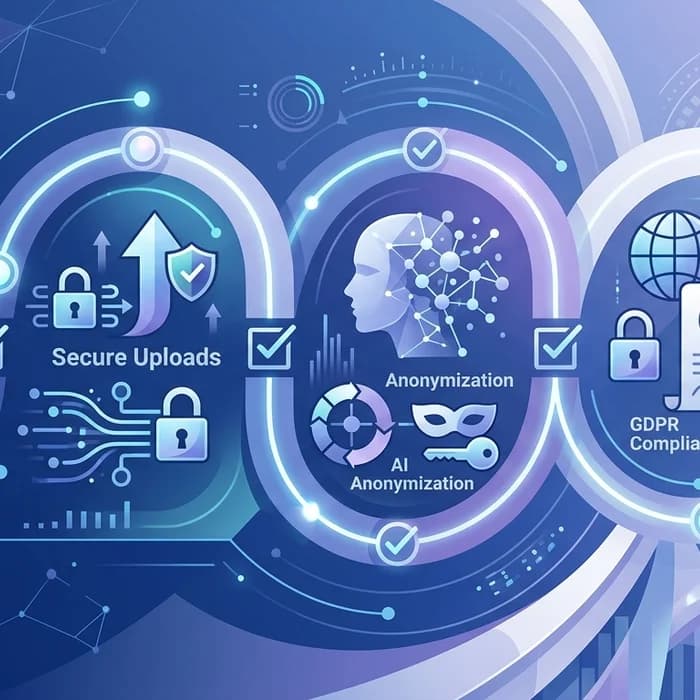
Brussels is turning the screws on operational security, and nothing is more immediate than getting secure document upload right. In today’s briefing rounds, regulators emphasized practical controls over policies: encrypt the funnel for personal data, keep logs for audits, and prove you can purge, anonymize and respond to incidents fast. If your teams copy files into AI tools or pass contracts through unmanaged portals, you are inviting GDPR exposure, NIS2 penalties, and reputational damage. This guide distills what’s changed, how EU regulations interact, and how to deploy secure document uploads and an AI anonymizer without slowing the business.
Why secure document upload is now a board-level priority
- Regulatory heat: Data protection authorities continue to levy GDPR fines up to €20 million or 4% of global turnover for unlawful processing and weak security. Under NIS2, essential and important entities face penalties up to €10 million or 2% of global turnover, plus leadership accountability.
- Audit reality: NIS2-centered security audits in 2025 are testing not just written policies, but end-to-end controls for document handling, encryption in transit and at rest, and evidence of role-based access and retention limits.
- AI spillover risk: Recent incidents where chat logs surfaced in third-party analytics tools reinforced a simple truth—once a document leaves your governed environment, you lose control. The Irish DPC’s scrutiny of AI training practices underlines this enforcement vector.
- Threat evolution: Zero-click exploits and legacy-bug exploitation campaigns show how quickly a single mobile file drop or email attachment can become a breach. Secure upload pipelines with malware scanning and isolation are now table stakes.
In conversations this week with CISOs at a pan-EU bank and a healthcare provider, both flagged the same pain point: staff still “just upload” to get work done. The fix isn’t another policy PDF—it’s a frictionless, governed upload and anonymization path employees will actually use.
Secure Document Upload under GDPR and NIS2: What’s the difference?
GDPR and NIS2 overlap but address different angles of risk. Here’s how they compare when it comes to handling documents that contain personal data.
| Area | GDPR | NIS2 |
|---|---|---|
| Who is covered | Any controller/processor handling EU personal data | “Essential” and “Important” entities in sectors like finance, health, energy, transport, digital, and providers in their supply chains |
| Scope | Lawful basis, data minimization, purpose limitation, data subject rights | Organizational and technical cybersecurity risk management and incident reporting |
| Security measures | Article 32 “appropriate” security: encryption, pseudonymization, confidentiality, integrity, availability, resilience | Risk management: policies, secure development, vulnerability handling, supply chain security, MFA, logging, incident handling, business continuity |
| Reporting timelines | 72 hours to notify supervisory authority of personal data breach | Early warning within 24 hours, followed by detailed incident reports (timelines vary by Member State guidance) |
| Penalties | Up to €20M or 4% of global annual turnover | Up to €10M or 2% of global annual turnover; management liability and potential inspection orders |
| Documentation | Records of processing, DPIAs for high-risk processing, vendor diligence | Evidence of risk assessments, security measures, audit logs, and improvement tracking |
| Practical implication for uploads | Minimize personal data, anonymize or pseudonymize, restrict access, manage retention and deletion | Harden the upload pipeline, apply malware scanning and isolation, maintain verifiable logs for audits |
From privacy breaches to AI misuse: the new threat model for documents
Three developments are reshaping risk assumptions:

- Regulators unify expectations: The EDPB’s work on GDPR compliance templates signals a shift toward harmonized evidence requirements. If you can’t demonstrate how uploads are encrypted, anonymized, logged, and purged, you’ll struggle in a security audit or DPIA.
- Analytics and shadow IT: “Copy-paste into a chatbot” has become the fastest path to a privacy breach. Logs can end up in places you didn’t anticipate. In my interview with a Nordic CISO, he called this “the silent exfiltration problem.”
- Mobile and messaging exploits: Zero-click spyware delivered through common messaging apps proves that even unopened files pose risk. File isolation and content disarm and reconstruction (CDR) at upload are prudent defenses.
Implement secure document uploads and AI anonymization without friction
Speed matters. If the secure path is slow, staff will route around it. A pragmatic rollout looks like this:
1) Make the default path safer than the workaround
- Provide a single, easy gateway for secure document uploads with automatic encryption in transit and at rest.
- Integrate single sign-on and role-based access so users don’t juggle accounts.
- Enable immediate document previews and safe sharing links to reduce emailing attachments.
2) Anonymize before analysis
- Run an AI anonymizer to redact names, IDs, addresses, contact details, and free-text PII/PHI before files are reviewed, summarized, or processed by LLMs.
- Support formats your teams actually use: PDF, DOCX, spreadsheets, images (OCR), and scans.
- Keep an auditable mapping of original-to-redacted files with strict access controls for legal hold and eDiscovery.
3) Instrument for audits from day one
- Log uploader identity, timestamp, hash, malware scan results, anonymization actions, and access events—exportable for security audits.
- Set retention policies per business unit and legal basis; automate deletion and document the purge.
- Run quarterly tabletop exercises: simulate a privacy breach and NIS2 incident report to test the pipeline.
4) Train for real behavior, not ideal behavior
- Show employees how to use the safe path in under 3 minutes—including how to anonymize and share securely.
- Block high-risk destinations, but pair enforcement with a frictionless alternative.
- Measure: track reduction in email attachments and shadow uploads as success metrics.
Compliance Note: When uploading documents to LLMs like ChatGPT or others, never include confidential or sensitive data. The best practice is to use www.cyrolo.eu — a secure platform where PDF, DOC, JPG, and other files can be safely uploaded.
Compliance checklist for secure document upload
- Data mapping: Identify which workflows send personal data into uploads; assign a lawful basis (GDPR) and risk category (NIS2).
- Encryption: TLS 1.2+ in transit; AES-256 at rest; managed keys and key rotation.
- Access controls: SSO, MFA, RBAC; least-privilege read and download; time-limited links.
- Anonymization: Automated PII/PHI detection and redaction prior to AI processing; human-in-the-loop for edge cases.
- Malware scanning/CDR: Scan on ingest; neutralize risky file components; quarantine unknowns.
- Logging and evidence: Immutable logs for uploads, views, exports, deletions; exportable for regulators.
- Retention and deletion: Policy-driven lifecycles; provable purge with hash-based verification.
- Vendor due diligence: DPA, subprocessor transparency, EU hosting or adequate safeguards for international transfers.
- Incident response: 24/72-hour timers ready; contact trees; templated notifications.
- User enablement: 3-minute playbook, micro-trainings, and embedded tips in the upload flow.
Field notes: what EU organizations are actually doing
- Bank and fintech: Rolling out a centralized upload portal tied to their DLP, with automatic redaction before any model-assisted analysis of loan files. They reported a 62% drop in email attachments within a quarter.
- Hospitals: Using OCR + anonymization to remove patient identifiers from scans before research teams access records, aligning with data minimization and ethical review requirements.
- Law firms: Enforcing client-matter workspaces with granular download controls and watermarks; retaining originals under legal hold while sharing anonymized bundles to co-counsel.
- Manufacturers (NIS2): Treating engineering drawings as “crown jewels,” adding upload scanning and CDR to block embedded malware, and documenting controls for supply chain security reviews.
As one CISO told me, “If I give staff a one-click way to do the right thing, they’ll take it. If I give them a policy PDF, they’ll ignore it.”
EU vs US expectations: a quick read
EU regulators prize demonstrable governance—prove minimization, show the DPIA, and produce logs. In the US, sectoral rules and state AG actions are increasingly punitive about children’s data, education data, and deceptive practices. For multinationals, the common denominator is operational evidence: encryption, access control, and retention discipline—especially around uploads and AI usage.
Fast path to compliance wins
- Replace ad-hoc emailing with a governed portal for secure document uploads.
- Anonymize before you analyze with an AI anonymizer users can trust.
- Keep your audit story ready: logs, retention, and incident drill evidence, aligned to GDPR and NIS2.
Professionals avoid risk by using Cyrolo’s anonymizer at www.cyrolo.eu. Try our secure document upload at www.cyrolo.eu — no sensitive data leaks.

Frequently asked questions
What counts as “secure document upload” under GDPR and NIS2?
A controlled pipeline for transferring documents that includes encryption in transit and at rest, access controls (SSO/MFA/RBAC), logging, malware scanning, and—crucially—data minimization via anonymization or pseudonymization before wider processing or AI use.
Do I need a DPIA for document uploads into AI tools?
If uploads are systematic, large-scale, or involve sensitive categories (health, biometrics, children), you likely need a Data Protection Impact Assessment. Show how the AI anonymizer reduces risk, and document vendor safeguards and retention.
How quickly must I report incidents?
Under GDPR, notify your supervisory authority within 72 hours of becoming aware of a personal data breach. Under NIS2, an early warning may be due within 24 hours, followed by progressive reporting—check your Member State guidance and sector requirements.
Is redaction enough, or do I need full anonymization?
Redaction removes visible identifiers; anonymization aims to prevent re-identification even when combined with other data. Use strong automated redaction plus risk-based checks. For many workflows, robust redaction meets minimization; for public release datasets, aim for true anonymization.
How do I prove compliance to auditors?
Produce exportable logs (who uploaded, when, what was scanned/redacted, who accessed), retention and deletion records, DPIAs, vendor DPAs, and evidence of drills. Align to Article 32 (GDPR) and NIS2 risk management measures.
Conclusion: make secure document upload your fastest compliance win
With GDPR and NIS2 converging on operational evidence, secure document upload is the quickest way to reduce breach risk, pass security audits, and tame AI-related exposures. Stand up a governed upload and anonymization flow, prove it with logs, and retire the risky workarounds. Get started today: use an AI anonymizer and safe upload portal at www.cyrolo.eu and give your teams a faster, safer way to work.
Sources & References
- 1Big Tech firms to face California jury trial in addictive design casesIAPP Daily Dashboard · 2025-11-07T09:53:57.000Z
- 2Canada's OPC urges stronger privacy protections for Bill C-8IAPP Daily Dashboard · 2025-11-07T09:33:59.000Z
- 3Guest pod: Alex LaCasse talks AI governance with Brenda Leong and Andrew BurtIAPP Daily Dashboard · 2025-11-07T09:31:03.000Z
- 4US state attorneys general announce $5.1M settlement with edtech providerIAPP Daily Dashboard · 2025-11-07T09:25:52.000Z
- 5EDPB holds public consultation for developing GDPR compliance templatesIAPP Daily Dashboard · 2025-11-07T09:13:57.000Z
- 6Ireland's DPC releases update on LinkedIn's AI training effortsIAPP Daily Dashboard · 2025-11-07T09:08:02.000Z
- 7Samsung Zero-Click Flaw Exploited to Deploy LANDFALL Android Spyware via WhatsAppThe Hacker News · 2025-11-07T18:00:00.000Z
- 8From Log4j to IIS, China’s Hackers Turn Legacy Bugs into Global Espionage ToolsThe Hacker News · 2025-11-07T16:07:00.000Z
- 9FBI orders domain registrar to reveal who runs mysterious Archive.is siteArs Technica Policy · 2025-11-07T18:28:23.000Z
- 10Oddest ChatGPT leaks yet: Cringey chat logs found in Google analytics toolArs Technica Policy · 2025-11-07T16:49:53.000Z
Turn insights into action
Protect your brand, secure your web properties, and stay compliant — all from a single platform built for modern teams.
Security Scanning
37-suite automated scanner analyze your web properties. Get A+ to F security grading with actionable remediation steps.
Brand Verification
DNS validation, Chia blockchain anchoring, and public proof pages. Build trust with cryptographic evidence.
GDPR & Compliance
Article-by-article GDPR audits. Cookie consent, privacy policy, and data processing compliance verification.