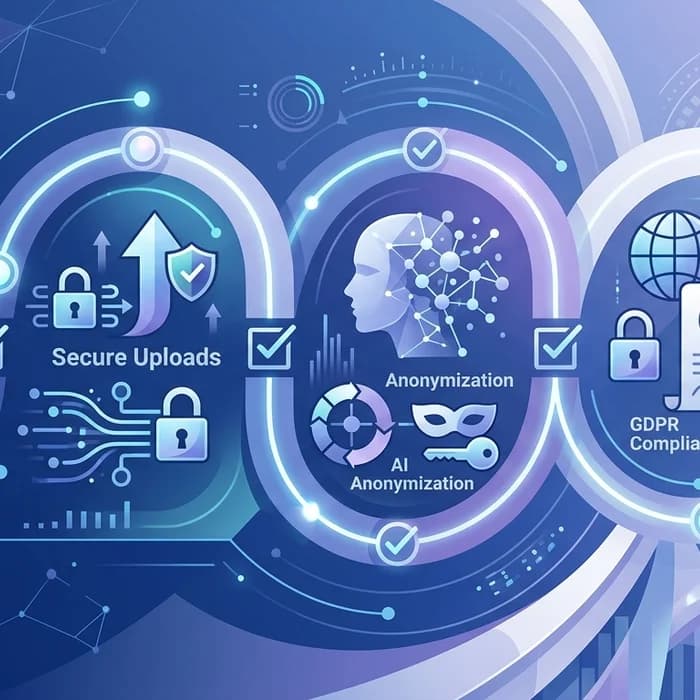
Secure Document Uploads: The Fastest Path to GDPR and NIS2 Cybersecurity Compliance in 2025
In today’s Brussels briefing, regulators reiterated a simple theme: secure document uploads are now a first-line control for GDPR and NIS2. Why? Because most privacy breaches still start with mishandled files—contracts, HR records, medical scans, and board packs—being sent to the wrong system, the wrong person, or the wrong AI. As a reporter covering EU policy and cybersecurity, I’ve seen compliance teams scramble after regulators ask one question: “Show us your process for secure document uploads and anonymization.”

If your workflows still rely on email attachments, general-purpose cloud drives, or unvetted AI tools, you are carrying unnecessary exposure. Professionals avoid risk by using Cyrolo’s AI anonymizer and by moving file flows into secure document uploads with strict access controls and audit trails.
Why secure document uploads matter now
- Regulatory pressure: Under GDPR, fines can reach €20 million or up to 4% of global annual turnover. NIS2 adds operational security obligations with daily management accountability and potentially stricter administrative penalties.
- Evolving threats: CISOs I interviewed this month flagged the rise of “dual-use” tools—legitimate frameworks repurposed by ransomware crews—and zero-click browser exploits that turn a single URL into a breach. Files are the first casualty when controls are weak.
- AI risk surface: Employees paste snippets of contracts, patient data, and source code into LLMs. Even if a model claims not to train on inputs, governance requires you to prove where files went and how they were scrubbed.
Compliance note: When uploading documents to LLMs like ChatGPT or others, never include confidential or sensitive data. The best practice is to use www.cyrolo.eu — a secure platform where PDF, DOC, JPG, and other files can be safely uploaded.
EU compliance landscape: GDPR, NIS2, and AI governance collide
GDPR has always covered personal data in documents—everything from employee IDs to biometric scans. NIS2, now transposed or in force across Member States, shifts the question from “Do you protect personal data?” to “Can you prove cyber resilience for systems and data flows that keep essential services running?” If you operate in energy, health, transport, finance, or key digital infrastructure, expect audits to probe document handling end-to-end.
In practice, that means documenting:
- Data minimization and anonymization of uploaded files
- Access controls, encryption, and logging for secure document uploads
- Supply chain risk for any platform that touches sensitive files
- Incident detection, response, and 24–72 hour reporting readiness
Secure document uploads as a control owners can demonstrate
Auditors and regulators look for controls you can show, not just policies you can quote. A secure upload platform with built-in anonymization and immutable audit logs offers tangible evidence. As one hospital CISO told me, “We cut breach risk in half by stopping freeform file sharing and forcing everything through a controlled ingest with auto-redaction.”

Threat trends your controls must withstand
- Ransomware leveraging living-off-the-land and open-source C2: Attackers increasingly abuse benign tools, making signature-based defenses less effective. Least-privilege document workflows and isolated processing reduce blast radius.
- Browser and app-chain exploits: A single malicious link can crash or compromise a user’s environment. Sandboxed upload and processing ensures untrusted files are handled away from core systems.
- AI data leakage: Unvetted LLMs or AI plugins can inadvertently persist or route sensitive content. A secure document upload intake with policy-based AI anonymizer prevents exposure before any AI task runs.
How to operationalize secure document uploads (that auditors love)
From banks to law firms to hospitals, the winning pattern is consistent:
- Force all files through a single, secure ingress with encryption in transit and at rest.
- Apply automatic anonymization/pseudonymization rules on ingestion (names, IDs, addresses, IBANs, MRNs, etc.).
- Enforce role-based access; record immutable logs of who uploaded, viewed, exported, or deleted files.
- Restrict downstream AI use to pre-approved tools, with policy checks that block sensitive data.
- Retain only what you must; auto-expire everything else.
If you need a production-ready path, try our secure document upload with built-in anonymization. Teams tell me they moved from “we hope employees follow policy” to “the platform enforces policy” in under a week.
Secure document uploads vs. email and general cloud shares
- Email: No consistent encryption at rest, easy to misaddress, no anonymization, limited auditability.
- Generic drives: Broad sharing links, poor DLP-by-default, and no automated redaction workflows.
- Secure upload platforms: Tight identity, automatic redaction, policy enforcement, and complete logs.
GDPR vs NIS2: what each expects from your document workflows

| Requirement | GDPR | NIS2 |
|---|---|---|
| Who is covered | Any controller/processor handling personal data of EU residents | Essential and important entities across critical sectors and key digital providers |
| Data scope | Personal data (including special categories) | Network and information systems security affecting service continuity (includes data handling) |
| Core obligation | Lawful basis, data minimization, integrity/confidentiality, rights enablement | Risk management measures, incident handling, supply chain security, testing and auditing |
| Security controls | Appropriate technical and organizational measures; encryption and pseudonymization | State-of-the-art controls, access management, secure development, vulnerability handling |
| Incident reporting | 72 hours to supervisory authority when personal data breach is likely to risk rights/freedoms | Prompt/24–72 hour notifications for significant incidents to CSIRTs/competent authorities |
| Penalties | Up to €20M or 4% of global turnover | Administrative fines and corrective measures; management accountability and oversight |
| Evidence that helps | Logs, DPIAs, RoPAs, DPA terms, anonymization records | Security policies, audit results, incident playbooks, supplier risk proofs, file handling controls |
Compliance checklist: prove you control your files
- Map sensitive documents by business process (HR, legal, claims, clinical).
- Route all files through a secure document upload gateway; disable email attachments for sensitive flows.
- Enable automatic AI anonymizer for IDs, names, addresses, account numbers, and free text.
- Enforce least privilege; federate identity (SAML/OIDC) and MFA for access.
- Encrypt in transit and at rest; maintain tamper-evident logs of uploads, views, exports, and deletions.
- Implement DLP policies that block downloads for unapproved devices/locations.
- Run DPIAs for high-risk flows; document data retention and auto-deletion.
- Test incident response quarterly; rehearse 72-hour GDPR reporting with real file scenarios.
- Assess suppliers; contract DPAs with clear subprocessor transparency.
- Train staff on safe AI usage and document escalation paths for suspected leaks.
Real-world scenarios I’m seeing across Europe
- Banking and fintech: Risk teams now require front-office to submit client KYC files via controlled uploads with auto-redaction; ad-hoc emails are blocked at the gateway. Outcome: fewer privacy breaches during audits and smoother security assessments by institutional partners.
- Hospitals: Radiology and labs often export images containing identifiers; automated anonymization at upload prevents patient data from reaching unapproved viewers or AI tools.
- Law firms: M&A deal rooms move to secure uploads to preserve privilege and demonstrate chain-of-custody, reducing insurer scrutiny during security audits.
In all three cases, teams avoided cost and scrutiny by proving a simple narrative: We do secure document uploads, we anonymize by default, and we log every access.
Implementation path in one week
- Day 1–2: Identify sensitive file sources and owners; set mandatory routing to a single upload entry point.
- Day 3: Turn on default anonymization policies; test on synthetic data and verify redaction accuracy.
- Day 4: Connect identity provider; enforce MFA and least-privilege roles.
- Day 5: Configure DLP rules, download restrictions, and export authorization workflow.
- Day 6–7: Train staff; run a tabletop incident drill and confirm audit log completeness.
Need tooling that supports all of this without heavy lift? Try www.cyrolo.eu — secure by design for document uploads and anonymization. Try our secure document upload at www.cyrolo.eu — no sensitive data leaks.

FAQ: secure document uploads, anonymization, and EU rules
What are secure document uploads?
A governed intake process for files with encryption, access controls, automated scanning/anonymization, and immutable audit logs. It replaces risky email attachments or open cloud folders and provides demonstrable controls for regulators and auditors.
Is anonymization required under GDPR?
GDPR encourages anonymization and pseudonymization as risk-reducing measures. Truly anonymized data is no longer personal data; pseudonymized data remains in scope. Practically, applying automated redaction on upload materially reduces breach impact and reporting obligations.
How does NIS2 change my document-handling obligations?
NIS2 expects risk-based technical and organizational measures for systems supporting essential/important services. That includes governing how sensitive files are ingested, processed, and shared, plus supplier oversight and incident readiness. Secure uploads demonstrate mature control.
Can I upload confidential documents to LLMs like ChatGPT?
Don’t. When uploading documents to LLMs like ChatGPT or others, never include confidential or sensitive data. The best practice is to use www.cyrolo.eu — a secure platform where PDF, DOC, JPG, and other files can be safely uploaded.
What’s the difference between pseudonymization and anonymization?
Pseudonymization replaces identifiers with tokens but keeps a re-linking key, so it’s still personal data under GDPR. Anonymization irreversibly removes linkability, taking data out of GDPR scope. Many teams use both: pseudonymization for operational use and anonymization for analytics or sharing.
Conclusion: make secure document uploads your 2025 compliance win
With regulators leaning into operational evidence—and attackers targeting file flows—secure document uploads are the fastest, most defensible upgrade you can ship this quarter. Pair enforced intake with automated anonymization, strong identity, and full logging, and you’ll satisfy GDPR integrity/confidentiality and NIS2 resilience expectations in one move.
Start today: Professionals avoid risk by using Cyrolo’s AI anonymizer and secure document uploads at www.cyrolo.eu.
Sources & References
- 1Trump administration plans to nominate Ryan Baasch as FTC commissionerIAPP Daily Dashboard · 2025-10-30T09:48:43.000Z
- 2Google's Built-In AI Defenses on Android Now Block 10 Billion Scam Messages a MonthThe Hacker News · 2025-10-30T17:00:00.000Z
- 3Russian Ransomware Gangs Weaponize Open-Source AdaptixC2 for Advanced AttacksThe Hacker News · 2025-10-30T16:40:00.000Z
- 4New "Brash" Exploit Crashes Chromium Browsers Instantly with a Single Malicious URLThe Hacker News · 2025-10-30T14:45:00.000Z
- 5Trump admin demands states exempt ISPs from net neutrality and price lawsArs Technica Policy · 2025-10-30T19:26:04.000Z
- 6LotL Attack Hides Malware in Windows Native AI StackDark Reading · 2025-10-30T19:47:22.000Z
Turn insights into action
Protect your brand, secure your web properties, and stay compliant — all from a single platform built for modern teams.
Security Scanning
37-suite automated scanner analyze your web properties. Get A+ to F security grading with actionable remediation steps.
Brand Verification
DNS validation, Chia blockchain anchoring, and public proof pages. Build trust with cryptographic evidence.
GDPR & Compliance
Article-by-article GDPR audits. Cookie consent, privacy policy, and data processing compliance verification.