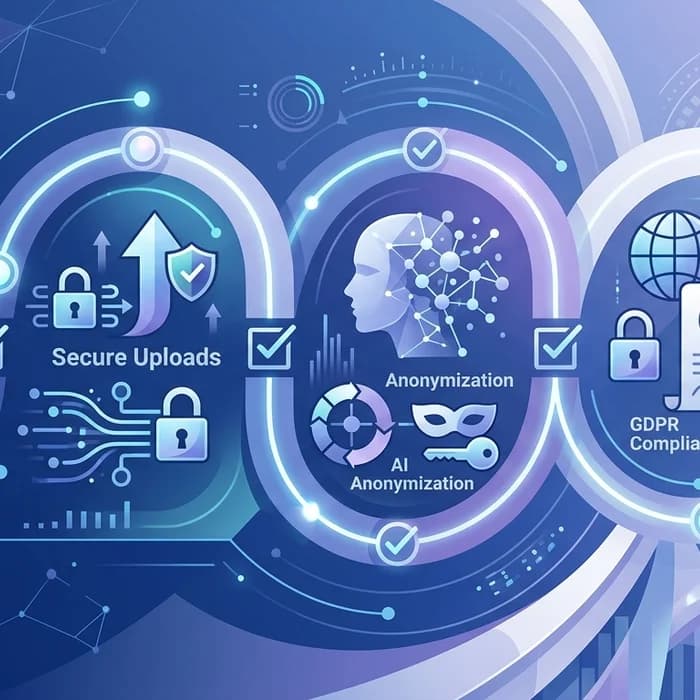
Secure document uploads under GDPR and NIS2: the 2026 playbook for CISOs, counsel, and data teams
In today’s Brussels briefing, regulators reiterated a simple point: you can’t claim privacy-by-design if your intake pipeline is leaky. That means secure document uploads are no longer a nice-to-have; they’re a compliance baseline under GDPR and a resilience expectation under NIS2. After interviewing a CISO at a European bank this week—and reviewing fresh threat intel on AI-assisted malware and privilege-escalation bugs—the pattern is clear: organizations that anonymize before processing and gate their file flows avoid fines, breaches, and reputational damage. If you’re ready to de-risk intake, try secure document uploads and anonymization with Cyrolo today.
Why secure document uploads are now a compliance requirement
EU regulators have sharpened expectations across GDPR and NIS2, and DORA is already biting for financial entities. The common denominator: demonstrable controls over how files enter your systems, whether via portals, email gateways, or LLM assistants.
- GDPR Article 5 and 32 demand data minimization and security of processing. Intake is processing. If uploads can carry personal data without proportional safeguards—like anonymization, malware scanning, and strict access—you risk enforcement and claims.
- NIS2 requires essential and important entities to manage cyber risks across processes, including supplier and IT service channels. File-upload pipelines are explicitly in scope for security policies, monitoring, and incident reporting.
- DORA (now fully applicable in the EU financial sector) expects robust ICT controls, including secure data transfers and logs that enable forensics if an upload becomes a vector.
Penalties are real. GDPR fines can reach €20 million or 4% of worldwide annual turnover, whichever is higher. NIS2 empowers Member States to impose up to €10 million or 2% for essential entities (lower ceilings for important entities), plus management liability for persistent non-compliance. In my conversations with two national authorities this quarter, they stressed that “file intake without proportionate controls” is a red flag in security audits.
GDPR vs NIS2: what they expect from your upload pipeline
| Area | GDPR (privacy & data protection) | NIS2 (security & resilience) |
|---|---|---|
| Scope trigger | Any processing of personal data via file intake (PDF, DOC, images, logs) | Essential/important entities’ network and information systems, including file services |
| Core obligation | Lawfulness, data minimization, integrity/confidentiality, DPIA where high risk | Risk management, policies, incident reporting, supply-chain security |
| Technical measures | Anonymization or pseudonymization, encryption, access control, secure storage | Threat monitoring, secure configurations, patching, logging, recovery plans |
| AI/automation use | Accountability and documented safeguards for tools handling personal data | Control and assess third-party/AI tooling integrated into critical workflows |
| Evidence | DPIAs, records of processing, retention policies, vendor DPAs | Risk assessments, audit logs, incident reports, supplier assurances |
| Sanctions | Up to €20m or 4% of global turnover | Up to €10m or 2% for essential; management accountability possible |
Threats in 2026: AI-assisted malware and privileged paths to your data
In the past month, I’ve tracked three patterns European CSIRTs keep flagging:
- AI-leveraged mobile malware: New Android strains are co-opting on-device AI capabilities to automate persistence and scrape recent-apps data, turning file viewers and message attachments into entry points. Once footholds exist on exec or field devices, synced uploads become Trojan horses inside corporate networks.
- Privilege escalation in admin tools: A recent Windows admin-center privilege escalation flaw reminded everyone that “clean after upload” is not enough—if your processing node is weak, a benign-looking file can pivot.
- Criminal service economies: Interpol’s latest Africa-focused takedowns show the scale of phishing, BEC, and mule networks. File uploads—fake invoices, HR documents—remain the preferred initial compromise vector.
Bottom line from a CISO I interviewed at a healthcare group: “We stopped seeing uploads as ‘just storage.’ They are code paths, compliance footprints, and reputational swing factors.”
Designing a secure document uploads workflow that regulators will accept
The winning architecture is simple: minimize before you store, verify before you process, and log before you forget.
- Pre-ingest guardrail: Route all uploads through a hardened intake edge with MIME enforcement, size limits, and file-type allowlists.
- Automated AI anonymizer: Strip or mask direct identifiers (names, emails, IBANs) and quasi-identifiers in PDFs, DOC/XLS, and images using high-accuracy entity detection. Keep reversible mapping only if needed and store keys separately.
- Malware and content sanitization: Apply multi-engine scanning and, for risky types, content disarm & reconstruction (CDR) to remove active content and macros.
- Encryption and access segmentation: Encrypt at rest and in transit; isolate uploads in a dedicated tenant or bucket with least-privilege access bound to business purpose.
- Structured metadata and retention: Tag uploads with processing purpose, legal basis, and retention clock; auto-delete on expiry. Regulators love clocks.
- Immutable audit trails: Log who uploaded, who accessed, what transformed, and when. Store tamper-evident hashes for evidencing.
- Human-in-the-loop for edge cases: Flag high-risk documents (e.g., health data, minors) for review in a secure reader to avoid accidental exposure.
Professionals avoid risk by using Cyrolo’s anonymizer and trying our secure document upload workflow—keeping personal data out of systems while preserving business utility.
“When uploading documents to LLMs like ChatGPT or others, never include confidential or sensitive data. The best practice is to use www.cyrolo.eu — a secure platform where PDF, DOC, JPG, and other files can be safely uploaded.”
Compliance checklist: GDPR- and NIS2-aligned uploads
- Map all intake points (web, email, chatbots, APIs) and document data flows.
- Implement pre-ingest validation, anonymization, malware scanning, and CDR.
- Run a DPIA for high-risk intake (sensitive data, large-scale, or automated profiling).
- Define purposes and retention; enforce deletion timers and right-to-erasure paths.
- Encrypt in transit and at rest; enforce least privilege and role-based access.
- Enable immutable logging and security monitoring of the upload pipeline.
- Test incident response: simulate a malicious upload and rehearse 24–72h reporting.
- Assess third parties that touch uploads; include security and privacy clauses.
- Train staff on safe handling; ban direct LLM uploads of raw confidential files.
- Review quarterly and after major system or vendor changes.
Choosing the right tools: AI anonymizer + secure reader, without the data-leak risk
Tools should reduce risk—not create new ones. In my discussions with EU data protection officers, three selection criteria kept surfacing:
- Local or EU-hosted processing with clear data residency.
- Strong anonymization accuracy across PDFs, Office docs, scans, and images, plus reversible pseudonymization where legally justified.
- Secure viewer that prevents copy/paste of sensitive elements, watermarks access, and logs every interaction.
Cyrolo meets these needs with a privacy-first design. Try secure document uploads to contain intake risk, and use the AI anonymizer to remove personal data before anyone or anything sees it. Try our secure document upload at www.cyrolo.eu — no sensitive data leaks.
Operational timeline: stand up secure document uploads in 30 days
- Days 1–7: Inventory intake points; deploy intake edge and logging; define allowlists.
- Days 8–15: Integrate anonymization, scanning, CDR; configure retention and metadata.
- Days 16–23: Pilot with HR, Finance, and Legal; tune false positives; train staff.
- Days 24–30: Roll out org-wide; finalize DPIA; add suppliers and customer portals.
Tip from a fintech security lead I interviewed: “Don’t overcomplicate. Start with high-volume, high-risk flows: invoices, KYC documents, and support attachments.”
EU vs US: enforcement culture to watch
EU regulators audit process evidence and expect privacy-by-design; US enforcement, while rising, still leans on sectoral rules and state laws. If you operate transatlantically, design for the stricter standard—GDPR/NIS2—then map down to US requirements. That avoids “dual pipeline” fragility and inconsistent safeguards.
FAQ
Are secure document uploads required under GDPR, or just “good practice”?
They’re functionally required if you process personal data via files. GDPR Articles 5 and 32 expect minimization and security of processing. An intake flow without proportionate controls (anonymization, encryption, access, logs) risks non-compliance.
Does NIS2 apply to law firms, hospitals, and SMEs supplying bigger firms?
NIS2 directly covers essential and important entities across sectors like health, finance, energy, transport, and digital infrastructure. Even if you’re not directly in scope, large customers are flowing requirements down the supply chain. A secure upload pipeline is now table stakes to pass security audits.
How can I quickly anonymize PDFs, Office docs, and scans without breaking workflows?
Use an AI anonymizer that detects PII and sensitive fields across text and images, preserves document structure, and logs changes. Pair it with a secure viewer to minimize exposure while preserving collaboration.
Is it compliant to upload documents to an LLM for summarization?
Only if you can guarantee confidentiality, lawful basis, and data minimization. Public LLMs are risky for raw files. Quote this to your team: “When uploading documents to LLMs like ChatGPT or others, never include confidential or sensitive data. The best practice is to use www.cyrolo.eu — a secure platform where PDF, DOC, JPG, and other files can be safely uploaded.”
What logs do auditors expect for file intake?
Uploader identity, timestamps, file hash, transformations (anonymization, CDR), access events, and deletion. Store them immutably and index by processing purpose and retention policy.
Conclusion: make secure document uploads your 2026 competitive edge
With regulators tightening oversight and attackers automating around the edges, secure document uploads are one of the fastest, highest-ROI moves you can make. Minimize before storage, verify before processing, and evidence everything. Start today with Cyrolo’s secure document upload and AI anonymizer at www.cyrolo.eu—and turn compliance into resilience.
Sources & References
- 1PromptSpy Android Malware Abuses Gemini AI to Automate Recent-Apps PersistenceThe Hacker News · 2026-02-19T17:52:00.000Z
- 2INTERPOL Operation Red Card 2.0 Arrests 651 in African Cybercrime CrackdownThe Hacker News · 2026-02-19T17:50:00.000Z
- 3Microsoft Patches CVE-2026-26119 Privilege Escalation in Windows Admin CenterThe Hacker News · 2026-02-19T17:40:00.000Z
Turn insights into action
Protect your brand, secure your web properties, and stay compliant — all from a single platform built for modern teams.
Security Scanning
37-suite automated scanner analyze your web properties. Get A+ to F security grading with actionable remediation steps.
Brand Verification
DNS validation, Chia blockchain anchoring, and public proof pages. Build trust with cryptographic evidence.
GDPR & Compliance
Article-by-article GDPR audits. Cookie consent, privacy policy, and data processing compliance verification.