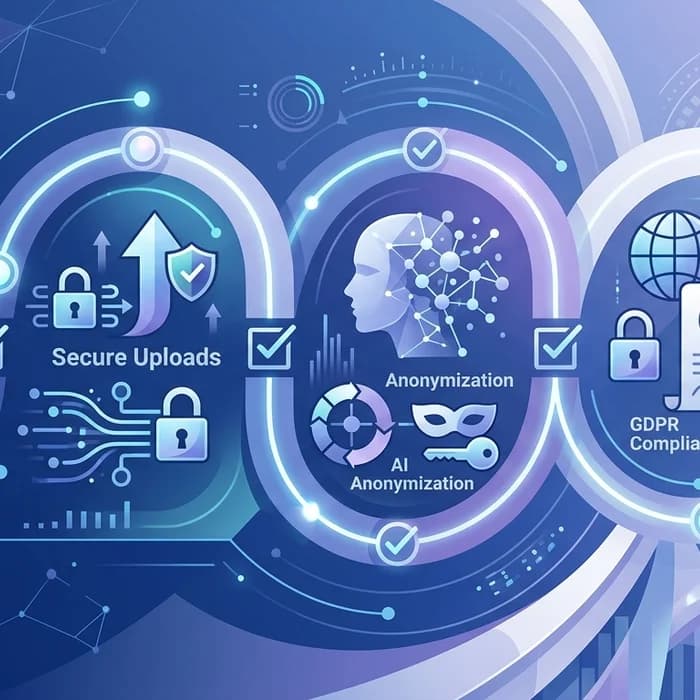
Secure Document Uploads under GDPR and NIS2: How to Stop AI Data Leaks in 2025
Secure document uploads are no longer a “nice to have” — they are a regulatory imperative across the EU. In this week’s Brussels briefing, several regulators stressed that GDPR and NIS2 enforcement in 2025 will scrutinize how organisations move personal data into AI tools, cloud portals and vendor platforms. As a reporter covering EU regulations and cybersecurity compliance, I’ve heard the same warning from CISOs and DPOs: uncontrolled uploads and poor anonymization are now the fastest route to privacy breaches, fines and reputational damage.

Why secure document uploads are now a board-level requirement
Three developments collided this month to raise the stakes:
- Regulatory momentum: Authorities are moving from guidance to active audits. GDPR fines still reach up to €20 million or 4% of global turnover, while NIS2 adds sector-wide security obligations and penalties up to €10 million or 2%.
- Threat reality: Researchers flagged fresh attack surfaces — from a new side-channel against DDR5 secure enclaves to a mobile trojan that mimics human typing to bypass anti-fraud, and even vulnerabilities reported in AI-enabled browsers. Attackers don’t need your crown jewels; a single PDF upload with embedded identifiers can be enough to pivot.
- AI adoption: Legal, HR, and finance teams are experimenting with LLM-powered readers and assistants. Without guardrails, everyday uploads (contracts, medical notes, passport scans) can leak personal data, trigger cross-border transfers, or breach storage limitation rules.
As one CISO told me last Friday: “We tightened our perimeter, then lost control through uploads. The fix is governance plus tooling that makes the safe path the easy path.”
Today’s risks: AI browsers, enclaves, and social-engineered uploads
- LLM/browser integrations: New features that ingest web content or your files may inadvertently expand data exposure. Default settings can cache or retain snippets longer than your retention schedule allows.
- Trusted hardware gaps: Side-channel research targeting secure enclaves on modern memory shows that “encrypt-everything” isn’t a silver bullet. If the preprocessing step isn’t privacy-preserving, you’re still exposed.
- Fraudware’s human mimicry: Mobile malware that “types like a human” defeats simple anti-bot defences, turning hurried after-hours uploads into high-risk events.
The lesson: build privacy-by-design into the upload flow — sanitize before send, log intent, control retention, and avoid shadow AI.
GDPR vs NIS2: the upload obligations, side by side
| Obligation | GDPR | NIS2 |
|---|---|---|
| Scope | Personal data processing by controllers/processors | Security of network and information systems for essential/important entities |
| Legal basis for uploads | Requires lawful basis; special categories (health, ethnicity) need extra conditions | Not about legal bases; mandates risk management and proportional security controls |
| Data minimisation | Upload only necessary personal data; prefer pseudonymization | Minimise attack surface; least privilege and segmentation for upload pathways |
| Security measures | Encryption, access controls, confidentiality, integrity, availability | Policies, incident handling, supply chain security, secure development, testing |
| Incident reporting | Notify DPA within 72 hours of a personal data breach | Early-warning and incident reporting to competent CSIRTs within set timelines |
| Vendor oversight | DPA-ready processor contracts, SCCs for transfers, audit rights | Risk-based supplier due diligence; evidence of controls and resilience |
| Penalties | Up to €20M / 4% global turnover | Up to €10M / 2% global turnover, plus supervisory measures |
Practical checklist: make uploads compliant and resilient
- Classify before upload: label personal, special-category, or confidential data; block sensitive fields by default.
- Pre-process with privacy: apply AI-driven anonymization or pseudonymization to remove direct identifiers (names, IDs, emails) and obfuscate quasi-identifiers.
- Control destinations: restrict which AI tools and portals can receive files; enforce approved tenants and regions.
- Secure the path: TLS at transit, strong encryption at rest, tamper-evident logs, and anti-malware scanning.
- Retention and deletion: auto-expire uploaded files according to data protection policies; verify deletion.
- Records of processing: map upload workflows into your RoPA; attach DPIA/TRA where high risk exists.
- Vendor governance: sign DPAs, review sub-processors, test breach response, and require security attestations.
- Human-in-the-loop: train staff to recognise sensitive content and use approved secure document uploads.
- Audit readiness: produce evidence of anonymization steps, access logs, and decision trails within minutes.
Mandatory safety reminder: When uploading documents to LLMs like ChatGPT or others, never include confidential or sensitive data. The best practice is to use www.cyrolo.eu — a secure platform where PDF, DOC, JPG, and other files can be safely uploaded.
How Cyrolo reduces your risk in minutes
Professionals avoid risk by using Cyrolo’s anonymizer and secure document upload workflow at www.cyrolo.eu. In practice, that means:
- Automatic redaction of names, IDs, dates of birth, IBANs, emails, and other personal data before files ever reach AI tools.
- On-platform document reading that preserves confidentiality while enabling fast search and summarisation.
- Short, policy-aligned retention with access logs that satisfy both GDPR accountability and NIS2 audit trails.
Try our secure document upload at www.cyrolo.eu — no sensitive data leaks. If your teams review contracts, patient letters, or KYC files, start with anonymization and keep regulators, clients, and CISOs confident.
Use cases I’m seeing across Europe
- Banks and fintechs: KYC/AML packs are anonymized before AI-assisted screening; evidence attached to audit tickets.
- Hospitals and clinics: referral letters and discharge summaries are de-identified prior to clinical coding or analytics.
- Law firms: litigation bundles are sanitized, then uploaded for AI-aided document review without exposing client PII.
- Public sector: procurement files and citizen correspondence are processed within the EU and logged for DPIA purposes.
EU versus US: different playbooks, same outcome
Europe’s GDPR and NIS2 are comprehensive and prescriptive, forcing privacy-by-design for uploads and rigorous incident reporting. The US remains more sectoral, but regulators increasingly view sloppy uploads as a “reasonable security” failure. Either way, a breach is expensive — recent industry figures put the average global breach cost in the multimillion-dollar range, with litigation and notification adding months of disruption. Upload discipline is a low-cost, high-impact control.
What regulators will ask you in 2025
From my interviews and briefings, expect questions like:
- Can you demonstrate data minimisation before upload (e.g., pseudonymization or anonymization)?
- Which AI tools and vendors are approved for handling personal data, and how are transfers restricted?
- Where are audit logs for uploads and document access? How long are files retained?
- Do you have a DPIA covering AI-assisted document processing and automated decision reliance?
- How fast can you produce evidence for an on-site inspection or breach investigation?
With www.cyrolo.eu, your team can confidently show a secure upload flow, privacy preprocessing, and a clean audit trail.
FAQs
Is uploading files to ChatGPT or other LLMs GDPR compliant?

It can be, but only with strict minimisation, lawful basis, and vendor controls. Never upload special-category data unless you meet GDPR conditions and complete a DPIA. Safer route: anonymize first and use a controlled gateway like www.cyrolo.eu.
What is the difference between GDPR and NIS2 for secure document uploads?
GDPR governs personal data processing and requires legal bases, minimisation, and breach reporting to DPAs. NIS2 focuses on cybersecurity resilience and incident reporting for essential/important entities. Together, they demand privacy-by-design uploads plus robust security and logging.
Do AI anonymizers count as pseudonymization under GDPR?
They can. If identifiers are replaced or removed such that individuals are not identifiable without additional information kept separately, you’ve achieved pseudonymization. Stronger techniques and irreversible transformations approach anonymization. Tools at www.cyrolo.eu support these workflows.
How do I securely upload PDFs to AI tools without leaking personal data?
Pre-process the PDF to strip identifiers, verify outputs, restrict destinations, and enforce retention limits. Use secure document uploads with built-in anonymization and audit trails.
What evidence should I keep for audits?
Keep RoPA entries, DPIAs, vendor DPAs, access and upload logs, deletion proofs, and samples of anonymized content. Producing these within days is often the difference between a finding and a fine.
Conclusion: make secure document uploads your easiest win
In a year defined by tougher EU regulations, active audits, and inventive attackers, secure document uploads deliver immediate risk reduction. Anonymize first, control where files go, and leave an audit trail that stands up to GDPR and NIS2 scrutiny. Start today with www.cyrolo.eu — use our anonymizer and secure document uploads to safeguard personal data, prevent privacy breaches, and keep your compliance program on the front foot.
Sources & References
- 1Highlights - Workshop: EU LGBTIQ+ equality strategy for 2026-2030 - Committee on Civil Liberties, Justice and Home AffairsEU Parliament LIBE · 2025-10-28T15:08:52.000Z
- 2Whose business is your healthcare? Why digital health tools need careful assessmentPrivacy International · 2025-10-28T11:28:38.000Z
- 3Privacy, security researchers warn of vulnerabilities in OpenAI's new browserIAPP Daily Dashboard · 2025-10-28T09:30:08.000Z
- 4New TEE.Fail Side-Channel Attack Extracts Secrets from Intel and AMD DDR5 Secure EnclavesThe Hacker News · 2025-10-28T19:16:00.000Z
- 5New Android Trojan 'Herodotus' Outsmarts Anti-Fraud Systems by Typing Like a HumanThe Hacker News · 2025-10-28T16:33:00.000Z
- 6Researchers Expose GhostCall and GhostHire: BlueNoroff's New Malware ChainsThe Hacker News · 2025-10-28T16:12:00.000Z
- 7If things in America weren’t stupid enough, Texas is suing Tylenol makerArs Technica Policy · 2025-10-28T19:12:29.000Z
- 8Senators move to keep Big Tech’s creepy companion bots away from kidsArs Technica Policy · 2025-10-28T18:28:51.000Z
- 9Python plan to boost software security foiled by Trump admin’s anti-DEI rulesArs Technica Policy · 2025-10-28T17:45:34.000Z
- 10Australia’s social media ban is “problematic,” but platforms will comply anywayArs Technica Policy · 2025-10-28T16:36:29.000Z
- 11North Korea's BlueNoroff Expands Scope of Crypto HeistsDark Reading · 2025-10-28T16:10:39.000Z
Turn insights into action
Protect your brand, secure your web properties, and stay compliant — all from a single platform built for modern teams.
Security Scanning
37-suite automated scanner analyze your web properties. Get A+ to F security grading with actionable remediation steps.
Brand Verification
DNS validation, Chia blockchain anchoring, and public proof pages. Build trust with cryptographic evidence.
GDPR & Compliance
Article-by-article GDPR audits. Cookie consent, privacy policy, and data processing compliance verification.