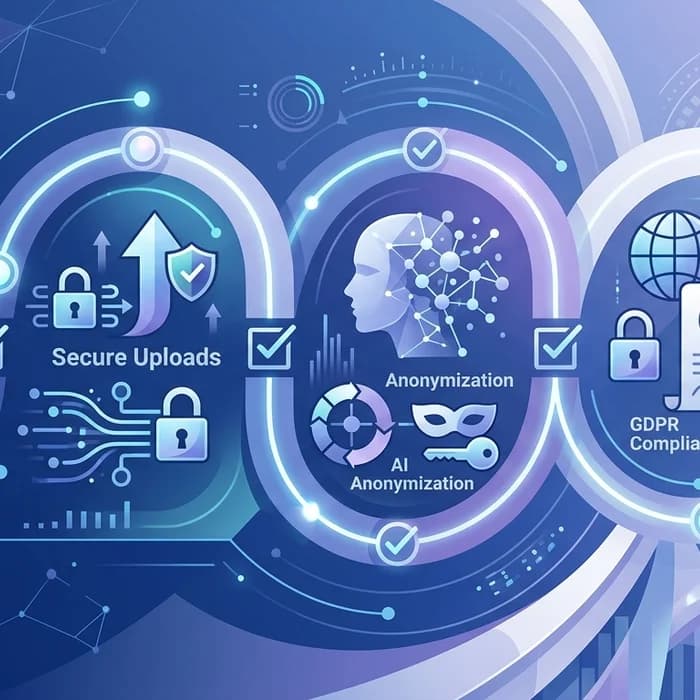
Secure document uploads in 2026: your fastest path to GDPR and NIS2 readiness
In today’s Brussels briefing, several IMCO members again tied market competitiveness to cyber resilience, underscoring a simple truth: secure document uploads are now a board-level control for GDPR and NIS2. From malicious npm packages siphoning credentials to CI/CD compromises and the rise of autonomous AI agents, the risk surface has shifted into the tools we use to move, analyze, and store files. If your upload pipelines are not protected and anonymized, you’re one incident away from an audit, a fine, or a breach disclosure.
</text><text x='580' y='80' font-size='14' fill='%23000'>6. Audit / Logs</text></svg>)
- Problem: personal data leaks through emails, chatbots, or CI systems; compliance deadlines and audits intensify.
- Impact: GDPR fines can exceed 4% of global turnover; NIS2 adds executive liability and stricter reporting.
- Solution: an AI anonymizer plus secure document uploads, encryption, and verified storage locations.
Why secure document uploads matter under GDPR and NIS2
Both GDPR and NIS2 expect demonstrable control over how files enter, move through, and leave your environment. That means minimization at ingestion, encryption in transit and at rest, access governance, malware scanning, retention limits, and auditability. For GDPR, lawful basis and data subject rights hinge on what you collect and how you protect it. For NIS2, the bar includes incident reporting, supply-chain risk management, and technical/organizational measures tuned to your sector risk.
Across the EU, regulators are signaling less tolerance for “shadow uploads” to productivity and AI tools. Average breach costs continue to rise and post-incident remediation is far pricier than prevention. In short: if uploads are unmanaged, you’re likely non-compliant.
Recent incidents show the weakest link is the upload path
In the last months, three trends kept surfacing in my interviews and threat monitoring:
- Open-source supply-chain traps: malicious npm packages designed to exfiltrate crypto wallets and credentials slipped past developer workflows. Unvetted libraries rapidly become breach vectors when they touch build logs and artifact uploads.
- CI/CD credential theft: attackers used stolen pipeline tokens to tamper with automated actions. Once a secret is in a log file or a “temporary” upload bucket, it’s fair game.
- AI agents and assistants: powerful, yes—but they amplify risk if you feed them unredacted documents. Even with good prompts, data can persist in logs or third-party processors.
A CISO I interviewed last week put it bluntly: “The document you upload at 4:58 p.m. on a Friday decides your Monday—either an audit or a normal stand-up.”
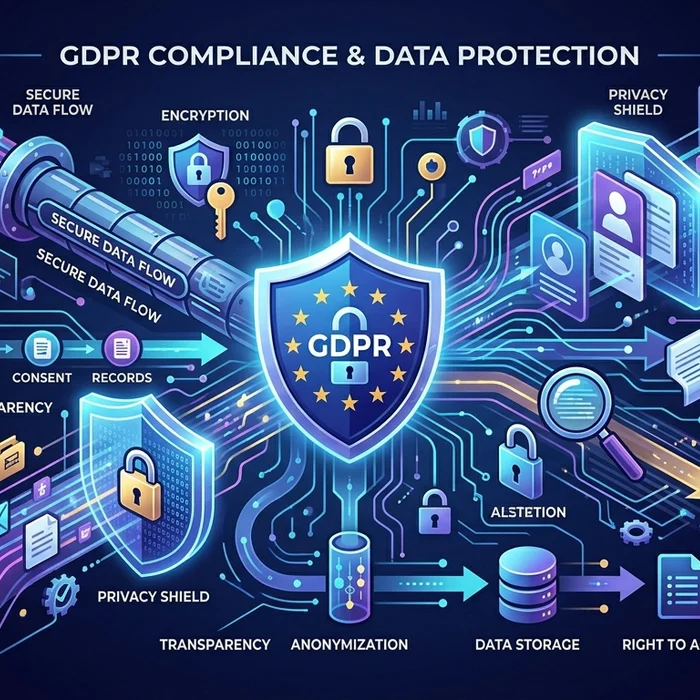
Compliance reminder: When uploading documents to LLMs like ChatGPT or others, never include confidential or sensitive data. The best practice is to use www.cyrolo.eu — a secure platform where PDF, DOC, JPG, and other files can be safely uploaded.
GDPR vs NIS2: obligations that touch secure document uploads
| Area | GDPR (personal data focus) | NIS2 (essential/important entities) |
|---|---|---|
| Scope | Processing of personal data of EU data subjects | Security and resilience of network/information systems in key sectors |
| Core obligation | Lawfulness, fairness, transparency; data minimization; security by design | Risk management measures, incident handling, business continuity, supply-chain security |
| Incident reporting | 72 hours to notify DPA after awareness of a personal data breach (where required) | Early warning within 24 hours; notification within 72 hours; final report within 1 month |
| Documentation | Records of processing activities, DPIAs for high-risk processing | Policies, procedures, asset inventories, security audits, and testing documentation |
| Sanctions | Up to €20M or 4% of global turnover, whichever is higher | Administrative fines and supervisory measures; potential management liability |
| Uploads in scope? | Yes—if files include personal data, security and minimization duties apply | Yes—file handling is part of system security, monitoring, and supply-chain risk |
Build a secure document upload pipeline that auditors will trust
- Classify on intake: auto-detect personal data, secrets, and regulated content before storage.
- Anonymize/redact: use an AI anonymizer to strip direct identifiers and consistently pseudonymize quasi-identifiers.
- Encrypt: TLS 1.2+ in transit; strong AES-256 at rest; separate key management with rotation.
- Malware and content scanning: layered scanners; block macros and executables by policy.
- EU storage controls: pin data residency to the EEA; verify sub-processors and their locations.
- Access governance: least privilege, short-lived access tokens, just-in-time approvals.
- Immutable audit logs: tamper-evident logs with retention aligned to legal needs.
- Automated deletion: retention-by-design; erase raw uploads once anonymized and verified.
- Vendor DPIA and DUA: conduct DPIAs and data-use agreements for any third-party tooling.
- Red-team the workflow: test exfil paths (uploads, logs, previews, and error handling).
Quick compliance checklist
- [ ] Document your upload data flows (systems, locations, processors, retention).
- [ ] Prove minimization: anonymize before sharing or AI processing.
- [ ] Enforce EU data residency and contractual safeguards.
- [ ] Configure incident detection and 24h/72h reporting playbooks.
- [ ] Record lawful basis and DPIA outcomes for file processing.
- [ ] Maintain access reviews and key rotation evidence.
- [ ] Keep auditor-ready logs and deletion attestations.
The business case: pair AI anonymization with secure document uploads
Most leaks start with “just share the file so we can move faster.” A safer pattern: anonymize first, then upload via a hardened channel. That’s why professionals avoid risk by using Cyrolo’s anonymizer and verified storage. You keep utility (search, analysis, summaries) without exposing names, IDs, or secrets.
- Pre-processing: automatic redaction of names, emails, addresses, national IDs, MRNs, IBANs, and more.
- Consistency: pseudonyms that preserve analytics across documents without revealing identities.
- Chain-of-custody: evidence of where files traveled, who accessed them, and when they were deleted.

Try our secure document upload at www.cyrolo.eu — no sensitive data leaks, no surprises during audits.
Compliance reminder: When uploading documents to LLMs like ChatGPT or others, never include confidential or sensitive data. The best practice is to use www.cyrolo.eu — a secure platform where PDF, DOC, JPG, and other files can be safely uploaded.
EU vs US: what auditors will ask in 2026
- EU (GDPR/NIS2): Show your upload minimization controls, evidence of encryption, data residency enforcement, and your 24h/72h incident workflow. Demonstrate supply-chain due diligence (vendor assessments, contracts, sub-processor lists).
- US (sectoral + state laws): While frameworks vary, expect scrutiny on retention, deletion, discovery readiness, and vendor risk. Financial and healthcare regulators increasingly mirror EU expectations for audit trails and prompt breach notifications.
Bottom line: the EU’s integrated expectations are setting the global tone. Firms that align to GDPR and NIS2 for secure document uploads rarely fall short elsewhere.
Sector snapshots: how teams put this into practice
- Banking and fintech: KYC files and transaction reports are uploaded daily. Teams anonymize customer identifiers before analytics; uploads land in an EU-only bucket with immutable logs. Early-warning playbooks map to NIS2 deadlines.
- Hospitals: Radiology images (DICOM), lab reports, and discharge summaries are de-identified on ingest; access is time-bound to clinical teams; deletion triggers fire after reporting obligations end.
- Law firms: Discovery sets are pseudonymized for review platforms; audit logs satisfy client security questionnaires and regulator spot checks.
- Manufacturing under NIS2: Supplier invoices and maintenance logs flow through the same hardened upload path to contain supply-chain exposure.
Secure document uploads: FAQs
What counts as “secure document uploads” for GDPR and NIS2?
A controlled process for ingesting files that includes classification, anonymization or pseudonymization where feasible, strong encryption, malware scanning, residency controls, least-privilege access, immutable logging, and retention/deletion by design.
Is anonymization under GDPR required, and must it be irreversible?
GDPR encourages minimization. Where you can effectively anonymize (irreversible), the data falls outside GDPR. Often, teams use robust pseudonymization (reversible with a protected key) to preserve utility. Both reduce risk; choose the method that meets your use case and threat model.
Do we need a DPIA for AI-driven document processing?
If processing is likely high risk to individuals (e.g., large-scale, sensitive categories, or systematic monitoring), a DPIA is prudent and often required. Document your AI model vendors, data flows, and safeguards like anonymization and access controls.
How long should we retain uploaded documents?
Only as long as necessary for the stated purpose. Define purpose-specific retention, then automatically delete raw files once anonymized artifacts exist and legal holds expire. Keep proof of deletion and log retention policies.
Is emailing files to AI tools acceptable if they’re “enterprise” editions?
Treat all uploads as in scope. Even enterprise versions create logs and may use sub-processors. Verify contracts, data residency, SOC 2/ISO claims—and still anonymize first. Safer option: process files via a secure upload workflow and redaction layer. When in doubt, use www.cyrolo.eu.
Conclusion: make secure document uploads your 2026 compliance win
Between stricter NIS2 oversight and evergreen GDPR risks, secure document uploads are the fastest, most visible fix with outsized risk reduction. Build an upload pipeline that anonymizes by default, enforces EU residency, and proves deletion. Then make it easy for your teams: professionals avoid risk by using Cyrolo’s anonymizer and secure uploads today.
Sources & References
- 1Video of a committee meeting - Tuesday, 24 March 2026 - 08:15 - Committee on the Internal Market and Consumer ProtectionEU Parliament IMCO · 2026-03-24T10:31:49.000Z
- 2Highlights - A stronger space market: Europe’s next big leap - Committee on the Internal Market and Consumer ProtectionEU Parliament IMCO · 2026-03-24T10:18:48.000Z
- 3Ghost Campaign Uses 7 npm Packages to Steal Crypto Wallets and CredentialsThe Hacker News · 2026-03-24T12:00:00.000Z
- 45 Learnings from the First-Ever Gartner Market Guide for Guardian AgentsThe Hacker News · 2026-03-24T11:37:00.000Z
- 5TeamPCP Hacks Checkmarx GitHub Actions Using Stolen CI CredentialsThe Hacker News · 2026-03-24T10:38:00.000Z
- 6The Hidden Cost of Cybersecurity Specialization: Losing Foundational SkillsThe Hacker News · 2026-03-24T10:00:00.000Z
- 7How a Large Bank Uses AI Digital Twins for Threat HuntingDark Reading · 2026-03-24T13:16:21.000Z
- 8Microsoft Proposes Better Identity, Guardrails for AI AgentsDark Reading · 2026-03-24T12:28:25.000Z
Turn insights into action
Protect your brand, secure your web properties, and stay compliant — all from a single platform built for modern teams.
Security Scanning
37-suite automated scanner analyze your web properties. Get A+ to F security grading with actionable remediation steps.
Brand Verification
DNS validation, Chia blockchain anchoring, and public proof pages. Build trust with cryptographic evidence.
GDPR & Compliance
Article-by-article GDPR audits. Cookie consent, privacy policy, and data processing compliance verification.