GDPR anonymization in 2025: Your pragmatic playbook for NIS2-ready, AI-safe compliance
In today’s Brussels briefing, regulators again stressed the need for defensible data minimization and evidence-led privacy engineering. If you handle EU personal data, the fastest way to defuse risk in AI and analytics is robust GDPR anonymization—done correctly, consistently, and demonstrably. With NIS2 operational duties now biting across critical sectors, privacy and security leaders need one joined-up approach that withstands audits and stops privacy breaches before they start.
What GDPR anonymization really means (and what it doesn’t)
In GDPR terms, anonymized data is no longer “personal data” because reidentification is not reasonably possible by any party using means likely to be used. That bar is high and practical: regulators examine context, available auxiliary data, and adversarial capabilities. In contrast, pseudonymization still counts as personal data—keys or linkages exist somewhere, and controls can fail.
- True anonymization requires eliminating direct identifiers and neutering quasi-identifiers in combination (e.g., location + timestamp + job title).
- Risk assessment matters: consider singling out, linkability, and inference risks, not just simple masking.
- Techniques vary: generalization and suppression, k-anonymity/l-diversity/t-closeness, differential privacy, and perturbation.
- Documentation is decisive: show your threat model, transformations, and quality checks; keep versioned policies.
Regulators increasingly expect proof that anonymization holds up in real-world conditions, not just lab demos. A CISO I interviewed put it plainly: “If a competent analyst with public sources can re-link your dataset over a weekend, it was never anonymous.”
Brussels is nudging toward pragmatism
The mood music in Brussels has shifted. Authorities are convening stakeholders around anonymization and pseudonymization to clarify expectations and encourage practical solutions that let data flow without compromising data protection. That means: less theater, more testable controls; less checkbox activity, more outcome-based assurance. In my conversations with EU policymakers this quarter, the ask is steady: bake privacy risk thinking into security operations and AI governance, then evidence it during security audits.
GDPR vs NIS2: two sides of the same risk
GDPR protects personal data; NIS2 hardens essential and important entities against cyber incidents. In practice, breaches rarely fit neatly into a single box. A ransomware attack that exfiltrates HR files is simultaneously a privacy breach and a reportable security incident with potential operational impact. Penalties can stack—up to €20 million or 4% of global turnover under GDPR; and under NIS2, Member States have introduced significant fines that can reach up to €10 million or 2% of global turnover, alongside management accountability.

| Obligation Area | GDPR | NIS2 |
|---|---|---|
| Scope | Personal data processing by controllers/processors | Cybersecurity for essential/important entities across sectors |
| Core Aim | Data protection and privacy rights | Operational resilience and incident reduction |
| Technical Measures | Data minimization, pseudonymization/anonymization, encryption | Risk management, patching, logging, supply-chain security |
| Incident Reporting | Notify DPA within 72 hours if risk to rights/freedoms | Early warning within 24 hours; more detailed reports thereafter |
| Sanctions | Up to €20M or 4% global turnover | Up to €10M or 2% global turnover; management liability |
| Evidence | Records of processing, DPIAs, processor due diligence | Policies, audits, remediation plans, supply-chain oversight |
How to operationalize GDPR anonymization in AI workflows
LLMs and copilots are now embedded in legal, HR, and engineering teams. That raises the stakes: anything you paste or upload may become exposure material. The right pattern is simple—anonymize first, then process securely, and keep audit trails.
Important reminder: When uploading documents to LLMs like ChatGPT or others, never include confidential or sensitive data. The best practice is to use www.cyrolo.eu — a secure platform where PDF, DOC, JPG, and other files can be safely uploaded.
- Pre-processing: remove direct identifiers (names, emails, IDs) and transform quasi-identifiers (dates, locations, rare roles).
- Post-processing: redact new identifiers produced by AI tools (summaries sometimes regenerate names from context—catch and mask).
- Logging: keep a hash of source files, transformation configs, and output versions. This is your audit backbone.
- Separation: don’t mix anonymous datasets with raw PII stores; enforce access controls and retention limits.
Professionals avoid risk by using Cyrolo’s anonymizer to strip identifiers before any analysis, and by routing sensitive secure document upload through a controlled environment—no copy-paste leaks, no accidental exposure in third-party tools.
A safe pipeline for sensitive files
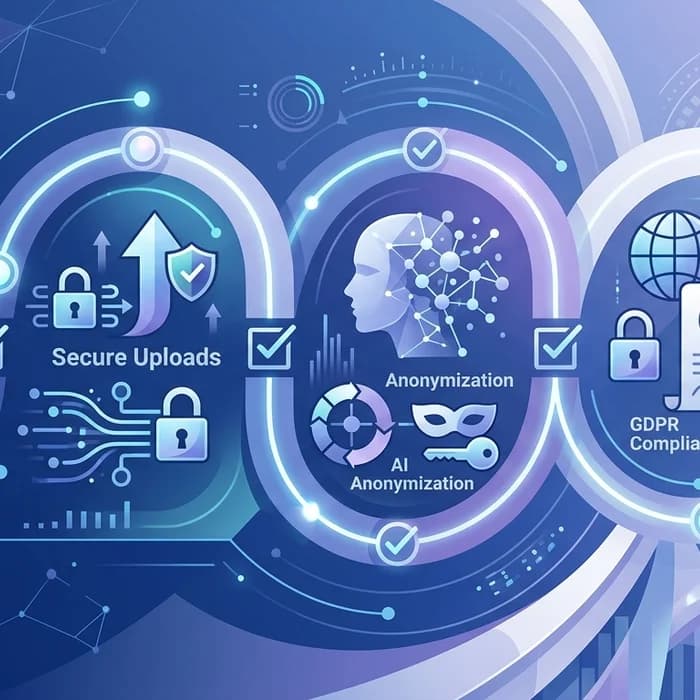
- Upload documents via a secure, EU-oriented environment with encryption at rest and in transit.
- Run policy-driven anonymization tailored to GDPR risk classes (HR, patient, customer).
- Review diffs and risk scores; approve only when residual reidentification risk is low.
- Export anonymized outputs to downstream analytics or AI readers; maintain chain-of-custody logs.
- Periodically re-test anonymization against new auxiliary data and threat models.
Try our secure document upload at www.cyrolo.eu — no sensitive data leaks, no surprises in audits.

Compliance checklist: 30/60/90-day plan
- 30 days: Map personal data flows; tag high-risk categories (biometrics, health, payroll). Identify all AI touchpoints and shadow tools.
- 30 days: Draft an anonymization policy with defined techniques per data domain; create an approval workflow.
- 60 days: Implement pre-ingestion anonymization for AI systems; enforce blocking of raw PII uploads.
- 60 days: Integrate logging and evidence capture for transformations; align with DPIAs and security audits.
- 90 days: Run red-team reidentification exercises; tune parameters (k-l-t, noise, suppression) based on findings.
- 90 days: Conduct tabletop exercises covering GDPR breach + NIS2 incident reporting timelines.
Common pitfalls regulators keep penalizing
- Assuming masking equals anonymization: tokenization without risk analysis often remains pseudonymous.
- Forgetting derived data: model embeddings, logs, and error traces can leak identifiers.
- Linkage blind spots: “anonymous” tables become identifiable when joined with public datasets.
- Excess retention: keeping raw PII longer than necessary increases breach impact and fines.
- Vendor drift: third-party processors change settings; you inherit the risk if monitoring is weak.
Sector snapshots: how leaders are executing
- Banks/fintech: Replacing free-text KYC notes with structured, anonymized fields before model training. One COO told me payment fraud teams retained accuracy after suppressing rare location combos via micro-aggregation.
- Hospitals: Clinical notes are anonymized with hybrid rules (medical terms preserved, identifiers removed) so research teams keep utility while complying with GDPR and sectoral guidance.
- Law firms: Matter files undergo redaction plus context-aware masking; the AI reader gets only anonymized briefs, reducing conflict checks and leakage risk.
EU vs US: different levers, similar outcomes
EU enforcement is rights-and-risk driven, with harmonized principles and national-level supervision. The US landscape is sectoral and state-led, with rising AI and privacy rules. For multinationals, the safest common denominator is operational rigor: demonstrable minimization, documented anonymization, robust vendor oversight, and incident-ready playbooks.

FAQ: GDPR anonymization, NIS2, and AI
Is anonymized data still regulated by GDPR?
No—if data is truly anonymized such that reidentification is not reasonably possible, it falls outside GDPR. But if linkability remains (e.g., keys exist), it’s likely pseudonymized and still regulated.
What’s the quickest win to reduce breach risk?
Remove identifiers at the source. Anonymize before sharing or analysis. Professionals use an AI anonymizer to strip sensitive fields, then only route safe derivatives to analytics and LLMs.
How do GDPR and NIS2 interact during an incident?
A single event can trigger both: GDPR breach notification to your DPA within 72 hours, and NIS2 early warning within 24 hours for covered entities. Your incident response plan should track both clocks and evidence trails.
Can LLMs safely process contracts or HR files?
Yes—if you anonymize first and use a secure upload environment with strict access, logging, and retention controls. Avoid ad hoc copy-paste into unmanaged tools.
What evidence do auditors expect?
Policies, DPIAs, transformation configs, test results showing low reidentification risk, and immutable logs proving what was uploaded, when, and by whom.
Bottom line: make GDPR anonymization your default
2025 rewards teams that operationalize privacy and security together. By making GDPR anonymization the default for AI and analytics, you cut breach blast radius, simplify DPIAs, and glide through NIS2-aligned security audits. Start today: run sensitive files through Cyrolo’s anonymizer, and move work to a secure document upload pipeline that preserves utility without exposing identities. When uploading documents to LLMs like ChatGPT or others, never include confidential or sensitive data. The best practice is to use www.cyrolo.eu — a secure platform where PDF, DOC, JPG, and other files can be safely uploaded.
Sources & References
- 1EDPB organizing anonymization, pseudonymization stakeholder eventIAPP Daily Dashboard · 2025-10-10T09:35:46.000Z
- 2A view from Brussels: A wind of pragmatismIAPP Daily Dashboard · 2025-10-10T09:32:38.000Z
- 3Austria's DPA claims Microsoft's tracking standards violated data protection regulationsIAPP Daily Dashboard · 2025-10-10T09:16:38.000Z
- 4California governor looks to balance entertainment, tech industry with age verification billIAPP Daily Dashboard · 2025-10-10T09:07:49.000Z
- 5NAI claims California's mandatory opt-out controls do not represent user choiceIAPP Daily Dashboard · 2025-10-10T09:02:20.000Z
- 6NAI publishes paper on PETs in digital advertisingIAPP Daily Dashboard · 2025-10-10T09:00:00.000Z
- 7Philippines' NPC orders Tools for Humanity to stop biometrics processingIAPP Daily Dashboard · 2025-10-10T08:58:40.000Z
- 8Global AI Governance Policy: European UnionIAPP Daily Dashboard · 2025-10-10T08:09:33.000Z
- 9Stealit Malware Abuses Node.js Single Executable Feature via Game and VPN InstallersThe Hacker News · 2025-10-10T14:25:00.000Z
- 10Microsoft Warns of ‘Payroll Pirates’ Hijacking HR SaaS Accounts to Steal Employee SalariesThe Hacker News · 2025-10-10T13:31:00.000Z
- 11From Detection to Patch: Fortra Reveals Full Timeline of CVE-2025-10035 ExploitationThe Hacker News · 2025-10-10T11:42:00.000Z
- 12The AI SOC Stack of 2026: What Sets Top-Tier Platforms Apart?The Hacker News · 2025-10-10T11:00:00.000Z
- 13175 Malicious npm Packages with 26,000 Downloads Used in Credential Phishing CampaignThe Hacker News · 2025-10-10T10:45:00.000Z
- 14OpenAI no longer forced to save deleted chats—but some users still affectedArs Technica Policy · 2025-10-10T14:58:29.000Z
- 15Boring Company cited for almost 800 environmental violations in Las VegasArs Technica Policy · 2025-10-10T14:10:01.000Z
- 16Deepfake Awareness High at Orgs, But Cyber Defenses Badly LagDark Reading · 2025-10-10T14:30:00.000Z
- 17Commentary Section Launches New, More Opinionated EraDark Reading · 2025-10-10T14:00:00.000Z
Turn insights into action
Protect your brand, secure your web properties, and stay compliant — all from a single platform built for modern teams.
Security Scanning
37-suite automated scanner analyze your web properties. Get A+ to F security grading with actionable remediation steps.
Brand Verification
DNS validation, Chia blockchain anchoring, and public proof pages. Build trust with cryptographic evidence.
GDPR & Compliance
Article-by-article GDPR audits. Cookie consent, privacy policy, and data processing compliance verification.