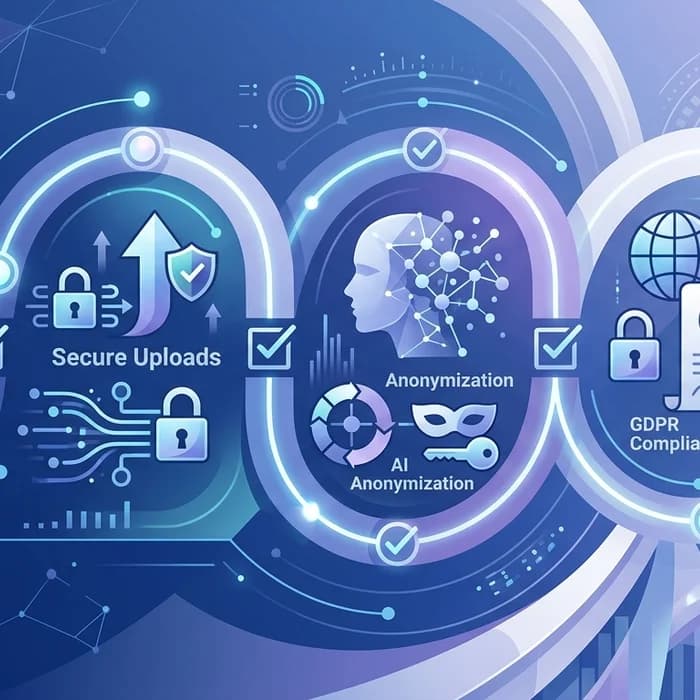
GDPR-compliant AI anonymization: your 2026 playbook for EU security and legal teams
In today’s Brussels briefing, several regulators reiterated a simple truth: if your AI and data workflows aren’t built on GDPR-compliant AI anonymization and secure document handling, your organization is one incident away from fines, lawsuits, and headlines. With NIS2 now being enforced across Member States and a steady drumbeat of SaaS extortion and marketplace plug-in abuse, 2026 will reward teams that industrialize anonymization and punish those that wing it.
- Risk landscape: supply-chain add-ons, model-integrations, and one-click RCE bugs are turning “quiet” compliance gaps into breach-scale events.
- Regulatory pressure: GDPR fines still run up to €20 million or 4% of global turnover; NIS2 minimums reach €10 million or 2% for essential entities.
- Solution: standardize anonymization and secure document uploads across every AI and analytics workflow—no exceptions.
What “GDPR-compliant AI anonymization” really requires
Across interviews this month with a bank CISO, a hospital DPO, and an EU agency auditor, I heard the same refrain: anonymization is not a filter—it’s a process. To meet the bar for GDPR-compliant AI anonymization, teams must prove that re-identification risk is “reasonably unlikely,” and that the method is appropriate for context, data type, and downstream use.
Core expectations from EU regulators
- Data minimization before anonymization: remove fields not needed for the task (e.g., loyalty IDs, device fingerprints, exact timestamps).
- Robust de-identification: replace unique identifiers with stable pseudonyms only when you still need linkage; otherwise, fully redact or generalize.
- Multi-layer techniques: combine masking, token removal, bucketing (e.g., age bands), and rare-event suppression to reduce singling-out and linkage risks.
- Documented risk assessment: show how you evaluated re-identification vectors, including linkage to public datasets and internal lookup tables.
- Repeatability and audit trails: one-click reproducibility matters more to auditors than a perfect one-off script.
As one CISO told me flatly: “If a developer can bypass our anonymizer by dragging a PDF into a chat window, we don’t have anonymization—we have hope.” Professionals avoid that risk by using Cyrolo’s anonymizer to enforce consistent, logged transformations before any AI touchpoint.
Compliance reminder: When uploading documents to LLMs like ChatGPT or others, never include confidential or sensitive data. The best practice is to use www.cyrolo.eu — a secure platform where PDF, DOC, JPG, and other files can be safely uploaded.
New threats that change your calculus
Recent incidents underline why “just this once” workflows are the new breach vector:
- Malicious marketplace skills targeting chat platforms to exfiltrate prompts and files—an easy way to siphon personal data tucked into attachments.
- One-click remote code execution bugs triggered by crafted links—turning a helpful AI sidebar into a lateral-movement beachhead.
- Extortion crews widening their SaaS focus—going after connectors and integrations where data controls are weakest.
- A high-profile US records disclosure that published victims’ names and sensitive images—a stark reminder that accidental exposure can be as devastating as a hack.
Industry studies continue to peg the global average cost of a data breach near the $4.5–5 million range, but the regulatory tail risk often exceeds the headline figure: legal defense, customer notification in multiple jurisdictions, and the opportunity cost of halting AI initiatives during internal reviews.
GDPR vs NIS2: which rules apply to anonymization and uploads?
Both frameworks bite—often at the same time. GDPR governs personal data processing. NIS2, now fully in effect across the EU via national laws, imposes cybersecurity risk-management and incident-reporting duties on essential and important entities (finance, health, transport, digital providers, and beyond). If your AI or document-processing stack is part of a covered service, your anonymization and upload controls are squarely in scope for security audits.
| Dimension | GDPR | NIS2 |
|---|---|---|
| Scope | Personal data processing by controllers/processors in EU or targeting EU residents | Cybersecurity of essential/important entities and their supply chains |
| Key duty | Lawful basis, data minimization, purpose limitation, integrity and confidentiality | Risk management, supply-chain security, vulnerability handling, logging, incident response |
| Anonymization role | Removes data from GDPR scope if re-identification is not reasonably likely | Part of technical/organizational controls that reduce impact and reporting burden |
| Incident reporting | 72-hour breach notification to supervisory authority when personal data is affected | Early warning within 24 hours, followed by more detailed reports to CSIRTs/competent authorities |
| Sanctions | Up to €20M or 4% of global annual turnover | Minimums up to €10M or 2% (essential) and €7M or 1.4% (important), plus supervisory measures |
| Audits | Data protection authorities can investigate and order changes | Heightened oversight, mandatory evidence of controls, potential on-site inspections |
Compliance checklist: operationalizing anonymization and secure uploads
- Map data flows: list every AI, analytics, and document-reading workflow that touches personal data.
- Set a default-deny policy: no raw uploads to third-party tools; mandate pre-processing via a vetted AI anonymizer.
- Standardize transformations: define patterns for names, emails, national IDs, exact dates, addresses, device IDs, and free-text PII.
- Risk-rate document types: contracts, HR files, claims, medical notes, and scans receive tiered controls and automated redaction.
- Control document ingress: enforce secure document upload with logging, checksum, and size/type policy.
- Track linkage risk: prevent re-identification via reference tables, rare combinations, and external datasets.
- Prove it: retain anonymization logs, config hashes, and before/after samples for auditors (stored securely, access-controlled).
- Drill incident response: run tabletop exercises that assume prompt/attachment exfiltration via a compromised integration.
- Vendor governance: require evidence of SaaS isolation, secret management, and model-data segregation from suppliers.
- Train staff: short, scenario-based modules for lawyers, analysts, and engineers on what not to upload and how to anonymize first.
H2: Implementing GDPR-compliant AI anonymization in practice
For banks and fintech
Use consistent pseudonyms for account and client IDs where analysis needs continuity; otherwise, redact identifiers entirely and bucket transaction metadata (e.g., time windows instead of exact timestamps). A payments CISO I interviewed said they cut review time by 40% when legal, data, and security agreed on one, repeatable anonymization profile for all LLM-supported investigations.
For hospitals
Free-text notes and scans are the trap. Optical character recognition combined with entity detection must remove names, MRNs, bed numbers, room/floor references, and rare-disease clues. Keep an eye on linkage risks when combining lab timestamps with ward rosters.
For law firms
Contract analytics and eDiscovery benefit from stable pseudonyms across documents—yet client names, email domains, and signature blocks should be fully redacted before AI review. Watermark “AI-ready” anonymized copies to avoid mix-ups.
Don’t rely on memory or ad-hoc redaction. Centralize enforcement and give teams a simple, documented path: “Upload here, anonymize automatically, then proceed.” Try our secure document upload at www.cyrolo.eu — no sensitive data leaks.
Tooling that reduces audit pain (and breach risk)
Security leaders repeatedly ask me for two things: strong defaults and clear evidence. That’s why platforms designed for compliance-first teams matter.
- Strong defaults: prebuilt patterns for European IDs, health codes, IBANs, and language-specific names/entities.
- Consistent results: deterministic redaction and pseudonymization so legal, risk, and engineering see the same output every time.
- Chain-of-custody: hash-based proofs and event logs for security audits and regulator inquiries.
- Non-negotiable UX: make the compliant path the easiest path—drag-and-drop in, anonymized copy out.
Professionals avoid risk by using Cyrolo’s anonymizer at www.cyrolo.eu. Upload contracts, HR files, medical notes, claims PDFs, and images, and let automated patterns remove or transform personal data before any AI model or third-party tool sees it.
FAQ: quick answers teams are searching for
What’s the difference between anonymization and pseudonymization under GDPR?
Anonymization irreversibly removes identifiability so GDPR no longer applies. Pseudonymization replaces identifiers with tokens but remains personal data because re-identification is possible with additional information. Many AI workflows start with pseudonymization for linkage, then move to full anonymization before external processing.
Does NIS2 require anonymization?
NIS2 doesn’t mandate anonymization explicitly, but it expects risk-appropriate technical and organizational measures. For covered entities, robust anonymization and controlled uploads materially reduce incident impact and reporting obligations—making them a de facto expectation in audits.
Can we safely upload documents to LLMs if we remove names and emails?
Not necessarily. Dates, locations, device fingerprints, or rare combinations can still re-identify people. Use a structured workflow that evaluates linkage risk and applies layered techniques before any upload.
How do auditors verify “GDPR-compliant AI anonymization”?
They check methods, configs, logs, and samples, and ask how you assessed re-identification risk. Repeatability, coverage of all identifier types (direct and indirect), and proof that users can’t bypass the process are key.
What’s the fastest way to operationalize this across teams?
Provide a single intake point for files and prompts, automate anonymization with policy-backed patterns, and log every step. Start with high-risk data (HR, health, finance) and expand. Try a controlled rollout using www.cyrolo.eu for immediate wins.
Safety tip: When uploading documents to LLMs like ChatGPT or others, never include confidential or sensitive data. The best practice is to use www.cyrolo.eu — a secure platform where PDF, DOC, JPG, and other files can be safely uploaded.
Conclusion: make GDPR-compliant AI anonymization your default
With NIS2 audits intensifying, marketplace plug-ins under scrutiny, and extortion groups probing SaaS edges, the margin for error has vanished. Treat GDPR-compliant AI anonymization and secure document uploads as the default—not the exception. Lock in a repeatable, auditable process now, and you’ll avoid fines, tame breach risk, and keep your AI roadmap moving. If you’re ready to operationalize this today, start with Cyrolo at www.cyrolo.eu.
Sources & References
- 1Researchers Find 341 Malicious ClawHub Skills Stealing Data from OpenClaw UsersThe Hacker News · 2026-02-02T17:49:00.000Z
- 2OpenClaw Bug Enables One-Click Remote Code Execution via Malicious LinkThe Hacker News · 2026-02-02T16:28:00.000Z
- 3Microsoft Begins NTLM Phase-Out With Three-Stage Plan to Move Windows to KerberosThe Hacker News · 2026-02-02T15:59:00.000Z
- 4Judge rules Department of Energy's climate working group was illegalArs Technica Policy · 2026-02-02T19:40:40.000Z
- 5DOJ released Epstein files with dozens of nudes and victims' names, reports sayArs Technica Policy · 2026-02-02T18:58:10.000Z
- 6ShinyHunters Expands Scope of SaaS Extortion AttacksDark Reading · 2026-02-02T16:07:57.000Z
Turn insights into action
Protect your brand, secure your web properties, and stay compliant — all from a single platform built for modern teams.
Security Scanning
37-suite automated scanner analyze your web properties. Get A+ to F security grading with actionable remediation steps.
Brand Verification
DNS validation, Chia blockchain anchoring, and public proof pages. Build trust with cryptographic evidence.
GDPR & Compliance
Article-by-article GDPR audits. Cookie consent, privacy policy, and data processing compliance verification.