GDPR-compliant document anonymization: how EU teams avoid fines, leaks, and AI risk in 2026
Brussels is tightening the screws on data protection and cybersecurity. In the last week alone, committees in Parliament debated stronger consumer enforcement while civil society pressed for deeper scrutiny of omnibus digital rules. For compliance, legal, and security leaders, the through-line is simple: GDPR-compliant document anonymization and secure handling of files are now baseline controls for avoiding fines, audit findings, and AI-related data loss. In this briefing, I unpack what regulators expect in 2026, how NIS2 and GDPR intersect, and how to operationalize anonymization and secure document uploads without slowing the business.
Why GDPR-compliant document anonymization is non-negotiable in 2026
In today's Brussels briefing, several officials reiterated what many of you already feel in audits: anonymization and minimization are no longer “nice-to-haves” — they are the line between routine oversight and corrective measures. Under GDPR Articles 5(1)(c), 25, and 32, you’re expected to minimize personal data, embed privacy by design, and secure processing. Enforcement continues to climb: authorities have not hesitated to levy multi-million-euro penalties for excessive collection, poor redaction, or uncontrolled data sharing. A DPA investigations head I spoke to in January summarized it bluntly: “If you can anonymize before you share, we’ll expect you to.”
- Fines risk: up to €20 million or 4% of global turnover for severe GDPR infringements.
- Audit attention: ad hoc redactions in Word or PDF editors are routinely flagged as unreliable.
- AI pressure: legal teams increasingly rely on LLMs for summaries and clause checks; without strong anonymization and a secure upload path, that’s a breach vector.
On the cyber front, recent incidents — including ransomware leveraging unpatched email servers — show how quickly data exfiltration becomes a data protection incident. A CISO I interviewed last week warned that “documents parked in shared drives are now one phishing campaign away from disclosure,” urging teams to strip personal data at source and maintain immutable logs of anonymization before any external sharing.
Where GDPR-compliant document anonymization fits under NIS2
NIS2 isn’t a privacy law, but it is a force multiplier. For essential and important entities, NIS2 requires documented risk management, supplier controls, and incident reporting that, in practice, make sloppy document handling untenable. If a ransomware incident exposes unredacted personal data, you face a double hit: breach reporting under NIS2 and personal data breach obligations under GDPR.
| Obligation area | GDPR | NIS2 |
|---|---|---|
| Who is in scope | Any controller/processor handling personal data in the EU | Essential/important entities in sectors like finance, health, energy, digital infrastructure, managed services |
| Core duty | Lawful basis, data minimization, integrity/confidentiality, privacy by design (incl. anonymization/pseudonymization) | Cyber risk management, incident prevention/detection, business continuity, supplier security |
| Incident reporting | Notify DPA “without undue delay,” within 72 hours of becoming aware (if risk to rights/freedoms) | Early warning within 24h; incident notification within 72h; final report within 1 month (Member State transpositions confirm) |
| Penalties | Up to €20m or 4% global turnover | Effective, proportionate, dissuasive — including significant administrative fines and orders |
| Proof of compliance | Records of processing, DPIAs, technical logs (e.g., anonymization), policies, vendor DPAs | Risk assessments, policies, incident logs, supplier oversight, technical measures evidence |
Bottom line: when your DPO and CISO sit together, they should align on a simple principle — remove or mask personal data early, prove it with logs, and ensure any sharing or AI use happens via a controlled, auditable pipeline.
Practical workflow: anonymize, then share securely — without slowing the business
- Classify the document: Does it contain personal data (names, IDs, emails, health or financial info)? If yes, anonymize before transfer or external processing.
- Automate detection: Use an AI anonymizer that reliably finds direct identifiers and high-risk quasi-identifiers across PDF, DOCX, images (OCR), and email exports.
- Apply context-aware anonymization: Replace with irreversible tokens, generalize dates/locations when needed, and keep a secure mapping only if your legal basis requires reversibility.
- Log everything: Capture who anonymized what, when, and which entities were removed — logs satisfy GDPR accountability and NIS2 audit evidence.
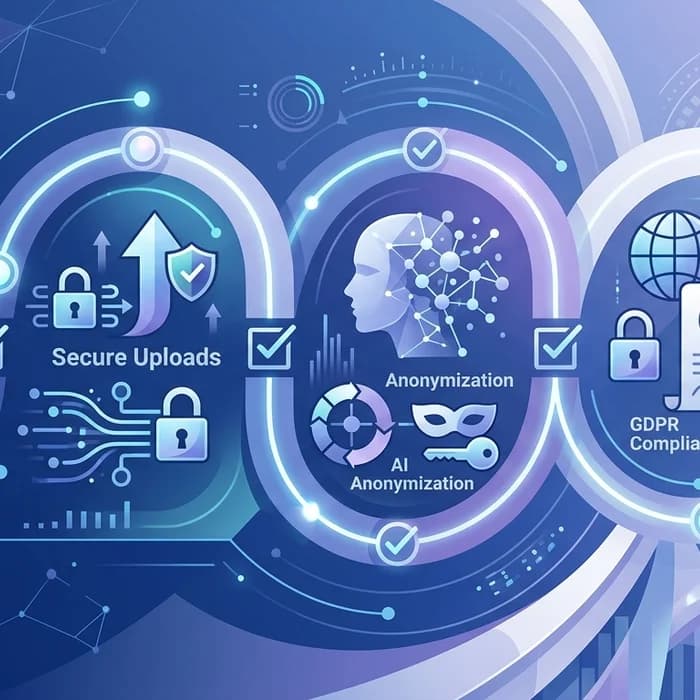
- Use a hardened upload path: For reviews, vendor sharing, or AI-assisted summaries, send only the anonymized version via a secure upload channel with access controls.
- Verify before release: Run a second pass to detect residual identifiers, especially in scanned attachments, comments, and embedded metadata.
Professionals avoid risk by using Cyrolo’s anonymizer to strip personal data at speed, then continue their workflows with a secure document upload — no sensitive data leaks.
Compliance checklist you can show an auditor
- Data flow documented: where documents originate, where they go, and who accesses them.
- Policy mandates anonymization before any external sharing or AI processing.
- Tooling: AI anonymizer with multi-format support (PDF, DOCX, JPG/PNG via OCR), confidence scoring, and audit logs.
- Access controls and encryption for storage and transfer; no personal data in unsecured channels.
- Vendor due diligence for any processors; DPAs signed; SCCs where required.
- Incident plan: playbooks for containment, notification (GDPR 72h; NIS2 24/72/1-month), and evidence preservation.
- Training: staff know when and how to anonymize; red flag list (IDs, health data, customer emails, IBANs).
- Periodic audit: sample documents reviewed to validate anonymization efficacy and residual risk.
Real-world scenarios regulators are scrutinizing
1) Banks and fintechs
Use case: exchanging transaction dispute files with external counsel. Risk: account numbers, PII in free-text notes, and metadata in scanned evidence. Solution: tokenize direct identifiers, generalize dates (month/year), and remove free-text notes with sensitive narratives before counsel review. Keep a secure mapping only if strictly necessary for litigation strategy. Share via a locked-down channel. We see this exact scenario in supervisory sampling.
2) Hospitals and research centers
Use case: preparing case summaries for cross-border research. Risk: HIPAA-equivalent health data, rare disease identifiers, small-population re-identification. Solution: irreversibly anonymize, including quasi-identifiers (age bands, 3-digit postcodes). Store mappings separately with restricted access and a DPIA rationale if reversibility is required for follow-up care. Audit logs are essential.
3) Law firms and discovery
Use case: e-discovery sets sent to a review vendor or an AI tool for privilege tagging. Risk: client names, emails, and attachment metadata leaking to third-party systems. Solution: an AI anonymizer to strip PII from headers, bodies, and images; verify with a second-pass scan; and ship only sanitized sets via a secure document upload workflow. One breach here snowballs into client loss and regulatory probes.
Across these sectors, I’m seeing a consistent pattern in 2026: regulators triangulate data protection with cyber resilience. A single ransomware foothold on an unpatched mail server can expose troves of unredacted documents; if your files are anonymized by default, the downstream regulatory impact is materially reduced.
Audits in 2026: what regulators actually ask for
- Show me a live run: demonstrate anonymization on a typical case file, including OCR of scanned IDs.
- Prove irreversibility: explain your method (e.g., hashing + salt, irreversible tokenization, generalization) and why re-identification risk is negligible.
- Produce logs: who ran the process, what was removed, time-stamped evidence, and exception handling.
- Vendor path: if you shared with a processor or an AI tool, show the secure upload route, access controls, and contractual safeguards.
- Incident linkage: if you had a cyber incident, map which documents were involved and whether they were anonymized pre-breach.
Note the policy context: consumer enforcement cooperation is set to intensify, and rights groups are pressing the Council and Commission for deeper scrutiny of omnibus digital packages. Translation: cross-border sweeps and coordinated actions will increasingly examine data handling and dark patterns — and sloppy redactions are low-hanging fruit.
How Cyrolo helps you operationalize the controls
- Find and remove personal data fast: names, emails, phone numbers, IBANs, IDs, and more — across text and images.
- Multi-format coverage: PDFs, Word docs, scans (OCR), plus common image formats.
- Audit-ready logs: time-stamped evidence you can hand to DPOs, CISOs, and regulators.
- Secure share path: anonymize first, then move sanitized files through a controlled, encrypted upload channel.
Try our secure document upload at www.cyrolo.eu — no sensitive data leaks. Legal, compliance, and security teams across the EU are already cutting review times while hardening against privacy breaches and security audits.
Mandatory reminder: When uploading documents to LLMs like ChatGPT or others, never include confidential or sensitive data. The best practice is to use www.cyrolo.eu — a secure platform where PDF, DOC, JPG, and other files can be safely uploaded.
FAQ: your most searched questions, answered
What counts as GDPR-compliant document anonymization?
Anonymization means individuals are no longer identifiable, directly or indirectly, considering “reasonably likely” means. That typically requires removing direct identifiers (names, emails, IDs) and mitigating quasi-identifiers (dates, locations, unique roles) via generalization or suppression. Document it, test it, and keep audit logs to show your method and results.
Is pseudonymization enough for GDPR and NIS2?
Not by itself. Pseudonymization reduces risk but is still personal data under GDPR because re-identification remains possible. Use pseudonymization where you need linkability (e.g., case management), but share externally or process with AI tools only after irreversible anonymization whenever feasible.
Can I upload contracts to ChatGPT safely?
Only if they are properly anonymized first and you have a contractual and technical control set that meets your organization’s risk appetite. Many teams choose to remove personal data entirely, then use a controlled upload path. The safest route is to use a platform purpose-built for privacy and security. Try Cyrolo’s anonymizer and secure document upload to enforce those guardrails.
How do I prove anonymization to auditors?
Provide: policy, DPIA (if applicable), your anonymization methodology, before/after samples, residual risk assessment, and immutable logs (who ran the process, what was removed, timestamps). Align terms between your DPO and CISO to cover both GDPR and NIS2 expectations.
What file types can be anonymized and uploaded securely?
Compliance teams typically need PDFs, DOC/DOCX, and images (JPG/PNG) with robust OCR. Ensure your tooling handles embedded content, comments, headers/footers, and metadata. You can process and share safely using www.cyrolo.eu.
Conclusion: adopt GDPR-compliant document anonymization to cut risk and accelerate work
2026 will reward teams that minimize data early and prove it later. By operationalizing GDPR-compliant document anonymization and pairing it with a secure upload path, you cut exposure to privacy breaches, simplify NIS2 and GDPR audits, and keep AI use within safe bounds. Don’t leave this to chance — use Cyrolo’s anonymizer and secure document upload to protect your organization and move faster.
Sources & References
- 1Press release - Asylum: new rules for safe third countries and EU safe countries of origin listEU Parliament LIBE · 2026-02-10T12:33:08.000Z
- 2
- 3Hearings - Revision of the Consumer Protection Cooperation Regulation - 25-02-2026 - Committee on the Internal Market and Consumer ProtectionEU Parliament IMCO · 2026-02-10T13:12:01.000Z
- 4EDRi urged the Council to demand a proper scrutiny of the Digital Omnibus proposalEDRi · 2026-02-10T11:08:22.000Z
- 5From Ransomware to Residency: Inside the Rise of the Digital ParasiteThe Hacker News · 2026-02-10T13:59:00.000Z
- 6ZAST.AI Raises $6M Pre-A to Scale "Zero False Positive" AI-Powered Code SecurityThe Hacker News · 2026-02-10T11:40:00.000Z
- 7Warlock Ransomware Breaches SmarterTools Through Unpatched SmarterMail ServerThe Hacker News · 2026-02-10T10:24:00.000Z
- 8After Republican complaints, judicial body pulls climate adviceArs Technica Policy · 2026-02-10T12:15:19.000Z
- 9TransUnion's Real Networks Deal Focuses on Robocall BlockingDark Reading · 2026-02-09T23:05:21.000Z
- 10What Organizations Need to Change When Managing PrintersDark Reading · 2026-02-09T17:22:18.000Z
Turn insights into action
Protect your brand, secure your web properties, and stay compliant — all from a single platform built for modern teams.
Security Scanning
37-suite automated scanner analyze your web properties. Get A+ to F security grading with actionable remediation steps.
Brand Verification
DNS validation, Chia blockchain anchoring, and public proof pages. Build trust with cryptographic evidence.
GDPR & Compliance
Article-by-article GDPR audits. Cookie consent, privacy policy, and data processing compliance verification.