GDPR-compliant Data Anonymization in 2025: Your Fastest Path to NIS2 Readiness and Safe LLM Workflows
In today’s Brussels briefing, regulators again stressed accountability and effective redress in automated decision systems—another signal that GDPR-compliant data anonymization is no longer optional for teams using AI and handling sensitive files. Between accelerating NIS2 enforcement, rising breach costs, and headlines about record privacy settlements in the U.S., CISOs and counsels tell me the same thing: get anonymization and secure document uploads right, or expect audits, fines, and reputational damage.
Why now: the regulatory and threat landscape has changed
- EU regulators are aligning enforcement around data minimization, explainability, and effective judicial remedies in high-risk screening systems. That includes programs like ETIAS and any enterprise deploying AI.
- A U.S. state attorney general recently announced a $1.38B privacy settlement with a tech giant—proof that liability for privacy breaches is global, not just an EU concern.
- Threat activity is up: attackers have pivoted to abusing remote monitoring tools in logistics, stealing cloud credentials, and targeting mobile devices—driving complex, multi-vector privacy breaches.
- Average data breach costs hovered around the multi-million mark in recent studies, with legal fees and regulatory sanctions pushing totals higher for regulated sectors like finance and healthcare.
Against this backdrop, anonymization is the simplest lever to reduce the blast radius of any incident while keeping AI-assisted workflows productive and compliant.
What counts as GDPR-compliant data anonymization?
Under the GDPR, anonymized data is information that cannot be linked to an identifiable person by any party reasonably likely to access it—irreversibly and in practice, not just in theory. If re-identification is possible with reasonable effort, it’s not anonymized; it’s pseudonymized and still personal data.
Techniques used to achieve GDPR-grade anonymization usually include:
- Masking and redaction: Removing names, national IDs, emails, phone numbers, IBANs, medical record numbers.
- Generalization: Replacing precise values with broader ranges (e.g., “45–54” instead of “48”).
- Tokenization: Substituting identifiers with non-sensitive tokens, keeping a separate, highly protected mapping.
- K-anonymity and differential privacy controls: Ensuring that each record is indistinguishable among at least k individuals, and limiting what can be learned about any one person.
For practical compliance and speed, many teams apply layered controls—a combination of strong redaction for direct identifiers plus generalization and tokenization for quasi-identifiers. For AI-assisted analysis, this protects people while preserving analytical value.
GDPR vs NIS2: obligations you must align
Legal teams often ask me: “Is anonymization a GDPR-only issue?” No. Under NIS2, essential and important entities must prove robust security of network and information systems. If your AI or document processing allows personal data to leak through a compromised SaaS or cloud workflow, you’re facing both data protection and critical service risk.
| Obligation | GDPR | NIS2 | What this means for you |
|---|---|---|---|
| Scope | Personal data and data subjects’ rights | Security and resilience of essential/important entities | Privacy and operational security overlap in AI/document workflows |
| Legal focus | Lawfulness, minimization, storage limitation | Risk management, supply chain security, governance | Apply minimization by default; secure every vendor path |
| Incident reporting | Notify DPA within 72 hours if risk to rights/freedoms | Early warning in 24 hours; notification within 72 hours; final report in 1 month | Prepare joint privacy + cyber incident playbooks |
| Maximum fines | Up to €20M or 4% of global turnover | Up to €10M or 2% of global turnover (at least, depending on entity) | Dual exposure: privacy and operational penalties |
| Proof | DPIAs, records of processing, privacy by design | Policies, risk assessments, measures, supply chain oversight | Evidence-based controls: logs, audit trails, contracts, testing |
AI and LLM use: where anonymization prevents mistakes
In financial services and law firms, I routinely see teams paste contracts into chatbots for quick summaries. Hospitals feed discharge notes to assistants to standardize coding. Universities upload email archives to triage incidents. These are high-value workflows—and high risk if identifiers slip through.
- Law and consulting: Anonymize counterparties, deal codes, bank details, and staff identifiers before drafting or summarization.
- Healthcare: Remove patient identifiers and generalize dates/locations before AI-assisted coding or research queries.
- Higher education: Redact student numbers and contact details in mass communications and incident reviews.
- Logistics and manufacturing: Strip driver IDs and GPS coordinates from maintenance logs before LLM analysis.
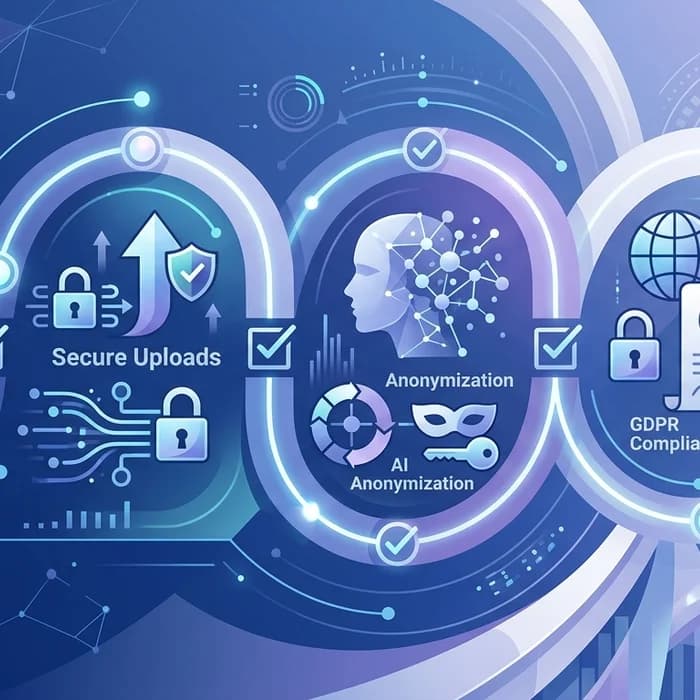
Professionals avoid risk by using Cyrolo’s AI anonymizer—it removes direct identifiers from PDFs, Word files, and images, and supports secure processing for teams under EU regulations.
Critical reminder for LLM uploads
When uploading documents to LLMs like ChatGPT or others, never include confidential or sensitive data. The best practice is to use www.cyrolo.eu — a secure platform where PDF, DOC, JPG, and other files can be safely uploaded.
Compliance checklist: fast path to GDPR-compliant data anonymization

- Inventory documents used with AI or external vendors (contracts, HR files, medical notes, incident reports).
- Classify identifiers: direct (name, email, phone, IBAN) vs quasi-identifiers (dates, locations, job titles, rare conditions).
- Define your anonymization policy: redaction for direct IDs; generalization/tokenization for quasi-IDs; k-anonymity thresholds where relevant.
- Set automation: default anonymization for defined folders and file types before any AI or SaaS processing.
- Run a DPIA for high-risk uses; document re-identification risk, safeguards, and residual risk acceptance.
- Harden supply chain: vet AI vendors; restrict retention, training, and cross-border transfers in contracts.
- Enable audit trails: log who uploaded, what was anonymized, and proof of removal before sharing.
- Train staff: “no raw PII into LLMs” is a rule, not a suggestion.
- Test resilience: simulate data exfiltration; verify anonymized datasets don’t re-identify individuals.
- Prepare reports: align incident notifications for GDPR (72h) and NIS2 (24h/72h/1 month) with templated evidence.
Need a turnkey path? Try our secure document upload—no sensitive data leaks, auditable, and ready for privacy and security teams.
Real-world pitfalls I keep seeing
- LLM pastes without review: Teams paste entire contracts into chatbots; DPIA says “pseudonymized,” but no proof. Regulators will ask for evidence that identifiers were removed—or fines follow.
- OCR blind spots: Scanned PDFs and images hide IDs in headers, footers, and stamps. Anonymizers must read multi-language text, tables, and handwriting.
- Email headers and metadata leaks: Names, internal IDs, and location data live in metadata. Strip them before sharing files out of your environment.
- Supply-chain gaps: Remote monitoring tools and third-party dashboards create untracked copies. Secure uploads with pre-anonymization reduces exposure if a vendor is compromised.
How Cyrolo helps privacy and security teams
- Automated anonymization: Redacts direct identifiers across PDFs, DOCX, images (JPG/PNG), and spreadsheets.
- Policy-based controls: Apply consistent masking and generalization by document type and department.
- Secure document handling: Controlled, logged document uploads for privacy-by-default processing.
- Audit-ready trails: Evidence for GDPR and NIS2 security audits and investigations.
A CISO I interviewed warned that “the next audit will ask how we prevented LLM misuse, not just how we detected it.” Cyrolo gives you that prevention story: minimize before you share.
EU vs US: enforcement signals to watch
- Europe: DPAs and EU bodies are signalling stricter expectations on automated decisions, data minimization, and effective redress. Expect tougher questions on anonymization quality and re-identification risk.
- United States: Mega-settlements show privacy liability is a board-level risk even outside GDPR. Multinationals should harmonize global anonymization standards rather than running two playbooks.

Bottom line: data minimization is becoming the universal language of compliance.
FAQ: GDPR-compliant data anonymization
1) What exactly is GDPR-compliant data anonymization?
It renders data irreversibly non-identifiable in practice. If identity can be restored with reasonable effort, the data remains personal and GDPR applies. True anonymization often combines redaction, generalization, and tokenization with tests against re-identification.
2) Is pseudonymized data still personal data?
Yes. Pseudonymization lowers risk but remains within GDPR. You still need a legal basis, DPIA where required, and full data subject rights handling. Only anonymized data falls outside GDPR’s scope.
3) How does NIS2 interact with anonymization?
NIS2 focuses on security and resilience. If your processes expose personal data via compromised vendors or AI tools, that’s a security and compliance failure. Pre-anonymizing documents reduces incident impact and supports faster, cleaner reporting.
4) Can I safely upload contracts or medical notes to AI assistants?
Only after robust anonymization and under strict vendor terms. Better yet, process files through a secure anonymization layer first. Use www.cyrolo.eu to anonymize and upload documents safely.
5) What’s the quickest way to start?
Identify your top three document types used with AI, define masking rules for direct identifiers, and automate pre-processing. Pilot a workflow using Cyrolo’s AI anonymizer and secure document uploads, then expand across departments.
Conclusion: Make GDPR-compliant data anonymization your default
With privacy fines rising, NIS2 deadlines biting, and adversaries exploiting supply chains, the safest way to keep AI productive is to minimize data at the source. Operationalize GDPR-compliant data anonymization, prove it with logs, and embed it in every AI and document workflow. Start today: professionals avoid risk by using Cyrolo’s anonymizer and secure uploads at www.cyrolo.eu.
Sources & References
- 1ETIAS Fundamental Rights Guidance Board: ensuring access to an effective judicial remedyEDPS · 2025-11-03T13:22:52.000Z
- 2Texas attorney general announces $1.38B settlement with Google in 2022 privacy lawsuitIAPP Daily Dashboard · 2025-11-03T09:24:38.000Z
- 3The war against 2 AI-specific cyber weaknesses continuesIAPP Daily Dashboard · 2025-11-03T09:00:23.000Z
- 4University of Pennsylvania hit with apparent data breach after mass emailsIAPP Daily Dashboard · 2025-11-03T08:55:24.000Z
- 5China call for global AI regulator to set standardsIAPP Daily Dashboard · 2025-11-03T08:50:33.000Z
- 6Cybercriminals Exploit Remote Monitoring Tools to Infiltrate Logistics and Freight NetworksThe Hacker News · 2025-11-03T13:18:00.000Z
- 7⚡ Weekly Recap: Lazarus Hits Web3, Intel/AMD TEEs Cracked, Dark Web Leak Tool & MoreThe Hacker News · 2025-11-03T12:56:00.000Z
- 8The Evolution of SOC Operations: How Continuous Exposure Management Transforms Security OperationsThe Hacker News · 2025-11-03T11:56:00.000Z
- 9Researchers Uncover BankBot-YNRK and DeliveryRAT Android Trojans Stealing Financial DataThe Hacker News · 2025-11-03T11:14:00.000Z
- 10New HttpTroy Backdoor Poses as VPN Invoice in Targeted Cyberattack on South KoreaThe Hacker News · 2025-11-03T10:42:00.000Z
- 11Internet Archive’s legal fights are over, but its founder mourns what was lostArs Technica Policy · 2025-11-03T12:00:51.000Z
- 12Let's Get Physical: A New Convergence for Electrical Grid SecurityDark Reading · 2025-11-03T14:00:00.000Z
- 13AI Developed Code: 5 Critical Security Checkpoints for Human OversightDark Reading · 2025-11-03T12:00:00.000Z
- 14‘TruffleNet’ Attack Wields Stolen Credentials Against AWSDark Reading · 2025-11-03T10:59:03.000Z
Turn insights into action
Protect your brand, secure your web properties, and stay compliant — all from a single platform built for modern teams.
Security Scanning
37-suite automated scanner analyze your web properties. Get A+ to F security grading with actionable remediation steps.
Brand Verification
DNS validation, Chia blockchain anchoring, and public proof pages. Build trust with cryptographic evidence.
GDPR & Compliance
Article-by-article GDPR audits. Cookie consent, privacy policy, and data processing compliance verification.