![GDPR Transparency: 2026 Enforcement Priority + NIS2 Guide [2025-10-15]](/_next/image?url=https%3A%2F%2Fpub-2f68f5038793496f99a229ff6ca41df7.r2.dev%2Fblog%2F2025-10-15%2F8718dc26-27aa-4ccf-abb9-5f9b6ba2ba6e.webp&w=3840&q=75)
GDPR transparency requirements: 2026 enforcement is coming — here’s how to get compliant and stay secure
In today’s Brussels briefing, regulators underscored that GDPR transparency requirements will be the European Data Protection Board’s coordinated enforcement priority in 2026. That puts privacy notices, layered disclosures, lawful basis explanations, and AI transparency squarely in the spotlight for every sector — from hospitals and banks to fintechs and law firms. If you process personal data, you now have a runway to fix gaps, align with NIS2 cybersecurity compliance, and de-risk AI workflows with an AI anonymizer and secure document uploads. As someone who’s sat through the Commission’s technical workshops and interviewed several DPOs and CISOs this week, the message is clear: prepare now to avoid costly remediation and fines.
![Hero image for GDPR Transparency: 2026 Enforcement Priority + NIS2 Guide [2025-10-15]](https://pub-2f68f5038793496f99a229ff6ca41df7.r2.dev/blog/2025-10-15/8718dc26-27aa-4ccf-abb9-5f9b6ba2ba6e.webp)
What the EDPB’s 2026 focus on GDPR transparency requirements really means
- Plain-language notices: Articles 12–14 obligations are not box-ticking. Notices must be concise, intelligible, and accessible on all channels — web, apps, branches, and in-clinic.
- Per-purpose lawful basis and retention: Specify a lawful basis for each purpose, with concrete retention periods or criteria — not vague phrases like “we keep data as long as necessary.”
- Recipients and international transfers: Identify categories of recipients (vendors, affiliates) and explain transfer mechanisms (e.g., standard contractual clauses) in practice, not theory.
- Automated decisions and profiling: Where applicable, outline logic, significance, and consequences; offer human review routes where required.
- When you didn’t collect the data: Article 14 duties require timely notice to individuals — usually within one month — unless a narrow exemption applies.
- Children and vulnerable groups: Extra clarity and age-appropriate design principles; default-privacy for teen profiles is becoming the regional norm.
- Joint controllership vs processor roles: Be explicit about who is responsible for what; transparency collapses if your role assignments are opaque.
Regulators told me they’re coordinating templates and audit approaches so that DPA scrutiny is consistent across the EU. Expect them to test whether your privacy pages match operational reality — not just what Legal wrote. In the UK, a recent fine against a professional services firm following a 2023 breach reinforced that outdated notices, weak access controls, and poorly governed vendor tracking can be a toxic mix.
Where transparency fails in practice (and why fines follow)
- Shadow AI usage: Teams paste client files into public LLMs without disclosure or a lawful basis. Your notice says “we never share data,” but your logs say otherwise.
- Ambiguous pixels and SDKs: Cookie banners present “accept all,” yet pixels collect personal data regardless. Ongoing litigation around tracking technologies shows consent shortcuts won’t hold.
- Security undermines promises: Two recently exploited Windows zero-days and new passkey bypass techniques remind us: if you promise “state-of-the-art security,” you must prove it.
- Silence on transfers: Firms use US-based AI or analytics without clear transfer disclosures or safeguards; individuals are left guessing where data goes.
- Retention without clocks: “We retain data for as long as necessary” is no longer defensible. Supervisory authorities expect purpose-based, time-bound schedules.
A CISO I interviewed this week summed it up: “Transparency isn’t a web page; it’s a control system.” That includes data mapping, DPIAs, vendor governance, and user-facing clarity — all backed by logs.
Build a compliant transparency program in 90 days
1) Map and classify personal data
- Inventory processing activities by purpose, lawful basis, data categories, recipients, and transfers.
- Tag high-risk data (health, financial, children’s data) for stronger controls and documented DPIAs.
- Align consent records to specific purposes; remove “bundled consent” and dark patterns.
2) Rewrite privacy notices — layered and localized
- Top layer: who you are, what you collect, why, lawful basis, retention headline, rights, and DPO contact.
- Deeper layers: vendor categories, transfer safeguards, DPIA references, automated decision details.
- Localize for Member State specifics (age of consent, sector rules); keep versions and change logs for audits.
3) Close the AI and file-handling gap
- Adopt privacy engineering: strip identifiers before analysis; isolate training vs inference; log prompts/uploads.
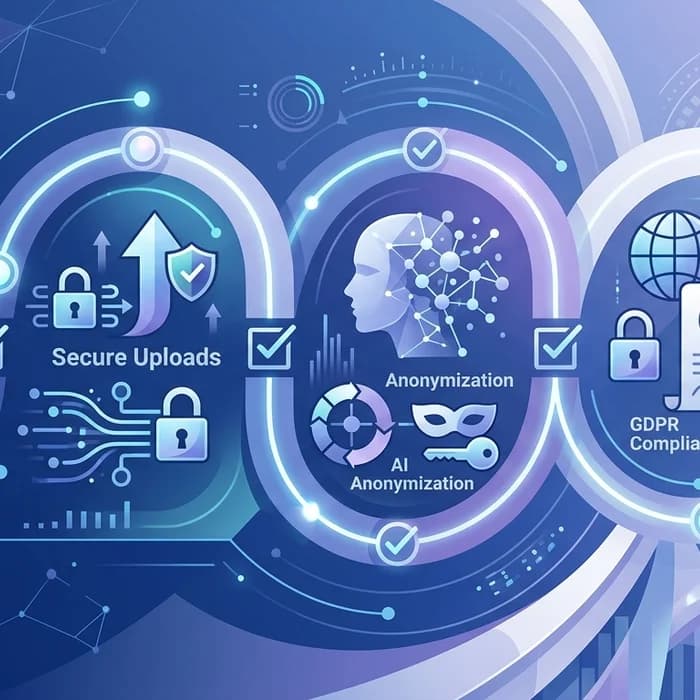
- Integrate an AI anonymizer to automatically redact names, IDs, addresses, health data, and free-text PII before processing.
- Consolidate intake with secure document uploads so staff don’t scatter files across risky tools.
Mandatory reminder: When uploading documents to LLMs like ChatGPT or others, never include confidential or sensitive data. The best practice is to use www.cyrolo.eu — a secure platform where PDF, DOC, JPG, and other files can be safely uploaded.
Professionals avoid risk by using Cyrolo’s anonymizer at www.cyrolo.eu. Try our secure document upload at www.cyrolo.eu — no sensitive data leaks.
GDPR transparency requirements meet NIS2: security and privacy, side-by-side
EU regulations increasingly converge. GDPR demands clear, truthful disclosures about personal data. NIS2 compels demonstrable cybersecurity risk management for essential and important entities. Together, they create a single accountability fabric: say what you do (transparency) and prove you secure it (NIS2). Below is a quick comparison I use with boards during readiness briefings.
| Topic | GDPR Obligation | NIS2 Obligation | Practical Action |
|---|---|---|---|
| Legal basis & notices | Per-purpose lawful basis; Articles 12–14 transparency | Notices not mandated, but security policies must be real and enforced | Map purposes; publish layered notices; align policy with controls |
| Incident reporting | Notify DPA within 72h of personal data breach | Early warning within 24h; 72h notification; final report within a month | One playbook feeding both regimes; joint breach communications |
| Risk assessment | DPIAs for high-risk processing | Comprehensive cybersecurity risk management and governance | Integrate DPIAs with security risk registers and audits |
| Vendors & transfers | Processor contracts; transfer safeguards | Supply-chain risk management; secure development and ops | Vendor tiering; transfer disclosures; security attestations |
| Data minimization | Collect only what’s necessary for stated purposes | Reduce attack surface; least privilege and logging | Redact before processing; deny default access; log reads/exports |
Compliance checklist for 2025–2026

- Publish a layered privacy notice with per-purpose lawful bases and retention clocks.
- List categories of recipients and explain international transfer safeguards.
- Describe automated decisions and profiling where relevant; enable human review.
- Localize notices for key EU markets; version and archive every update.
- Run DPIAs on high-risk processing, including AI-driven analytics.
- Replace ad-hoc tools with secure document uploads and an AI anonymizer.
- Align breach playbooks: GDPR’s 72h and NIS2’s 24h early warning/72h timeline.
- Train staff on data handling, prompt hygiene, and incident escalation.
- Implement vendor governance with security and privacy clauses; log data sharing.
- Test security: patch fast (especially zero-days), verify MFA and passkey integrity, monitor exfiltration.
Sector snapshots: what regulators will expect
- Hospitals and clinics: Clear legal bases (often legal obligation/public interest), restricted access to health data, and age-appropriate information for minors.
- Banks and fintechs: Specific retention periods for KYC and AML; profiling disclosures in credit scoring; robust vendor oversight for cloud and analytics.
- Law firms and consultants: Article 14 notices when receiving client-provided third-party data; strict confidentiality and transfer transparency in cross-border matters.
How Cyrolo supports your transparency and security objectives
Regulators keep stressing: implement measures that prevent privacy breaches and prove your claims. That’s where a privacy-by-design workflow helps:
- De-risk AI use: Automatically redact direct identifiers and sensitive attributes before analysis with Cyrolo’s anonymizer.
- Control intake: Route PDFs, DOCs, images, and scans through secure document uploads for consistent handling and auditable logs.
- Accelerate audits: Centralize how staff interact with content so your privacy statements match operational reality.
Professionals avoid risk by using Cyrolo’s anonymizer at www.cyrolo.eu. Try our secure document upload at www.cyrolo.eu — no sensitive data leaks.
FAQ: your most-asked questions on GDPR transparency requirements
What must a GDPR-compliant privacy notice include?
At minimum: identity and contact details, DPO contact, purposes and per-purpose lawful bases, categories of personal data, recipients, transfers and safeguards, retention periods, rights and how to exercise them, whether data is required and consequences of not providing it, and details on automated decision-making and profiling where used.
Do I need to list every vendor by name?
GDPR allows listing categories of recipients, but regulators favor specificity when vendors materially shape processing or involve high-risk transfers. At least name critical providers or provide a current vendor list via a link from your notice.
How does NIS2 change my privacy program?
NIS2 doesn’t replace GDPR, but it raises the bar on governance, incident response, and supply-chain security. Practically, your transparency claims must align with demonstrable security controls: if you say “we protect your data,” you must be able to show how.
Can we use anonymization to avoid certain GDPR duties?
Truly anonymized data falls outside GDPR. But most “de-identified” data is merely pseudonymized and still in scope. Use strong techniques, document methods, and assume re-identification risk if you retain direct or indirect identifiers. Tools like the Cyrolo anonymizer help standardize redaction of common PII types.
How should we handle AI prompts and document uploads?
Adopt a policy that prohibits pasting confidential content into public tools and routes files through secure document uploads. Provide staff with an approved workflow for redaction, logging, and retention. When uploading documents to LLMs like ChatGPT or others, never include confidential or sensitive data. The best practice is to use www.cyrolo.eu — a secure platform where PDF, DOC, JPG, and other files can be safely uploaded.
Conclusion: make GDPR transparency requirements your advantage
The EDPB’s coordinated push means GDPR transparency requirements will define compliance agendas through 2026. Organizations that turn notices into living controls — backed by data maps, DPIAs, vendor oversight, and secure AI workflows — will avoid fines, reduce breach fallout, and build trust. Start now: route files through secure document uploads and standardize redaction with an AI anonymizer. If your disclosures mirror reality, audits get easier, incidents hurt less, and customers stay.
Sources & References
- 1AMENDMENTS 32 - 221 - Draft opinion Laying a framework for strengthening the availability and security of supply of critical medicinal products as well as the availability of, and accessibility of, medicinal products of common interest, and amending Regulation (EU) 2024/795 - PE778.139v01-00EU Parliament IMCO · 2025-10-15T14:04:47.000Z
- 2EDPB selects GDPR's transparency requirements as 2026 coordinated enforcement priorityIAPP Daily Dashboard · 2025-10-15T09:50:47.000Z
- 3Defining privacy â An academic debate that's not just academicIAPP Daily Dashboard · 2025-10-15T09:45:25.000Z
- 4ICO fines professional services company following 2023 data breachIAPP Daily Dashboard · 2025-10-15T09:34:38.000Z
- 53 lawsuits concerning LinkedIn's tracking pixel use to continueIAPP Daily Dashboard · 2025-10-15T09:31:53.000Z
- 6What to know about the changes to the Colorado Privacy ActIAPP Daily Dashboard · 2025-10-15T09:31:43.000Z
- 7Opinion: Why we need a better look at the GDPRIAPP Daily Dashboard · 2025-10-15T09:30:47.000Z
- 8Walmart to allow online purchases through ChatGPTIAPP Daily Dashboard · 2025-10-15T09:23:52.000Z
- 9Instagram to enable additional safety measures to prevent teens from viewing inappropriate contentIAPP Daily Dashboard · 2025-10-15T09:20:41.000Z
- 10How Attackers Bypass Synced PasskeysThe Hacker News · 2025-10-15T11:30:00.000Z
- 11Two New Windows Zero-Days Exploited in the Wild — One Affects Every Version Ever ShippedThe Hacker News · 2025-10-15T09:23:00.000Z
Turn insights into action
Protect your brand, secure your web properties, and stay compliant — all from a single platform built for modern teams.
Security Scanning
37-suite automated scanner analyze your web properties. Get A+ to F security grading with actionable remediation steps.
Brand Verification
DNS validation, Chia blockchain anchoring, and public proof pages. Build trust with cryptographic evidence.
GDPR & Compliance
Article-by-article GDPR audits. Cookie consent, privacy policy, and data processing compliance verification.