NIS2 compliance checklist: a 2026 field guide for GDPR-aligned, secure document workflows
In today’s Brussels briefing, regulators reiterated that NIS2 isn’t just a cyber law—it’s an operational mandate touching procurement, vendors, logs, and how you move files across the enterprise. This NIS2 compliance checklist is written for CISOs, DPOs, legal counsel, and operations teams that need a realistic plan to meet EU regulations without slowing delivery. It connects the dots between GDPR, cybersecurity compliance, data protection by design, and the daily tasks of handling personal data, secure document uploads, and redaction workflows—areas where an AI anonymizer can remove risk at scale.
Why NIS2 matters right now
Two developments today underscore why the EU’s security bar is rising:
- A critical n8n flaw (CVE-2026-25049) allows system command execution via malicious workflows—an example of how low-code automation can become a breach pathway when guardrails are weak.
- Reports of malicious NGINX configurations enabling large-scale web traffic hijacking show that a single misdirected reverse proxy can cascade into privacy breaches, credential theft, and service disruption.
At a closed-door session I attended this morning, one national regulator stressed that NIS2 expects “assurance, not promises”: asset inventories, configuration baselines, security audits, and incident reporting must be demonstrable. A CISO I interviewed put it bluntly: “If your automation and file workflows aren’t locked down, you’re one phishing email away from an unauthorized data transfer—and an investigation.”
GDPR vs NIS2: obligations compared
GDPR and NIS2 are complementary: GDPR protects personal data; NIS2 fortifies essential and important entities against operational and security risks. Both expect proportionality, documented controls, and accountability.
| Topic | GDPR | NIS2 |
|---|---|---|
| Primary focus | Protection of personal data and data subjects’ rights | Cybersecurity risk management and resilience of essential/important entities |
| Scope | Controllers and processors of personal data | Operators in designated sectors; supply chain vigilance expected |
| Key measures | Data minimization, DPIAs, privacy by design, records of processing | Risk management policies, incident handling, business continuity, supply chain security, vulnerability disclosure |
| Incident reporting | Notify authority “without undue delay” (often interpreted within 72 hours) when a breach risks rights and freedoms | Early warning quickly (e.g., within 24 hours), followed by more detailed notifications per national transposition |
| Governance | DPO (where required), training, processor oversight, data protection impact assessments | Executive accountability, board oversight, security audits, logging and monitoring, secure configurations |
| Penalties | Up to €20M or 4% of global turnover (higher of the two) | Up to ~€10M or 2% of global turnover (Member State specific) plus supervisory measures |
| Cross-border effects | Applies to non-EU firms offering goods/services to EU data subjects | Applies to entities providing services in the EU; supply chain obligations reach non-EU providers |
Your NIS2 compliance checklist
Use this practitioner-focused NIS2 compliance checklist to drive a 90-day sprint and then mature iteratively:
- Map scope and criticality
- Confirm your entity classification (essential vs important) and in-scope services.
- Inventory assets tied to critical services, including third-party SaaS and automation platforms.
- Harden configurations and automation
- Baseline NGINX, identity providers, VPN, and CI/CD with secure-by-default templates.
- Lock down low-code tools (e.g., workflow engines) with signed nodes, least privilege, and execution guards to prevent malicious workflows like the CVE-2026-25049 class.
- Secure document and data flows
- Classify documents (personal data, sensitive categories, trade secrets) and apply data minimization.
- Introduce pre-processing: automated anonymization and policy checks before files leave controlled environments.
- Monitoring, logging, and detection
- Centralize logs for reverse proxies, workflow engines, and data exfiltration points; retain per policy.
- Alert on anomalous proxy rules, sudden workflow edits, or mass file conversions/uploads.
- Incident handling and reporting
- Define severity thresholds and a 24-hour early-warning playbook aligned to national NIS2 transposition.
- Drill tabletop scenarios: proxy hijack, automation abuse, privilege escalation, and third-party compromise.
- Supply chain and contracts
- Embed security requirements for processors; require timely vulnerability disclosure and patch SLAs.
- Document data flows and cross-border transfer safeguards for GDPR alignment.
- Governance and accountability
- Assign board-level oversight; track KPIs (MTTD, MTTR, patch latency, encryption coverage).
- Run periodic security audits and readiness reviews; maintain evidence repositories.
- Training and safe AI use
- Train staff on secure document uploads and redaction; prevent shadow AI usage.
- Standardize trusted tools for file handling and LLM interactions with guardrails.
Real-world pressure points and how to fix them
From banks to hospitals and law firms, the same tripwires recur:
- Misconfigured reverse proxies: A single stray NGINX rewrite can silently redirect users and siphon credentials. Solution: enforce configuration linting, peer review, and immutable deployments.
- Automation sprawl: Workflow tools with marketplace nodes or custom scripts expand your attack surface. Solution: signed components, execution sandboxes, and role-based approvals for workflow changes.
- Unstructured data risk: Personal data in PDFs, scans, and chat exports bypass DLP. Solution: pre-ingest scanning, automatic redaction, and controlled document uploads with encryption in transit and at rest.
- LLM oversharing: Teams paste case files or medical notes into chatbots. Solution: anonymize before sharing; use vetted platforms with strict data handling terms and access controls.
Safeguard unstructured data: anonymize first, then share
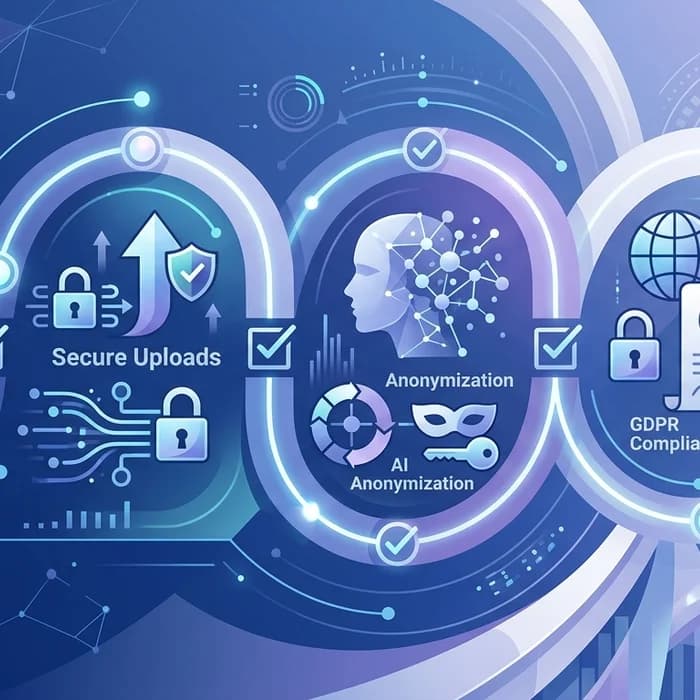
Professionals avoid risk by using Cyrolo’s anonymizer to strip names, IDs, and sensitive fields from PDFs, DOCs, images (JPG/PNG), and emails before they enter workflows, AI tools, or vendor tickets. Try our secure document upload at www.cyrolo.eu — no sensitive data leaks.
Operational benefits
- GDPR by design: automated masking supports data minimization and privacy by default.
- NIS2 evidence: logs, policy enforcement, and role-based access bolster audit readiness.
- Supply chain peace of mind: share only what is necessary with processors and LLMs.
Mandatory safe-AI reminder
👉 When uploading documents to LLMs like ChatGPT or others, never include confidential or sensitive data. The best practice is to use www.cyrolo.eu — a secure platform where PDF, DOC, JPG, and other files can be safely uploaded.
Timeline and practical milestones
- Week 1–2: Confirm classification; map critical services and data flows; freeze risky config changes pending review.
- Week 3–4: Implement proxy and workflow engine hardening; deploy anonymization pre-processing; set logging retention.
- Week 5–6: Run incident-response exercises; finalize early-warning procedures; align GDPR and NIS2 roles (CISO, DPO).
- Week 7–8: Supplier attestation requests; update contracts with reporting and patch SLAs; start continuous control monitoring.
- Week 9–12: Internal audit; address findings; publish executive dashboard; prepare evidence pack for regulators.
EU vs US outlook: what regulators expect
EU regulators favor demonstrable governance: documented risk assessments, reproducible configs, and measured improvements. In the US, sectoral rules (e.g., healthcare, financial services) and evolving SEC disclosure norms emphasize timely material incident reporting. If you operate transatlantically, harmonize on the strictest standard: 24-hour internal escalation, 72-hour external notification where applicable, encryption by default, and proactive vulnerability remediation.
Executive briefing: what to ask this week
- Do we have a current asset and workflow inventory, including low-code tools and reverse proxies?
- Are our NGINX and automation configs peer-reviewed, signed, and redeployed immutably?
- What percentage of outbound files pass through automated anonymization before leaving the domain?
- Can we produce evidence of incident handling within 24 hours and follow-on reports?
- Which vendors can execute system commands or transform documents on our behalf, and under what controls?
FAQ: quick answers teams are searching for
What is covered by NIS2 and how do I know if I’m in scope?
NIS2 applies to essential and important entities across sectors like energy, transport, health, financial services, digital infrastructure, and ICT providers. Confirm with national transposition lists and sector designations; when in doubt, treat critical services as in scope and apply proportional controls.
How does NIS2 interact with GDPR?
NIS2 focuses on cybersecurity resilience; GDPR governs personal data. If an incident compromises personal data, both frameworks may trigger duties: containment, notification, and evidence. Harmonize playbooks to avoid duplicate work and missed deadlines.
What are the most common NIS2 gaps found in audits?
Configuration drift (especially proxies), incomplete logging, weak supplier oversight, and ungoverned unstructured data flows. These gaps frequently surface during security audits and can lead to findings or supervisory measures.
How fast must I report incidents under NIS2?
Expect an early warning rapidly (often within 24 hours) and subsequent detailed reports per your Member State’s rules. Prepare templated briefs, decision trees, and contact lists to avoid delays.
How can I reduce risk when staff use AI tools?
Anonymize documents before sharing and route files through a vetted platform with encryption, access controls, and logging. Standardize on a secure option to prevent shadow AI and privacy breaches.
Get started: reduce risk today
The past week’s disclosures—from malicious NGINX hijacks to n8n workflow exploitation—reveal a simple truth: attackers target configurations and unstructured data. Your best defense combines hardened infrastructure, disciplined process, and data minimization at the file level.
- Run this NIS2 compliance checklist with your IT, legal, and security teams.
- Automate redaction and routing to neutralize personal data before it moves.
- Adopt a secure, centralized platform for document uploads and anonymization—and demonstrate privacy-by-design to regulators.
Try Cyrolo at www.cyrolo.eu to operationalize GDPR, NIS2, and data protection policies without slowing the business.
Conclusion: make the NIS2 compliance checklist your daily routine
NIS2 is not a one-off project; it’s the habit of resilient operations. Use this NIS2 compliance checklist to embed governance, close proxy and automation gaps, and protect personal data across document workflows. With proactive hardening, measurable controls, and secure file handling at www.cyrolo.eu, you’ll meet EU regulations, satisfy auditors, and keep services running—even as threats evolve.
Sources & References
- 1Critical n8n Flaw CVE-2026-25049 Enables System Command Execution via Malicious WorkflowsThe Hacker News · 2026-02-05T06:16:00.000Z
- 2Malicious NGINX Configurations Enable Large-Scale Web Traffic Hijacking CampaignThe Hacker News · 2026-02-05T04:56:00.000Z
- 3Protests Don't Impede Iranian Spying on Expats, Syrians, IsraelisDark Reading · 2026-02-05T07:00:00.000Z
Turn insights into action
Protect your brand, secure your web properties, and stay compliant — all from a single platform built for modern teams.
Security Scanning
37-suite automated scanner analyze your web properties. Get A+ to F security grading with actionable remediation steps.
Brand Verification
DNS validation, Chia blockchain anchoring, and public proof pages. Build trust with cryptographic evidence.
GDPR & Compliance
Article-by-article GDPR audits. Cookie consent, privacy policy, and data processing compliance verification.