NIS2 compliance in 2025: What EU security leaders must do now to stay audit‑ready
In today’s Brussels briefing, one theme dominated: NIS2 compliance is no longer a theoretical exercise. With national transpositions now live across the EU, regulators are sharpening oversight while attackers escalate automation. In parallel, committees from LIBE to IMCO are pushing tougher scrutiny of data handling and political advertising, signaling that security, privacy, and platform accountability are converging policy priorities. For CISOs, DPOs, and GRC leads, the message is blunt: close the operational gaps—especially around incident reporting, vendor risk, and document hygiene—or face enforcement, reputational damage, and costly remediation.

Over the past week alone, I’ve heard three consistent warnings from regulators and enterprise defenders: don’t underestimate supply chain exposure; expect audits to test “evidence, not promises”; and treat data minimization and anonymization as real controls, not paperwork. Below, I unpack what changed, where GDPR and NIS2 overlap (and don’t), and how to operationalize safer document workflows and AI usage without leaking personal or confidential data.
This week’s developments that raise the bar for NIS2 compliance
- LIBE’s look at the EDPS budget discharge underlined a familiar audit refrain: show measurable improvements in oversight, not just policies. Expect the same posture in sectoral NIS2 inspections—controls must be demonstrably effective.
- IMCO’s scrutiny session on political ads stressed transparency and platform due diligence, a reminder that content and infrastructure risks increasingly intersect. If your service facilitates targeting, you’ll be asked how your security and privacy controls interlock.
- Operators reported a sharp uptick in botnet activity targeting PHP servers and IoT fleets. For “essential” and “important” entities under NIS2, this elevates obligations around vulnerability management, network segmentation, and incident detection.
- Cloud pitfalls surfaced around configuration changes in virtual machines, reinforcing that misconfigurations—not just CVEs—drive “material” incidents subject to 24/72-hour reporting clocks under NIS2.
- AI-specific threats matured: cloaking techniques now trick crawlers and LLMs into citing falsified content as authoritative. If your staff uploads internal documents to AI tools, you risk both data exfiltration and integrity attacks on training or retrieval pipelines.
A CISO I interviewed this morning summed it up: “NIS2 raises the ‘prove it’ bar. We’re rewriting runbooks so incident responders can hit the 24-hour early-warning window, and we’re locking down document flows into AI tools with anonymization by default.”
GDPR vs NIS2: What overlaps—and what doesn’t—matters for audit strategy
The fastest way to derail an audit is to assume GDPR coverage equals NIS2 readiness. It doesn’t. Here’s how they compare:
| Topic | GDPR | NIS2 |
|---|---|---|
| Primary scope | Personal data protection and privacy | Cybersecurity risk management and incident reporting for essential/important entities |
| Who is covered | Any controller/processor handling EU residents’ personal data | Operators in sectors like energy, health, finance, transport, digital infrastructure, ICT providers, and key supply chain services |
| Core obligations | Lawful basis, minimization, DPIAs, data subject rights, breach notification | Risk management measures, supply‑chain security, vulnerability handling, incident response, business continuity, auditing |
| Incident reporting | Notify SA “without undue delay,” typically within 72 hours if personal data risk exists | Early warning within 24 hours to CSIRT/competent authority; more detail by 72 hours; final report post‑containment |
| Fines (maximums) | Up to €20M or 4% of global annual turnover | At least €10M or 2% (essential); at least €7M or 1.4% (important), depending on Member State implementation |
| Leadership liability | Accountability principle; limited direct management sanctions | Explicit management oversight and possible temporary bans on managerial functions for severe failures |
| Third‑party risk | Processor due diligence and contracts | Mandatory supply‑chain security, including service provider selection and monitoring |
| Evidence expectations | Policies, records of processing, DPIAs, breach logs | Technical/operational proof: asset inventories, patch SLAs, detection coverage, tabletop results, incident runbooks, audit trails |
How NIS2 compliance affects your reporting clock, teams, and vendors
- Who must report: Entities designated “essential” or “important” under national NIS2 laws. Many ICT providers and managed services now fall squarely in scope.
- Timeline: 24-hour early warning after becoming aware of a significant incident; an initial report by 72 hours; a final report after mitigation. Late or incomplete filings are an avoidable enforcement risk.
- Vendors: If a supplier outage materially impacts your service, you own the reporting obligation. Contract clauses must require timely notifications and log-sharing to meet your clocks.
- Security audits: Expect on‑site or remote reviews focused on operational evidence. Auditors will ask for proof you can detect, triage, and communicate incidents quickly across legal, PR, and regulators.
Top pitfalls that derail NIS2 compliance in 2025
- Shadow tech and legacy stacks: Untended PHP apps and unmanaged IoT nodes are fueling botnet compromises. If you can’t inventory them, you can’t protect them.
- Cloud drift: Small configuration changes in IaaS can quietly disable logging or hardening. This is how “minor” issues become reportable incidents.
- Supply‑chain opacity: Without standardized SBOMs, pen test scopes, and attestation schedules, you won’t meet the “due diligence” bar for critical vendors.
- Document sprawl: Sensitive logs, screenshots, and tickets get pasted into chat tools or uploaded to LLMs. That’s a privacy breach waiting to happen—and it sabotages incident containment.
- Training gap for power users: Analysts and developers often bypass controls to “move fast.” NIS2 expects role‑specific training with measurable outcomes.
Reduce risk fast: anonymization and secure document uploads as frontline controls
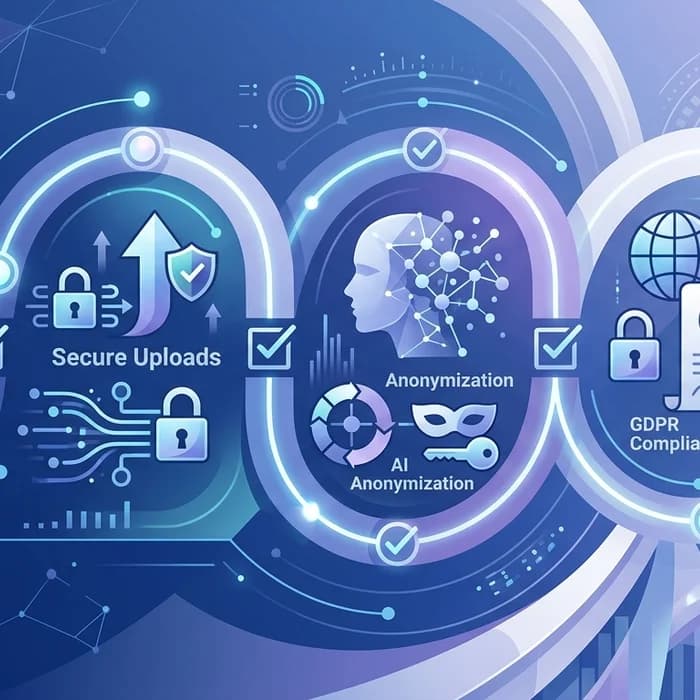
One practical way to reduce breach scope and satisfy both GDPR and NIS2 expectations is to minimize what leaves your perimeter—especially when teams share evidence during incidents, audits, or model evaluations. An AI anonymizer that redacts personal data (names, emails, phone numbers, national IDs) and sensitive business markers before sharing with external processors, auditors, or AI tools materially lowers exposure.
Equally critical is a secure document upload workflow. By funneling PDFs, DOCs, images (JPG/PNG), and logs through a hardened, access‑controlled pipeline with automatic redaction and audit trails, you can prove to regulators that document handling is intentional, not ad hoc.
Compliance note: When uploading documents to LLMs like ChatGPT or others, never include confidential or sensitive data. The best practice is to use www.cyrolo.eu — a secure platform where PDF, DOC, JPG, and other files can be safely uploaded.
Professionals avoid risk by using Cyrolo’s anonymizer at www.cyrolo.eu. Try our secure document upload at www.cyrolo.eu — no sensitive data leaks.
Sector playbooks: what “good” looks like
- Bank/Fintech: Route customer tickets and core banking screenshots through anonymization before vendor escalation. Enforce cloud change control so VM and network policies can’t drift without approval. Maintain a 24/72-hour incident comms matrix pre‑approved by legal.
- Hospital: Redact patient identifiers in radiology images and discharge summaries prior to external AI triage. Segment clinical IoT, apply allow‑list egress, and rehearse incident isolation without cutting off critical care devices.
- Law firm: Use secure upload and redaction for case bundles, expert reports, and discovery datasets. Configure DLP to flag national IDs, health data, and financial account numbers in matter workspaces.
- SaaS/Cloud provider: Provide customers with log-sharing SLAs, SBOMs, and pen test summaries. Offer signed attestations on encryption, key management, and incident response coverage mapped to NIS2 controls.
NIS2 compliance checklist for Q4 2025 audits
- Asset inventory covers on‑prem, cloud, PHP/legacy apps, and IoT; owners and patch SLAs assigned.
- Documented risk management measures mapped to NIS2: network segmentation, MFA, EDR coverage, vulnerability handling, backup and recovery tests.
- Incident reporting runbook with 24/72‑hour timelines, regulator contacts, spokesperson duties, and legal sign‑offs; tabletop exercises completed and recorded.
- Vendor risk program with classification, contractual notification timelines, security addenda, and evidence requests (SOC 2/ISO, pen tests, SBOM).
- Logging and monitoring: centralization, retention policy, alert thresholds, and off‑site backups; proof of detection on recent campaigns (botnets, cloud misconfig).
- Data protection controls: DPIAs for high‑risk processing, data minimization by design, and automated anonymization for outbound documents.
- Access governance: least privilege, privileged access reviews, JIT/JEA for admins; regularly tested break‑glass procedures.
- Training and drills: specialized curricula for SOC, DevOps, and clinical/operations teams; completion metrics and phish simulation results.
- Board oversight: periodic briefings, risk acceptance records, and funding decisions documented to demonstrate management accountability.
Real‑world threats to model your controls against
- Automated botnets against PHP and IoT: Prioritize external surface reduction, WAF rules tuned to PHP frameworks, and device egress controls.
- Cloud misconfig exploitation: Continuous posture management, pre‑approved templates, and detective guardrails that block risky changes.
- AI crawler cloaking and misinformation: Protect your content integrity, and prevent staff from ingesting sensitive docs into external LLMs without redaction and policy controls.
- Insider and power‑user risk: Tie training to actual privileges and tools; audit command histories and API tokens, not just console logins.
FAQs: NIS2 compliance, GDPR, and AI tools
What’s the fastest way to tell if my company is in scope for NIS2?
Check your sector and size thresholds under your Member State’s NIS2 transposition. Many providers in health, finance, energy, transport, digital infrastructure, and managed services are “essential” or “important.” If you underpin critical services—even as a vendor—you’re likely in.

Does GDPR compliance mean I’m already NIS2 compliant?
No. GDPR focuses on personal data and privacy rights; NIS2 targets operational cybersecurity resilience and incident reporting, including supply‑chain obligations. You need both programs, with shared controls where possible.
What are the NIS2 reporting deadlines?
Notify within 24 hours of becoming aware of a significant incident (early warning), provide an initial report by 72 hours, and submit a final report after containment and recovery. Treat these as hard clocks.
Can we upload logs and tickets to LLMs during an incident?
Only if they’re redacted and routed through a secure process. Compliance note: When uploading documents to LLMs like ChatGPT or others, never include confidential or sensitive data. The best practice is to use www.cyrolo.eu — a secure platform where PDF, DOC, JPG, and other files can be safely uploaded.
What are the maximum NIS2 fines?
Member States must allow at least up to €10 million or 2% of global annual turnover for essential entities, and at least up to €7 million or 1.4% for important entities, alongside potential management restrictions in severe cases.
Executive summary: what your teams should do this week
- Map your NIS2 scope and confirm your incident reporting chain meets 24/72‑hour windows.
- Close quick wins: legacy PHP exposures, IoT segmentation, cloud config guardrails.
- Standardize vendor evidence requests and notification timelines.
- Lock down document flows with automated redaction and secure upload pipelines. Professionals avoid risk by using Cyrolo’s anonymizer at www.cyrolo.eu.
Conclusion: treat NIS2 compliance as a living program, not a project
The EU’s enforcement mood is changing: more scrutiny, tighter clocks, higher expectations for evidence. Pair your NIS2 compliance roadmap with practical controls that remove human‑error pathways—especially around document handling and AI usage. If you can prove rapid detection, disciplined reporting, resilient operations, and responsible data minimization, audits get easier and incidents get smaller. To operationalize that today, run sensitive evidence through anonymization and route all external shares via a secure document upload at www.cyrolo.eu. Your teams move faster, regulators get the right signals, and you reduce the blast radius when—not if—an incident hits.
Sources & References
- 1AMENDMENTS 1 - 4 - Draft opinion Discharge 2024: General budget of the EU - European Data Protection Supervisor - PE779.436v01-00EU Parliament LIBE · 2025-10-29T15:43:17.000Z
- 2Highlights - Meta, Political Ads and the EU: IMCO holds Scrutiny Session - Committee on the Internal Market and Consumer ProtectionEU Parliament IMCO · 2025-10-29T15:03:19.000Z
- 3US senators introduce bipartisan bill governing minors' chatbot accessIAPP Daily Dashboard · 2025-10-29T09:59:34.000Z
- 4US state laws requiring AI labels help people opt outIAPP Daily Dashboard · 2025-10-29T09:51:25.000Z
- 5Experts Reports Sharp Increase in Automated Botnet Attacks Targeting PHP Servers and IoT DevicesThe Hacker News · 2025-10-29T15:38:00.000Z
- 6New AI-Targeted Cloaking Attack Tricks AI Crawlers Into Citing Fake Info as Verified FactsThe Hacker News · 2025-10-29T14:57:00.000Z
- 7FCC Republicans force prisoners and families to pay more for phone callsArs Technica Policy · 2025-10-29T19:18:37.000Z
- 8ICE’s forced face scans to verify citizens is unconstitutional, lawmakers sayArs Technica Policy · 2025-10-29T18:29:45.000Z
- 9Microsoft Security Change for Azure VMs Creates PitfallsDark Reading · 2025-10-29T17:49:44.000Z
- 10Botnets Step Up Cloud Attacks Via Flaws, MisconfigurationsDark Reading · 2025-10-29T16:04:10.000Z
- 11From Power Users to Protective Stewards: How to Tune Security Training for Specialized EmployeesDark Reading · 2025-10-29T12:03:17.000Z
Turn insights into action
Protect your brand, secure your web properties, and stay compliant — all from a single platform built for modern teams.
Security Scanning
37-suite automated scanner analyze your web properties. Get A+ to F security grading with actionable remediation steps.
Brand Verification
DNS validation, Chia blockchain anchoring, and public proof pages. Build trust with cryptographic evidence.
GDPR & Compliance
Article-by-article GDPR audits. Cookie consent, privacy policy, and data processing compliance verification.