NIS2 compliance in 2025: A Brussels briefing on what changes, what overlaps with GDPR and the Data Act, and how to stay audit‑ready
In today’s Brussels briefing, regulators and industry quietly agree on one thing: NIS2 compliance in 2025 will be measured not just by policies, but by provable operational controls — especially around data handling, supply chain security, and incident reporting. As the EU Data Act begins to bite and GDPR enforcement remains relentless, CISOs and legal teams face a tighter, more interconnected rulebook. The fastest wins I see on the ground: standardized risk controls, airtight vendor oversight, and safer content workflows — including automated anonymization before any AI use.
Why NIS2 compliance is now a board issue in 2025
- Penalties escalate: For essential entities, fines can reach the higher of €10 million or 2% of worldwide turnover; for important entities, up to €7 million or 1.4%.
- Deadlines passed, scrutiny rises: Member States transposed NIS2 by October 2024. National supervisors are now moving from guidance to inspections through 2025.
- Incident reporting clocks are strict: Early warnings within 24 hours and final reports typically within one month are becoming the norm across national implementations.
- Cost of failure is real: Industry studies put the average cost of a data breach near $4.9M, with higher impacts for critical sectors and supply chain incidents.
In interviews this autumn, a CISO at a European fintech told me: “We passed a policy audit last year. This year they asked for proof — logs, red-team artifacts, supplier attestations, and how we sanitize documents used to train internal AI.” That’s the new baseline.
The EU rulebook puzzle: NIS2, GDPR, and the Data Act
NIS2 drives operational security and reporting across essential and important entities. GDPR governs personal data, purpose limitation, and data subject rights. The Data Act — entering application in stages from 2025 — adds data access, portability, and cloud-switching safeguards. They overlap more than many teams expect:
- Security-by-design (NIS2 + GDPR): Risk management and “appropriate technical and organizational measures” are converging on the same controls: encryption, strong identity, logging, and vendor oversight.
- Data minimization and anonymization (GDPR + Data Act): If you share or process datasets, regulators increasingly expect robust anonymization or pseudonymization — and evidence of it.
- Cloud and switching (Data Act + NIS2): The Data Act’s switching rules expose weak IAM or poor exit plans; NIS2 expects resilience even during migrations, including incident-ready monitoring.
GDPR vs NIS2: What changes for your obligations
| Area | GDPR | NIS2 |
|---|---|---|
| Scope | Personal data processing | Network and information systems of essential/important entities |
| Core duty | Lawful basis, data subject rights, data minimization | Risk management, resilience, incident prevention and response |
| Security measures | Appropriate technical/organizational measures; DPIAs | Policies for risk, supply chain controls, incident plans, testing |
| Reporting | Breach notification to SA within 72h if risk to individuals | Early warning within 24h; follow-ups; final report within ~1 month |
| Penalties | Up to €20M or 4% global turnover | Up to €10M/2% (essential) or €7M/1.4% (important) |
| Vendors | Processors under Article 28; SCCs for transfers | Explicit supply chain risk management and oversight expectations |
Threat landscape update: Fake jobs, real breaches, and why supplier controls matter
This month, European defense suppliers reported renewed social engineering waves — “dream job” lures targeting engineers to steal drone and avionics IP. It’s a reminder that the path into your network may start with a CV, a CAD file, or a spec sheet delivered by a trusted partner.
- People are the perimeter: NIS2 expects security awareness and phishing-resistant authentication, not just policy documents.
- Content risk is supply chain risk: Documents used for collaboration, AI enrichment, or vendor onboarding must be sanitized and logged.
- Rapid reporting: A suspicious file that triggers lateral movement today becomes a regulatory notification tomorrow — your evidence trail must be ready.
Practical fix: normalize “clean-before-share.” Professionals avoid risk by using Cyrolo’s AI anonymizer to strip personal and sensitive markers from documents before distribution or AI use.
Practical roadmap to NIS2 compliance
30 days: Baseline and quick wins
- Confirm NIS2 scoping (essential vs important) and map supervisory authority.
- Refresh risk assessment to include AI use, document flows, and Data Act cloud dependencies.
- Enforce phishing-resistant MFA for admins and remote access.
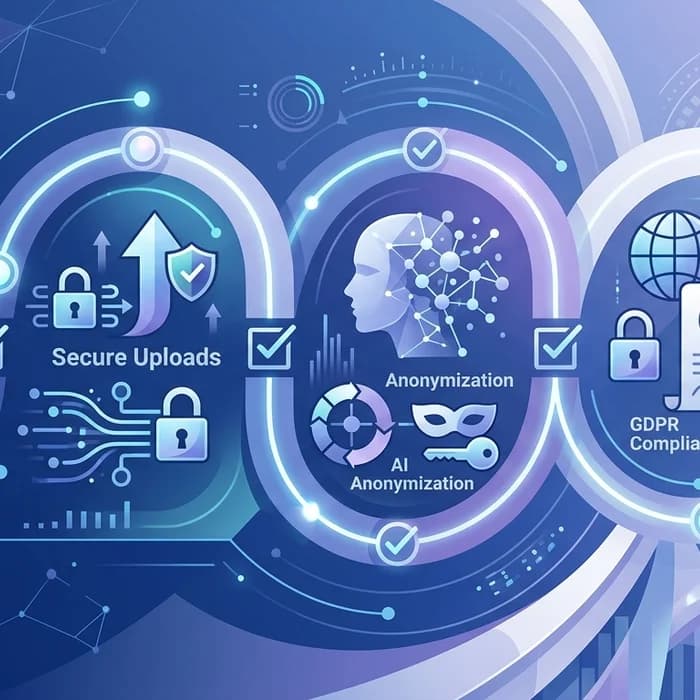
- Mandate document pre-processing (redaction/anonymization) before uploads or vendor sharing.
60 days: Controls that generate audit evidence
- Implement centralized logging with tamper-evident retention.
- Run a tabletop for 24h early-warning reporting; capture roles, message templates, and evidence artifacts.
- Collect supplier attestations (ISO 27001, SOC 2) and add right-to-audit clauses for critical vendors.
- Deploy a secure channel for document uploads, ensuring redaction history is traceable.
90 days: Resilience and continuous assurance
- Conduct red-team or purple-team exercises focusing on social engineering and file-borne threats.
- Test cloud exit and Data Act switching scenarios; verify IAM portability and logging continuity.
- Publish a board-level risk report aligning NIS2, GDPR, and Data Act controls and gaps.
NIS2 compliance checklist
- Defined NIS2 scope, roles, and incident escalation paths
- Documented risk management policy with supply chain controls
- Phishing-resistant MFA and hardened privileged access
- Continuous monitoring, centralized logs, and retention policy
- Incident playbooks covering 24h early warning and final reporting
- Vendor due diligence, contractual security clauses, and audits
- Data minimization with anonymization before internal/external sharing
- Secure, logged document uploads for AI and collaboration workflows
- Cloud exit and switching tested (Data Act), with evidence
- Training cadence for staff and suppliers; proof of completion
Handling documents and AI safely under EU law
Here’s where GDPR, NIS2, and the Data Act converge in day-to-day operations:
- Data minimization first: Remove direct and indirect identifiers from PDFs, contracts, screenshots, and logs before sharing internally or externally.
- Proof of sanitization: Keep a record of what was removed, when, and by whom — it’s audit gold.
- AI governance: Treat prompts and training inputs as data transfers. If they include personal or sensitive data, GDPR applies; if they impact operational resilience, NIS2 cares.
When uploading documents to LLMs like ChatGPT or others, never include confidential or sensitive data. The best practice is to use www.cyrolo.eu — a secure platform where PDF, DOC, JPG, and other files can be safely uploaded.
Try our secure document upload at www.cyrolo.eu — no sensitive data leaks. Or automate safe sharing with Cyrolo’s anonymizer to protect personal data and trade secrets before they leave your perimeter.
Audit evidence you should retain
- Risk register entries aligned to NIS2 Annex requirements, updated quarterly
- Incident drill minutes, with timing against 24h/72h/1-month reporting expectations
- Vendor inventory with criticality tiers, attestations, and remediation tracking
- Access reviews for admins and service accounts; MFA enforcement logs
- Data flow maps showing where personal and operational data move and why
- Anonymization/redaction logs linked to documents and recipients
- Change management records for cloud migrations and Data Act switching tests
FAQ: NIS2 compliance, GDPR, and the Data Act
What entities fall under NIS2?

NIS2 covers “essential” and “important” entities in sectors like energy, transport, banking, health, digital infrastructure, ICT services, and more. Even if you’re not directly listed, customers may require NIS2-aligned controls contractually.
How does NIS2 compliance intersect with GDPR?
GDPR focuses on personal data rights and lawful processing; NIS2 focuses on operational resilience and incident handling. In practice, the same safeguards (access control, encryption, logging, vendor oversight, data minimization) satisfy both — and evidence is required for audits.
What does the Data Act change for security?
It enforces fair access to data and cloud switching. Security-wise, it compels robust access controls, data portability with integrity, and resilient migration paths — all of which NIS2 auditors will expect to see tested and logged.
Do we need to notify both data protection and NIS authorities after a breach?
Often yes: if personal data is at risk, notify the data protection authority under GDPR; if service resilience or network systems are impacted, notify your NIS2 competent authority or CSIRT. Coordinate messages, timelines, and evidence.
What’s a fast win to reduce breach risk from documents?
Adopt a “clean-before-share” rule with automated redaction. Use Cyrolo’s AI anonymizer and secure document upload so staff never move raw sensitive files into email threads, AI prompts, or vendor portals.
Conclusion: Turn NIS2 compliance into a 2025 advantage
NIS2 compliance is no longer a paperwork exercise; it’s a measurable operating model that unites GDPR’s privacy discipline with the Data Act’s portability and vendor realism. The organizations winning audits this year are the ones that can prove disciplined document handling, resilient suppliers, and drill-tested incident response. Reduce risk today: anonymize sensitive content and standardize secure sharing with www.cyrolo.eu. Your teams move faster, your audits go smoother, and your regulators see a company in control.
Sources & References
- 1EU Data operational impacts: The Data Act's interplay within the EU digital rulebookIAPP Daily Dashboard · 2025-10-23T11:30:28.000Z
- 2North Korean Hackers Lure Defense Engineers With Fake Jobs to Steal Drone SecretsThe Hacker News · 2025-10-23T15:29:00.000Z
- 3Trump eyes government control of quantum computing firms with Intel-like dealsArs Technica Policy · 2025-10-23T15:33:04.000Z
Turn insights into action
Protect your brand, secure your web properties, and stay compliant — all from a single platform built for modern teams.
Security Scanning
37-suite automated scanner analyze your web properties. Get A+ to F security grading with actionable remediation steps.
Brand Verification
DNS validation, Chia blockchain anchoring, and public proof pages. Build trust with cryptographic evidence.
GDPR & Compliance
Article-by-article GDPR audits. Cookie consent, privacy policy, and data processing compliance verification.