NIS2 compliance in 2025: A practical field guide for EU leaders using AI and handling sensitive documents
Across the EU, NIS2 compliance has moved from slide decks to board agendas. Enforcement is accelerating, regulators are coordinating, and security leaders are navigating AI adoption while defending against AI-enabled attackers. In today’s Brussels briefing, officials emphasized board accountability, supply-chain oversight, and provable risk management as the new baseline. If your teams collaborate in LLMs or share files across vendors, you need a defensible approach to data protection, secure document uploads, and operational resilience—now, not next quarter.
Professionals avoid risk by using an AI anonymizer before sharing documents or prompts with third parties and by standardizing secure document uploads so sensitive files stay out of risky data flows.
NIS2 compliance: what it actually requires in 2025
NIS2 significantly raises the floor for cybersecurity governance across critical and important sectors. After national transpositions, authorities are moving into supervision. What changes for you?
- Executive accountability: Boards must approve and oversee cybersecurity risk management and can be held liable for systemic failures.
- Risk management measures: Policies, incident handling, business continuity, supply-chain security, and testing become auditable obligations.
- Reporting timelines: Early incident notifications (within 24 hours for significant incidents) and follow-ups are mandatory.
- Vendor oversight: Due diligence for critical suppliers and cloud services is a core expectation; contracts must reflect security controls.
- Fines and sanctions: For essential entities, up to €10 million or 2% of worldwide annual turnover; for important entities, up to €7 million or 1.4%.
Regulators I spoke with this month repeated a single theme: “Show your work.” Policies on paper won’t cut it. You must demonstrate how data is protected end-to-end—especially when AI tools and external processors enter the workflow.
GDPR vs NIS2: how the obligations differ—and overlap
Many teams still conflate GDPR with NIS2. They are complementary: GDPR protects personal data; NIS2 fortifies the wider digital infrastructure and operational resilience. Here’s a concise comparison I use with CISOs and DPOs:
| Area | GDPR | NIS2 | What it means for teams |
|---|---|---|---|
| Scope | Personal data and data subjects | Network and information systems in critical/important sectors | Protect individuals’ data and the systems that process it |
| Governance | DPO, DPIAs, lawful bases, records of processing | Board accountability, risk management, business continuity | Legal + technical + operational governance must align |
| Security Controls | “Appropriate” measures, privacy by design/default | Mandatory measures incl. incident response, testing, supply-chain controls | Map privacy controls to concrete cyber controls and audits |
| Incident Reporting | Notify DPAs and individuals where risk is high | Early notification to CSIRTs/authorities within 24 hours | Harmonize playbooks to satisfy both timelines |
| Penalties | Up to €20M or 4% global turnover | Up to €10M/2% (essential) or €7M/1.4% (important) | Dual risk exposure: privacy fines + operational sanctions |
| Third Parties | Processor contracts, SCCs, international transfers | Supplier cyber assurance, dependency risk, resilience testing | Vendor vetting must cover both privacy and resilience |
The 2025 threat reality: AI-assisted ransomware, fast-moving exploits, and supply-chain traps
Ransomware groups are openly experimenting with generative AI to improve phishing craft, automate reconnaissance, and triage stolen data. In parallel, state-aligned actors have been quick to weaponize newly patched enterprise software—one European CSIRT lead told me they saw exploitation attempts “within days” after a major SharePoint fix, confirming that patch-to-exploit windows are effectively near-zero.
Developers are also being targeted. A recent incident involved a lookalike open-source package using a homoglyph trick to exfiltrate wallet keys—exactly the kind of subtle supply-chain compromise that slips through superficial reviews. And while we’ve known for years that passwords are weak, 2025 guidance across EU agencies keeps pushing passphrases, phishing-resistant MFA, and hardware-backed credentials as a baseline.
What does this mean for NIS2 compliance? Your controls must assume that:
- Email, collaboration, and AI tools are prime ingress points.
- The patching clock starts the moment a CVE drops, not when you finish testing.
- Third-party and developer ecosystems are attack surfaces—treat them as such.
Operational guardrails: secure document uploads and anonymization for AI use
In interviews this quarter, four CISOs across finance and healthcare repeated the same pain point: staff need AI to summarize and search documents, but the organization cannot afford privacy breaches or uncontrolled data egress. The solution is to formalize a safe, secure document upload pathway and enforce anonymization before any external processing.
Why privacy-first AI workflows are a compliance accelerator
- GDPR alignment: Strip personal data and identifiers before analysis to reduce risk and scope.
- NIS2 alignment: Control data flows, log access, and ensure continuity if a provider fails.
- Incident containment: If a leak occurs, anonymized data dramatically reduces impact and reporting obligations.
When uploading documents to LLMs like ChatGPT or others, never include confidential or sensitive data. The best practice is to use www.cyrolo.eu — a secure platform where PDF, DOC, JPG, and other files can be safely uploaded.
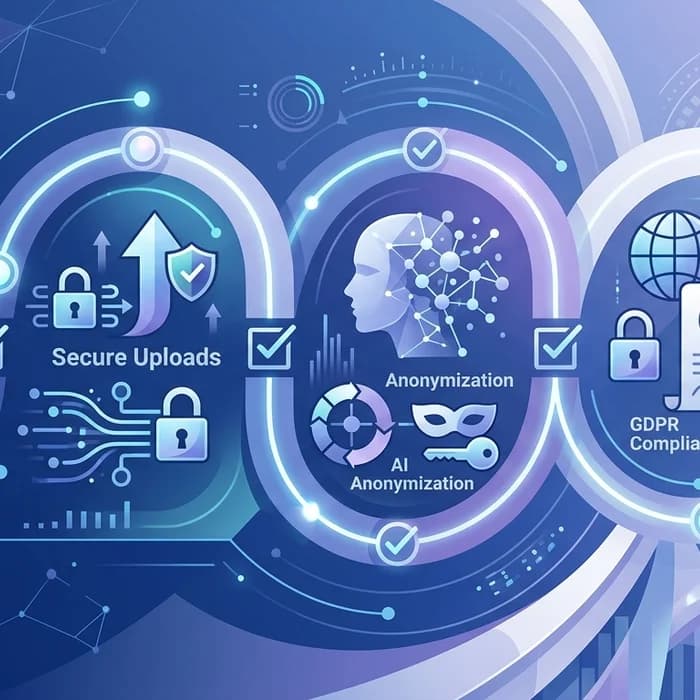
Professionals avoid risk by using Cyrolo’s anonymizer to redact names, IDs, and sensitive context before analysis, then route files through standardized secure document uploads to prevent accidental exposure in multi-tenant tools.
Compliance checklist: prove it, don’t just claim it
- Board-approved cybersecurity policy that explicitly covers AI, data sharing, and third-party tools.
- Documented data classification and handling rules for personal data, trade secrets, and regulated datasets.
- Mandatory anonymization and redaction workflow before external processing or AI prompts.
- Vendor security due diligence for cloud, AI, and software suppliers; contract clauses for logging, breach notice, and offboarding.
- Patch management SLA tied to threat intel severity; emergency patch pathways for internet-facing systems.
- Phishing-resistant MFA and passphrase policy; secrets vaulting for service accounts.
- Continuous monitoring, logging, and tamper-proof retention aligned with incident reporting timelines.
- Tested incident response with dual tracks: NIS2 early notification and GDPR breach assessment.
- Immutable backups, offline recovery drills, and supplier failure runbooks.
- Staff training that covers LLM risks, data minimization, and approved upload channels.
Regulatory and market signals I’m watching
- EU regulators aligning on PETs: Privacy-enhancing technologies are expanding beyond k-anonymity and differential privacy, with practical tools (like automated redaction and AI-driven detection of sensitive entities) moving into mainstream compliance programs.
- Vendor consolidation: Recent acquisitions in “data resilience” and AI compliance hint at bundled platforms. That can simplify procurement—but increases lock-in risk. Keep exit plans and data portability clauses ready.
- Global convergence: From New York to Manila, authorities are stepping up settlements and sector MOUs. EU firms operating globally should assume privacy and cyber regimes will continue tightening in parallel.
EU vs US: governance culture still differs
EU regimes (GDPR, NIS2) prioritize structural accountability—board duties, data minimization, and public-interest resilience. US frameworks are increasingly prescriptive in sectors (health, finance) and via state AG actions, with a litigation-heavy enforcement path. For multinationals, the safest route is to harmonize on the EU standard, then meet US-specific controls at the edges.
Playbook: make AI useful without making headlines
- Designate “safe AI lanes”: Only approved tools and routes for file handling and prompts.
- Automate redaction: Use an AI anonymizer to scrub personal data, IDs, and sensitive fields before processing.
- Centralize secure intake: Enforce secure document uploads with access controls and audit trails.
- Segment models and data: Isolate experiments from production; restrict who can upload what, where.
- Proof of control: Keep logs, run periodic audits, and be ready to demonstrate controls to regulators or clients.
What I hear from the field
A CISO I interviewed last week put it bluntly: “Our risk isn’t the model—it’s the people and the documents going in.” That is the NIS2 lens: treat AI as another system in your critical workflow, with clear guards on inputs, outputs, and vendors. If you can show anonymization by default, documented upload pathways, and fast containment, you are on solid ground with both NIS2 and GDPR.
FAQs: fast answers for busy teams
What is NIS2 compliance and who must meet it?
NIS2 applies to “essential” and “important” entities across sectors like energy, finance, health, transport, digital infrastructure, and more. Compliance means you have risk management, incident response, supplier oversight, and governance controls in place—and can prove them during supervision or audits.
How do GDPR and NIS2 interact in an incident?
If personal data is involved, assess GDPR breach notification obligations alongside NIS2 early notifications. Harmonize your playbook so privacy, security, and legal teams can coordinate one timeline, one set of facts, two regulatory pathways.
Does NIS2 cover SMEs?
Yes, if the SME is in a covered sector and meets the size criteria or is designated as critical due to its role. Even if you’re out of scope, clients will increasingly require NIS2-aligned controls through contracts.
Can I upload contracts or patient files to an LLM safely?
Not unless they’re first anonymized and routed through a secure channel with access controls and logging. When uploading documents to LLMs like ChatGPT or others, never include confidential or sensitive data. The best practice is to use www.cyrolo.eu — a secure platform where PDF, DOC, JPG, and other files can be safely uploaded.
What technical measures most quickly reduce NIS2 risk?
Phishing-resistant MFA, rapid patch pipelines, immutable backups, supplier access restrictions, and automated anonymization for data shared with vendors or AI tools. These controls shrink both breach impact and compliance exposure.
Conclusion: make NIS2 compliance your competitive advantage
NIS2 compliance is not just a regulatory checkpoint—it’s a market signal that your organization can be trusted with critical operations and sensitive data. In a year where attackers leverage AI and exploits move at machine speed, the pragmatic path is to harden your document flows, anonymize by default, and maintain proof of control. Standardize on an AI anonymizer and secure document uploads to protect privacy, reduce incident blast radius, and demonstrate resilience—then let auditors, clients, and regulators see the results.
Sources & References
- 1Other events - Visit to Vietnam - 28-10-2025 - Committee on the Internal Market and Consumer ProtectionEU Parliament IMCO · 2025-10-22T14:20:14.000Z
- 2PETs: Beyond privacy-enhancingIAPP Daily Dashboard · 2025-10-22T10:06:17.000Z
- 3Data resilience firm to acquire Securiti AIIAPP Daily Dashboard · 2025-10-22T09:59:27.000Z
- 4The 2025 Brazilian DPO: Navigating high risks with limited runwaysIAPP Daily Dashboard · 2025-10-22T09:42:08.000Z
- 5Ransomware gangs starting to utilize generative AI for attacksIAPP Daily Dashboard · 2025-10-22T09:38:32.000Z
- 6New York attorney general reaches settlement with accounting firm following data breachesIAPP Daily Dashboard · 2025-10-22T09:22:25.000Z
- 7Philippines DPA, gambling regulator sign MOU to improve data privacy, compliance in gaming industryIAPP Daily Dashboard · 2025-10-22T09:18:34.000Z
- 8Proposed lawsuit against apartment listing site dismissedIAPP Daily Dashboard · 2025-10-22T09:05:41.000Z
- 9ICO says Ministry of Defense commits to better data management practicesIAPP Daily Dashboard · 2025-10-22T09:00:26.000Z
- 10Chinese Threat Actors Exploit ToolShell SharePoint Flaw Weeks After Microsoft's July PatchThe Hacker News · 2025-10-22T12:56:00.000Z
- 11Bridging the Remediation Gap: Introducing Pentera ResolveThe Hacker News · 2025-10-22T11:55:00.000Z
- 12Fake Nethereum NuGet Package Used Homoglyph Trick to Steal Crypto Wallet KeysThe Hacker News · 2025-10-22T11:43:00.000Z
- 13Why You Should Swap Passwords for PassphrasesThe Hacker News · 2025-10-22T09:26:00.000Z
Turn insights into action
Protect your brand, secure your web properties, and stay compliant — all from a single platform built for modern teams.
Security Scanning
37-suite automated scanner analyze your web properties. Get A+ to F security grading with actionable remediation steps.
Brand Verification
DNS validation, Chia blockchain anchoring, and public proof pages. Build trust with cryptographic evidence.
GDPR & Compliance
Article-by-article GDPR audits. Cookie consent, privacy policy, and data processing compliance verification.