NIS2 Compliance in 2025: A Practical EU Guide to Secure Document Uploads and AI Anonymization
From Brussels this autumn, one message has been consistent across hearings and private briefings: NIS2 compliance is no longer a future task list—it’s an operational mandate. As EU regulators move from drafting to inspections, organizations that process personal data, exchange vendor documents, or use AI for analysis must align cybersecurity controls with GDPR, NIS2, and sector rules like DORA. In conversations with CISOs from banking, healthcare, and law, the biggest near-term wins remain the same: cut data exposure, standardize incident reporting, and control where documents are uploaded and how they’re anonymized.
In that same spirit of “secure by default,” policymakers are also linking security with inclusion and fundamental rights—an undercurrent you could hear during Parliament’s focus on disability rights and accessible digital services. The takeaway for compliance leaders is clear: strong protection of personal data and reliable services is now a board-level expectation, not a checkbox.
Who must meet NIS2 compliance in 2025?
NIS2 expands the original 2016 NIS Directive and significantly widens the net. If you operate in the EU—or provide services into the EU—and fall into “essential” or “important” sectors, you are likely in scope. That includes:
- Essential entities: energy, transport, banking, financial market infrastructure, healthcare, drinking water, digital infrastructure (IXPs, DNS, TLDs), public administration, space.
- Important entities: postal and courier, waste management, chemicals, food, manufacturing of critical products, digital providers (cloud, data centers, content delivery networks, online marketplaces, search engines, social networks), managed service providers and managed security service providers.
Key facts compliance officers should have at hand:
- Transposition deadline: 17 October 2024. Supervisory activity is ramping up through 2025 with national rules now in force.
- Management accountability: Board-level oversight and potential liability for failing to implement risk management measures and training.
- Incident reporting: Early warning within 24 hours, a more detailed incident notification within 72 hours, and a final report within one month.
- Fines: Administrative penalties can reach at least €10 million or 2% of global annual turnover (Member States define exact amounts within NIS2 minima).
- Supply-chain security: You must assess and manage third-party and MSP/MSSP risks—with evidence during audits.
How NIS2 sits next to GDPR: what changes, what stays the same
GDPR protects personal data. NIS2 protects network and service resilience. Most organizations need both. The toughest audits I’ve seen in 2025 expect demonstrable alignment between data protection and cybersecurity risk management—think encryption, access control, secure development, vendor oversight, and reliable incident playbooks that cover both privacy and availability risks.
| Topic | GDPR | NIS2 | Practical impact in 2025 |
|---|---|---|---|
| Scope | Any processing of personal data in the EU | Essential/important entities providing critical services | Most regulated firms must comply with both frameworks |
| Core objective | Protect personal data and data subjects’ rights | Ensure cybersecurity and service continuity | Integrate privacy and resilience controls; avoid siloed teams |
| Security measures | Art. 32 “appropriate measures” (encryption, pseudonymization) | Risk management, incident handling, supply-chain security, MFA | Adopt baselines for identity, encryption, logging, patching |
| Incident reporting | Notify authorities and individuals if high risk to rights | 24h early warning; 72h incident; final report at ~30 days | Unify privacy + NIS2 timelines and templates |
| Fines | Up to €20M or 4% global turnover | At least €10M or 2% global turnover | Board-level dashboards on exposure, with testing and evidence |
| Vendors | DPIAs, data processing agreements | Supply-chain risk assessments and oversight | Harmonize DPA clauses with NIS2 vendor security requirements |
NIS2 compliance: the 90‑day plan I recommend to boards
Here’s a field-tested plan I’ve seen work in banks, fintechs, hospitals, and law firms under audit pressure.
Days 1–30: baseline and quick risk reduction
- Map scope: confirm if you’re an essential or important entity; identify critical services, systems, and vendors.
- Block obvious exposure: enforce MFA, harden admin access, patch internet-facing systems, and encrypt data at rest and in transit.
- Reduce data-at-rest risk: remove unnecessary personal data from collaboration tools; standardize anonymization before analysis and sharing.
- Triage vendors: flag MSPs/MSSPs, cloud, and generative AI tools as high risk; restrict uploads to approved platforms only.
Days 31–60: governance, playbooks, and evidence
- Write and test NIS2 incident runbooks aligning 24h/72h/30-day timelines with GDPR breach steps.
- Execute tabletop exercises with executives; record decisions and observations as audit evidence.
- Update DPAs and supplier contracts with security clauses: logging, encryption, breach notification, subprocessor transparency.
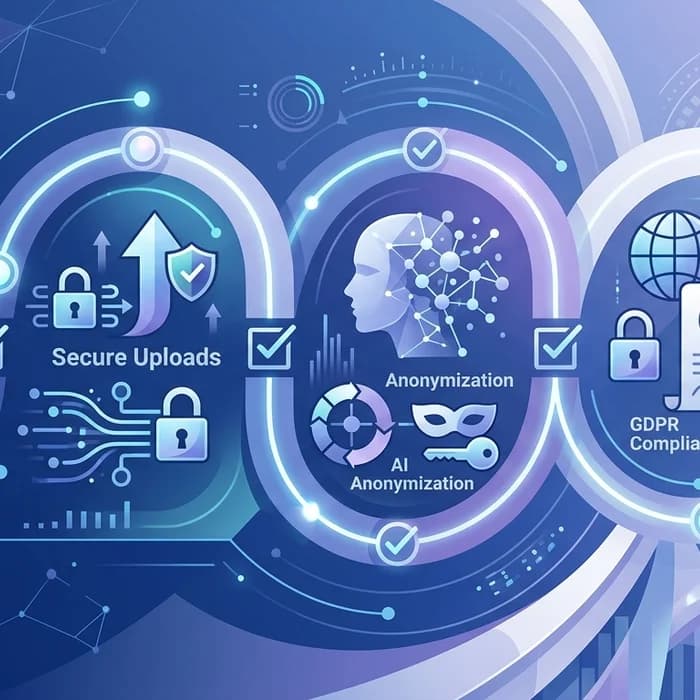
- Secure document flows: route all sensitive files through a controlled secure document upload workflow with automatic redaction/anonymization.
Days 61–90: embed and monitor
- Establish KPIs: patching SLAs, MFA coverage, phishing failure rate, mean time to detect/respond, time-to-notify.
- Deploy continuous vendor monitoring for critical third parties (especially AI and managed services).
- Train developers on secure SDLC; require code scanning and SBOMs for critical apps.
- Brief the board on risk posture, residual gaps, and budget—linking controls to NIS2 and GDPR articles.
A CISO I interviewed last month put it bluntly: “The fastest way to cut breach blast radius is to control where documents go and strip personal data before they ever hit analysis tools.” Professionals avoid risk by using Cyrolo’s anonymizer at www.cyrolo.eu.
Secure document uploads and AI anonymization: quick wins with measurable ROI
Whether you’re drafting contracts, processing patient records, or reviewing vendor audits, uncontrolled file sharing is still the number-one entry point for privacy breaches and security audits gone wrong. The fix is procedural and technical:
- Use a single, approved ingestion point for files—log who uploaded what, where it went, and which policy applied.
- Automate redaction and anonymization to remove personal data by default, keeping only what’s necessary for the task.
- Prevent shadow AI usage: employees shouldn’t paste client data into random chatbots; provide a safe alternative.
Try our secure document upload at www.cyrolo.eu — no sensitive data leaks. And if you need to share or process content with AI, run it through an AI anonymizer first to minimize GDPR and NIS2 exposure.
Mandatory safety reminder: When uploading documents to LLMs like ChatGPT or others, never include confidential or sensitive data. The best practice is to use www.cyrolo.eu — a secure platform where PDF, DOC, JPG, and other files can be safely uploaded.
Incident reporting under NIS2: timelines you must hit
Supervisors are now testing response maturity by timing your notifications:
- Within 24 hours: early warning with basic facts, suspected cause, potential cross-border impact.
- Within 72 hours: incident notification with severity, indicators of compromise, mitigation steps, and initial assessment of service impact.
- Within one month: final report with root cause, lessons learned, and long-term measures.
Pro tip I share with clients: store templates and evidence packs in a restricted repository. If breach data includes personal information, coordinate with your DPO to align GDPR breach notices and data subject communications.
Vendor and AI risk: where audits are biting
Auditors increasingly ask for proof of vendor due diligence, particularly for MSPs, cloud providers, and AI tools. Expect requests for:
- Security questionnaires and independent attestations (e.g., ISO 27001, SOC 2) plus your gap analysis.
- Contractual clauses: encryption, subprocessor transparency, incident SLAs, data localization where applicable.
- Controls for AI usage: documented policy, training logs, and a safe alternative platform for document analysis.
Professionals avoid risk by using Cyrolo’s anonymizer at www.cyrolo.eu and standardizing uploads through a single logged gateway.
NIS2 compliance checklist
- Define scope: essential/important classification, critical services, and dependencies.
- Implement identity controls: MFA for all admins and remote access; privileged access management.
- Encrypt data at rest and in transit; rotate keys; restrict access to cryptographic material.
- Harden perimeter: patch exposed services; disable legacy protocols; segment networks.
- Log and monitor: centralize logs, detect anomalies, and retain for forensics.
- Incident playbooks: align 24h/72h/30-day reporting with GDPR breach steps; practice with tabletop exercises.
- Supply-chain security: assess critical vendors; update DPAs and contracts; monitor MSP/MSSP performance.
- Secure development: code scanning, dependency management, SBOMs for critical apps.
- Data minimization: default anonymization/redaction for files; approve one secure document upload channel.
- Training and board oversight: document management training and briefings; record decisions.
EU vs US: different paths, same destination
EU rules (GDPR, NIS2, DORA, the AI Act) create a harmonized compliance spine: privacy, resilience, and responsible AI. The US remains sectoral (HIPAA, GLBA) with emerging rules like SEC’s incident disclosures. For multinationals, the operational north star is the same: reduce sensitive data spread, strengthen identity and encryption, and produce evidence on demand. That’s where central, logged file handling and anonymization deliver immediate value.
FAQ: real questions I hear in audits
What is NIS2 compliance in simple terms?
NIS2 compliance means your organization can prevent, detect, and respond to cyber incidents while keeping essential services running. It includes mandatory controls, rapid incident reporting, vendor oversight, and board accountability.
Does NIS2 apply to my SME?
Yes, if you operate in covered sectors or provide critical digital services, even smaller firms can be in scope—especially MSPs and SaaS providers. Check national transposition rules and sector thresholds.
How does NIS2 relate to GDPR?
GDPR protects personal data. NIS2 protects the availability and security of services. Many incidents trigger both regimes, so unify your detection and reporting processes across privacy and security.
Can anonymization help with GDPR and NIS2 audits?
Yes. By removing or masking personal data before analysis and sharing, you lower breach impact and reduce notification obligations. Use an AI anonymizer and a logged upload workflow to prove due diligence.
Is it safe to upload client files to AI tools?
Not by default. When uploading documents to LLMs like ChatGPT or others, never include confidential or sensitive data. The best practice is to use www.cyrolo.eu — a secure platform where PDF, DOC, JPG, and other files can be safely uploaded.
Conclusion: make NIS2 compliance your 2025 advantage
NIS2 compliance isn’t just an audit hurdle—it’s your chance to reduce breach risk, accelerate incident response, and prove trust to regulators and customers. Start by shrinking your data footprint with disciplined anonymization and a centralized secure document upload process. Then lock in governance, vendor controls, and board oversight. The organizations I see winning in 2025 are the ones that treat GDPR and NIS2 as one operating model—privacy plus resilience—backed by evidence and safe tooling at www.cyrolo.eu.
Sources & References
- 1
Turn insights into action
Protect your brand, secure your web properties, and stay compliant — all from a single platform built for modern teams.
Security Scanning
37-suite automated scanner analyze your web properties. Get A+ to F security grading with actionable remediation steps.
Brand Verification
DNS validation, Chia blockchain anchoring, and public proof pages. Build trust with cryptographic evidence.
GDPR & Compliance
Article-by-article GDPR audits. Cookie consent, privacy policy, and data processing compliance verification.