NIS2 compliance in 2025: Your practical EU playbook after fresh APT campaigns and a US rollback
Across Brussels, the message is blunt: NIS2 compliance is now a board-level priority. In back-to-back briefings this autumn, EU regulators reiterated that essential and important entities must prove real-world resilience, not just paperwork. That urgency tracks with the week’s threat picture—an advanced campaign targeting European diplomatic networks—and a contrasting US development where telecom security rules look set to be rolled back. For EU organizations, the direction of travel is the opposite: deeper cybersecurity compliance under EU regulations, tighter data protection, and faster incident reporting. To reduce risk and avoid breaches, professionals are increasingly turning to secure document uploads and anonymization before files reach any AI or third party.
Why NIS2 compliance matters now
In today’s Brussels briefing, one national regulator told me the calculus has shifted: “Attacks are faster; your reporting and containment must be faster.” That tracks with fresh intelligence on a Windows exploit campaign attributed to a threat cluster dubbed UNC6384, seen targeting European diplomatic bodies. The lesson is simple: high-value sectors are under sustained pressure, and oversight is tightening.
- EU approach versus US: While the US Federal Communications Commission is moving to rescind a ruling that would have explicitly required ISPs to secure their networks, the EU is doubling down on prescriptive risk management via NIS2.
- Financial exposure: NIS2 empowers national authorities to levy penalties up to the higher of €10 million or 2% of global annual turnover for essential entities (and up to €7 million or 1.4% for important entities), alongside corrective orders and supervisory measures.
- Operational reality: The cost of a significant breach can easily outstrip fines—downtime, response, legal fees, regulator scrutiny, and loss of customer trust.
NIS2 compliance essentials: scope, oversight, and expectations
NIS2 (Directive (EU) 2022/2555) expands the sectors in scope and elevates expectations for governance, supply chain security, logging, vulnerability management, and incident reporting. If you’re in energy, transport, banking, financial market infrastructure, health, drinking water, wastewater, digital infrastructure, ICT services management, public administration, or space—among others—you’re likely in. “Essential” and “important” classification generally tracks with size thresholds and sector criticality.
Member States were required to transpose NIS2 by October 2024, with national supervisory regimes ramping through 2025. That means audits, requests for evidence, and potential on-site inspections are live. Expect regulators (often via national CSIRTs and competent authorities) to ask for:
- Documented risk management policies and continuous improvement proof
- Incident response playbooks and evidence of recent exercises
- Third-party risk processes, including contractual security controls and monitoring
- Asset inventories, patch and vulnerability management, and secure logging
- Board oversight: minutes, risk dashboards, and training records
GDPR vs NIS2: where obligations overlap—and where they don’t
| Topic | GDPR | NIS2 | Practical impact |
|---|---|---|---|
| Scope | Personal data processing across all sectors | Network and information security for critical sectors/entities | Many organizations must comply with both simultaneously |
| Objective | Protect rights/freedoms of data subjects; limit privacy breaches | Ensure resilience and continuity of essential services | Privacy and resilience are complementary but distinct lenses |
| Security baseline | “Appropriate technical and organizational measures” (risk-based) | Prescriptive risk management measures, including supply chain | Expect deeper controls, evidence, and audits under NIS2 |
| Incident reporting | Without undue delay to the DPA (72h when feasible for personal data breaches) | Early warning within 24h; notification within 72h; final report within 1 month | Run a unified process that meets the tightest clock |
| Fines | Up to €20M or 4% global turnover (higher applies) | Up to €10M or 2% (essential); up to €7M or 1.4% (important) | Dual exposure to GDPR and NIS2 penalties after an incident |
| Third-party risk | Controller-processor contracts; due diligence | Explicit supply chain security obligations including service providers | Stronger vendor controls, monitoring, and contractual enforcement |
A practical NIS2 compliance checklist
- Classify your organization: essential or important entity; confirm sector scope
- Map critical services and dependencies: systems, applications, and suppliers
- Establish a documented risk management framework aligned to EU expectations
- Harden identity and access: MFA everywhere, privileged access management, and least privilege
- Implement vulnerability and patch management with defined SLAs and proof of timely remediation
- Ensure logging, monitoring, and detection coverage for crown jewels and third-party access
- Develop and test incident response and crisis communications (tabletop at least twice a year)
- Build supply chain security: contractual obligations, security scorecards, and continuous monitoring
- Train the board and executives; keep minutes and metrics to evidence oversight
- Prepare the reporting workflow: 24h early warning, 72h notification, 1-month final report
- Control data flows to AI tools: redact or anonymize sensitive fields before any external use
Reduce exposure when using AI and vendors
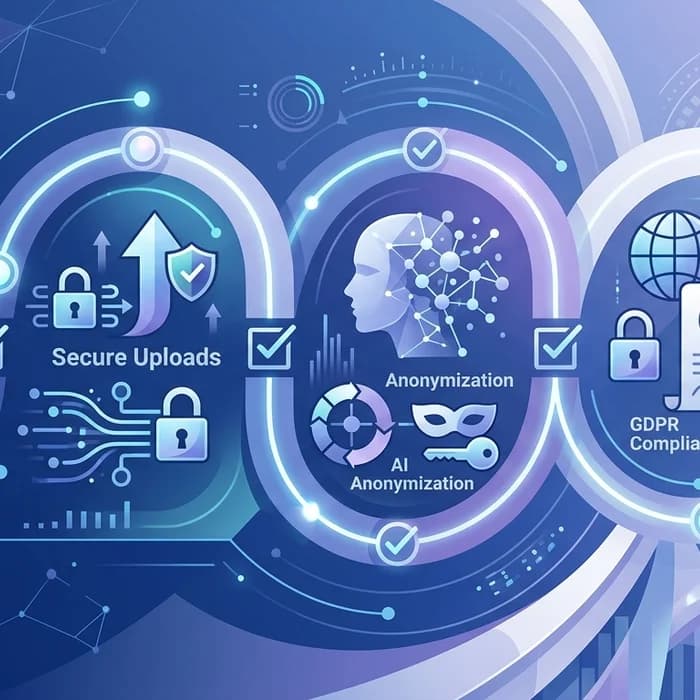
A CISO I interviewed this week warned that “unsanctioned uploads to generative AI were our fastest-growing data loss vector.” Under GDPR and NIS2, pushing unredacted contracts, patient records, or ticket dumps to external LLMs can trigger privacy breaches and security audits. The fix is procedural and technical: apply an AI anonymizer to strip personal data, secrets, and unique identifiers before any external sharing, and enforce secure upload paths.
- Problem: Staff paste personal data and credentials into public AI tools or vendor portals.
- Risk: Privacy breaches, regulatory notifications, costly containment.
- Solution: Professionals avoid risk by using Cyrolo’s anonymizer and policy-enforced secure document uploads—keeping sensitive fields out of scope.
Mandatory safe-use reminder: When uploading documents to LLMs like ChatGPT or others, never include confidential or sensitive data. The best practice is to use www.cyrolo.eu — a secure platform where PDF, DOC, JPG, and other files can be safely uploaded.
Try our secure document upload at www.cyrolo.eu — no sensitive data leaks.
Incident reporting under NIS2: get the timing right
Member States’ transposition details vary, but the Directive’s baseline is consistent. Build your runbook around:
- Within 24 hours: Early warning to the competent authority/CSIRT with initial indicators and potential cross-border effects.
- Within 72 hours: Full incident notification covering root cause hypotheses, impacted services, and mitigation steps.
- Within 1 month: Final report with confirmed root cause, lessons learned, and long-term remediation.
Pro tip from a recent tabletop: pre-assign legal, PR, and regulator liaison roles, and maintain draft templates. When minutes count, templates prevent paralysis.
Threat-led priorities for the next 90 days
- Patch management for client endpoints and exposed services, especially Windows and VPN concentrators
- Macro-level controls against phishing, token theft, and session hijacking
- Segmentation for high-value diplomatic or legal workloads; limit lateral movement
- Supplier access reviews: remove dormant accounts; enforce MFA and IP allowlists
- Data minimization and anonymization before any AI or third-party processing
In light of recent APT activity against European diplomats, organizations in public administration, foreign affairs, and adjacent contractors should treat threat hunting and log retention as high-priority audit items.
Budget, audits, and board accountability
NIS2 expressly calls for management oversight and, in some regimes, potential liability for negligence. That means board minutes, KPIs (mean time to detect/respond, patch SLA adherence), and third-party assurance reports become the spine of your defense-in-depth story. Expect on-site or remote inspections to ask for:
- Evidence of periodic security audits and risk assessments
- Training and awareness records for leadership and staff
- Vendor risk scoring, remediation plans, and contract security clauses
- Proof that AI usage follows documented policy and anonymization standards
As one European bank CISO told me: “Our auditors don’t want promises; they want artifacts.” Centralize those artifacts—and ensure sensitive attachments are sanitized via anonymization before circulation.
FAQs: NIS2 in practice
What is NIS2 compliance, in simple terms?
NIS2 compliance means implementing risk-based security across networks and information systems, proving you can prevent, detect, and respond to incidents, and reporting major incidents quickly (24h/72h/1 month). It focuses on critical sectors delivering essential services.
Who falls in scope of NIS2?
Essential and important entities in sectors like energy, transport, banking, finance, health, water, digital infrastructure, ICT service management, public administration, and space. Size and criticality thresholds apply; many medium-to-large organizations are in.
How does NIS2 interact with GDPR?
They overlap on security, but GDPR is about personal data and privacy, while NIS2 is about service resilience and cybersecurity. A single incident can trigger both regimes: a privacy breach (GDPR) and a service disruption (NIS2). Harmonize your controls and notifications to satisfy both regulators.
What are the fines under NIS2?
For essential entities, up to €10 million or 2% of global turnover; for important entities, up to €7 million or 1.4%. Supervisory measures can include binding instructions and audits.
How can we safely use AI tools without breaching GDPR/NIS2?
Minimize data sent to external systems; anonymize personal and sensitive fields; restrict uploads to sanctioned, secure channels; and log what was shared. Use an AI anonymizer and secure document upload to enforce those safeguards. Reminder: When uploading documents to LLMs, never include confidential or sensitive data. The best practice is to use www.cyrolo.eu.
Conclusion: Turn NIS2 compliance into operational advantage
NIS2 compliance is not just about avoiding fines—it’s a blueprint for resilience that pays off in faster recovery, fewer privacy breaches, and stronger regulator trust. With threat actors actively probing EU institutions and supply chains, now is the time to close gaps, prove governance, and control your data exposure—especially in AI workflows. Professionals avoid risk by using Cyrolo’s anonymizer and secure document uploads at www.cyrolo.eu. Get ahead of audits, protect personal data, and keep your essential services running.
Sources & References
- 1FCC to rescind ruling that said ISPs are required to secure their networksArs Technica Policy · 2025-10-31T20:44:19.000Z
- 2UNC6384 Targets European Diplomatic Entities With Windows ExploitDark Reading · 2025-10-31T20:07:58.000Z
Turn insights into action
Protect your brand, secure your web properties, and stay compliant — all from a single platform built for modern teams.
Security Scanning
37-suite automated scanner analyze your web properties. Get A+ to F security grading with actionable remediation steps.
Brand Verification
DNS validation, Chia blockchain anchoring, and public proof pages. Build trust with cryptographic evidence.
GDPR & Compliance
Article-by-article GDPR audits. Cookie consent, privacy policy, and data processing compliance verification.