NIS2 Compliance: Your 2025 Playbook for GDPR‑Aligned EU Cybersecurity Readiness
In today’s Brussels briefing, regulators reiterated that NIS2 compliance is no longer optional for operators of essential and important services across the EU. With national transpositions now in force, security teams face sharper obligations, tighter incident reporting, and heavier fines—on top of GDPR. Recent disruptions, from an industrial cyberattack that slowed beverage distribution to fresh ransomware exploits and cloud RCEs, underscore why EU regulations now press for verifiable resilience, not just policies on paper.

Why 2025 is different: Enforcement heat, real incidents, and supply‑chain exposure
I’ve spent the past months speaking with CISOs in banking, healthcare, manufacturing, and public administration. The message is consistent: boards are asking for evidence of readiness. One CISO told me bluntly, “We could pass a traditional security audit, but NIS2 asks for proof that our suppliers, our incident playbooks, and even our data‑handling with AI tools are resilient on day one.”
- Expanded scope: NIS2 covers more sectors (e.g., manufacturing, food production, waste management), reflecting how real-world disruptions ripple through economies. The recent industrial incident that triggered a beer shortage is a textbook example of why operational resilience matters.
- Mandatory reporting: Early warning within 24 hours, incident notification within 72 hours, and a final report within one month.
- Fines and accountability: Up to €10 million or 2% of global annual turnover for NIS2; GDPR still reaches up to €20 million or 4%. Executives can face personal accountability for persistent non-compliance.
- Supply chain scrutiny: Compromise often enters via vendors—see recurring exploits against common file-transfer and cloud components. NIS2 puts oversight duties on you, not just your suppliers.
GDPR vs NIS2: What overlaps—and what doesn’t
GDPR and NIS2 are complementary. GDPR protects personal data; NIS2 enforces cybersecurity resilience across networks and information systems. Together, they define the EU standard for cybersecurity compliance.
| Topic | GDPR | NIS2 |
|---|---|---|
| Primary Focus | Personal data protection and privacy | Cybersecurity risk management and operational resilience |
| Who’s In Scope | Controllers and processors of personal data | Essential & important entities in critical and key sectors |
| Core Obligations | Lawful basis, data minimization, DPIAs, breach notification | Risk management measures, incident reporting, supply chain security |
| Incident Reporting | 72 hours to DPA if personal data breach | 24h early warning, 72h incident notification, 1‑month final report |
| Penalties | Up to €20M or 4% of global turnover | Up to €10M or 2% of global turnover |
| Supply Chain | Accountability for processors | Explicit supplier risk management and verification |
| Security Measures | “Appropriate” technical and organizational measures | Baseline measures (e.g., incident handling, encryption, MFA, logging) |
| Audits & Supervision | Data Protection Authorities | National competent authorities & CSIRTs |
NIS2 compliance in practice: a 90‑day action plan
Based on interviews with EU regulators and lessons from recent ransomware and cloud exploitation waves, here’s a pragmatic path to demonstrate readiness quickly.

1) Map your critical services and dependencies
- Identify essential processes and the IT/OT systems they rely on.
- List vendors for file transfer, identity, code repositories, and cloud data stores.
2) Implement baseline technical controls
- MFA and least privilege across admins and remote access.
- Encrypted backups with offline copies; test restoration quarterly.
- Centralized logging and retention; ensure logs are immutable/tamper evident.
- Patch management SLAs for internet‑facing and widely exploited components.
3) Harden document and data workflows
- Control file‑transfer tools and cloud storage; segment by sensitivity.
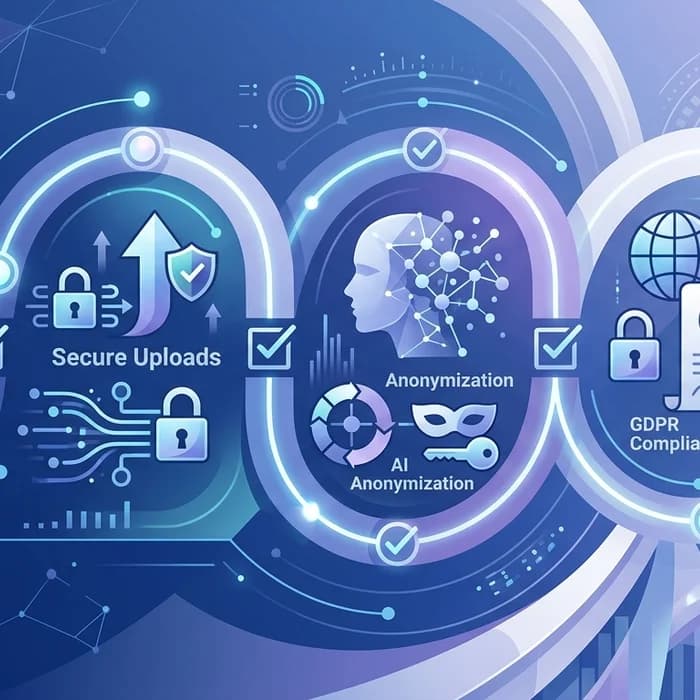
- Anonymize personal data before sharing with vendors or AI tools. Professionals avoid risk by using Cyrolo’s anonymizer to strip identifiers at upload.
- Use a secure document reader for PDF, DOC, and image files to prevent accidental leakage and ensure safe previews.
4) Prepare for incident reporting windows
- Draft a 24‑hour “early warning” template with severity estimation, suspected vector, and business impact.
- Pre‑assign roles for 72‑hour incident notification and one‑month final report.
- Run a 3‑hour tabletop on a ransomware + vendor exploit scenario.
5) Verify supplier security posture
- Contractually require MFA, logging, and timely patching for critical vendors.
- Request independent attestations or targeted control evidence.
6) Train staff on phishing and AI usage
- Run quarterly phishing simulations with modern lures (QR codes, “salted” spam themes, fake cloud shares).
- Define AI usage rules: what can be shared, how to anonymize, and approved tools.
7) Capture board oversight and continuous improvement
- Provide KPIs: patch latency, MFA coverage, backup success, incident MTTR.
- Document lessons learned and updates to risk treatment plans.
Compliance checklist: prove it, don’t just say it
- Service and asset map covering IT/OT, data flows, and critical vendors.
- Policies plus evidence: MFA logs, backup tests, vulnerability SLAs.
- Incident playbooks aligned to 24h/72h/1‑month reporting milestones.
- Supplier risk reviews with remediation tracking.
- Data minimization and AI anonymizer process for external sharing.
- Secure document handling with safe document uploads and redaction.
- Executive briefings and board minutes capturing risk decisions.
High‑risk workflows: documents, AI, and the human factor
Across hospitals, law firms, and fintechs, the most common blind spot I see is ungoverned document sharing and AI experimentation. Sensitive PDFs, DOCs, and JPGs are uploaded to public tools without anonymization. That’s a GDPR risk (personal data exposure) and a NIS2 risk (supply chain and operational disclosure).
- Problem: Data leaks via AI prompts, email forwarding, or browser plugin uploads. Once shared, you rarely get it back.
- Solution: Use Cyrolo’s anonymizer to automatically redact personal data before sharing, and open files in a secure document reader that prevents accidental leakage.
Compliance note: When uploading documents to LLMs like ChatGPT or others, never include confidential or sensitive data. The best practice is to use www.cyrolo.eu — a secure platform where PDF, DOC, JPG, and other files can be safely uploaded.
Incident reporting under NIS2: timelines you can actually meet

After a recent ransomware wave exploited a file-transfer chain, one EU manufacturer told me they lost half a day hunting logs across systems. That jeopardized their 24‑hour early warning. To stay within the NIS2 clock:
- 24 hours: Send an early warning with preliminary indicators of compromise, affected services, and potential cross‑border impact.
- 72 hours: Provide a structured incident notification with root-cause hypotheses, contain/eradicate steps, and expected service restoration.
- 1 month: Submit a final report with confirmed root cause, forensic evidence, impact, and corrective actions.
Designate an incident scribe, pre‑stage report templates, and ensure logs are centralized and retained long enough. Practically, this means security teams should automate evidence capture from endpoints, identity providers, and SaaS tools—and lock down documentation workflows with a vetted, secure reader to avoid fresh leaks during the response.
Europe vs United States: different routes to similar outcomes
EU regulations (GDPR, NIS2) set harmonized obligations and explicit reporting windows. In the US, board and disclosure pressure often arrives via securities and sectoral regulators rather than a single cybersecurity directive. Outcome-wise, both push for faster detection, transparent reporting, and supply‑chain diligence. If you operate transatlantically, treat NIS2’s structured reporting as your global “gold standard” and you’ll satisfy most parallel obligations elsewhere.
Budget, fines, and the cost of doing nothing
- Fines: NIS2 up to €10M or 2% of global turnover; GDPR up to €20M or 4%.
- Breach costs: Recovery, downtime, legal counsel, customer notification, and lost deals often eclipse fines.
- ROI: Simple investments—MFA coverage, immutable logging, verified backups, and safe document handling—prevent the majority of headline breaches.
For organizations that handle personal data daily, integrating anonymization at the point of upload is a low‑friction win. Try Cyrolo’s anonymizer and secure document reader today—no sensitive data leaks.

FAQ: NIS2 compliance, GDPR, and safe data handling
What entities must comply with NIS2 in 2025?
Essential and important entities across critical sectors (energy, transport, health, banking), plus key services like manufacturing and food supply. Check your national transposition for precise sector lists and size thresholds.
How do GDPR and NIS2 interact?
GDPR governs personal data processing; NIS2 mandates cybersecurity resilience and reporting. If an incident exposes personal data, both regimes can apply—meaning dual reporting to security authorities and data protection authorities.
What is the NIS2 incident reporting timeline?
Early warning within 24 hours, incident notification within 72 hours, and a final report within one month. Prepare templates and centralize logs to meet these deadlines.
Can I upload client documents to AI tools safely?
Not without safeguards. Anonymize first and use a secure reader. Compliance note: When uploading documents to LLMs like ChatGPT or others, never include confidential or sensitive data. The best practice is to use www.cyrolo.eu — a secure platform where PDF, DOC, JPG, and other files can be safely uploaded.
What quick wins show progress toward NIS2 compliance?
Universal MFA, tested backups, logging centralization, supplier security clauses, and implementing an AI anonymizer with a secure document upload workflow.
Conclusion: Make NIS2 compliance your operating system
NIS2 compliance is not a paperwork exercise; it’s how EU organizations keep services running when attackers strike and suppliers stumble. By aligning GDPR’s data protection with NIS2’s resilience playbook—especially around document handling, safe AI usage, and supply‑chain controls—you can cut breach risk and satisfy regulators. Start now: anonymize sensitive files with Cyrolo’s anonymizer and review critical documents in a secure document reader. That’s the fastest path from policy to proof—and to lasting NIS2 compliance.
Sources & References
- 1Cyberattack Leads to Beer Shortage as Asahi RecoversDark Reading · 2025-10-08T01:00:00.000Z
- 2Attackers Season Spam With a Touch of 'Salt'Dark Reading · 2025-10-07T21:18:57.000Z
- 3Security Concerns Shadow Vibe Coding AdoptionDark Reading · 2025-10-07T19:08:06.000Z
- 4Medusa Ransomware Actors Exploit Critical Fortra GoAnywhere FlawDark Reading · 2025-10-07T16:59:27.000Z
- 5Patch Now: 'RediShell' Threatens Cloud Via Redis RCEDark Reading · 2025-10-07T10:35:37.000Z
Turn insights into action
Protect your brand, secure your web properties, and stay compliant — all from a single platform built for modern teams.
Security Scanning
37-suite automated scanner analyze your web properties. Get A+ to F security grading with actionable remediation steps.
Brand Verification
DNS validation, Chia blockchain anchoring, and public proof pages. Build trust with cryptographic evidence.
GDPR & Compliance
Article-by-article GDPR audits. Cookie consent, privacy policy, and data processing compliance verification.