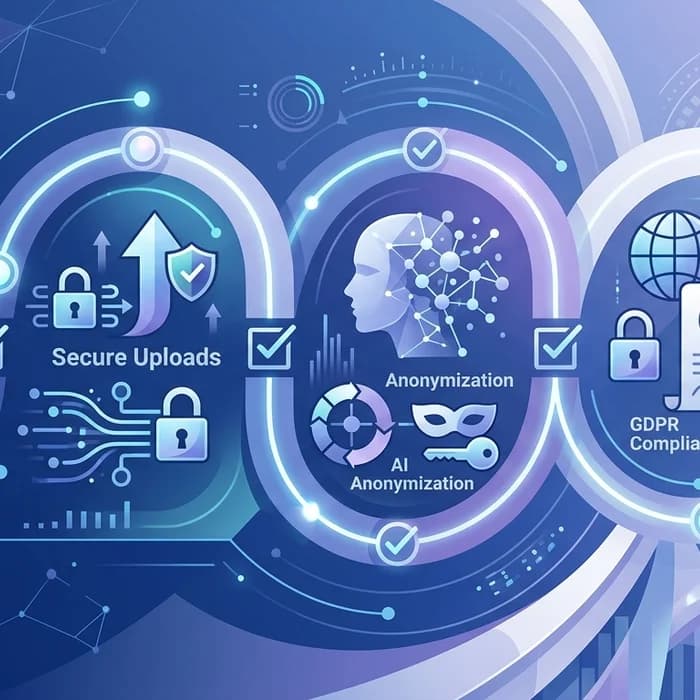
NIS2 compliance in 2025: from zero‑day chaos to clean audits (and how to get there)
In today’s Brussels briefing, one message dominated: NIS2 compliance is no longer a paper exercise—it’s a resilience mandate that must hold up under live fire. Within 24 hours, European security teams juggled emergency patching for a new “CitrixBleed 2” zero‑day and watched Google move against a phishing‑as‑a‑service operation dubbed Lighthouse. Regulators quietly remind me these are exactly the real‑world stressors your cybersecurity compliance program must withstand under EU regulations such as NIS2 and GDPR. If you handle personal data or run essential/important services, now is the time to harden processes, secure document uploads, and deploy AI anonymizer workflows that prevent privacy breaches.

Why NIS2 compliance just got harder this quarter
“We had hours to triage remote access exposure while the board asked about reporting obligations,” a financial‑services CISO told me after last night’s “CitrixBleed 2” scramble. The takeaway aligns with what EU regulators emphasized this week: your risk management, vulnerability handling, and incident reporting under NIS2 must be demonstrably operational—not only documented for audits, but proven during live incidents.
- Zero‑day reality: Rapid exploit development compresses your detection, patching, and communication windows. NIS2 expects a process, not perfection, but that process must be repeatable and evidenced.
- Phishing‑as‑a‑service: Industrialized credential theft (e.g., Lighthouse) means continuous email/identity controls, user education, and supplier vetting—plus proof that you do all three.
- Cross‑regime pressure: Privacy breaches sit at the intersection of NIS2 and GDPR. A single lapse can trigger parallel duties to security and data protection regulators.
NIS2 compliance: the essentials regulators are checking
Member States transposed NIS2 in late 2024, and enforcement is ramping across 2025. In interviews, supervisors consistently point to these pillars:
- Governance and accountability: Board‑level oversight, risk ownership, and training for executives.
- Vulnerability and patch management: Documented intake, risk‑based prioritization, and remediation SLAs tied to business impact.
- Incident lifecycle: Early detection, 24/72‑hour notifications, containment, forensics, and post‑incident lessons learned.
- Supply chain security: Due diligence, contract clauses, and continuous monitoring for critical vendors and cloud providers.
- Data protection interlock: Clear mapping of where personal data lives, how it’s anonymized or minimized, and how GDPR breach thresholds are assessed.
GDPR vs NIS2: where obligations overlap—and where they don’t
Legal and security teams still mix up scopes. Use this side‑by‑side to brief your board and align audits.
| Topic | GDPR | NIS2 |
|---|---|---|
| Primary focus | Protection of personal data and data subject rights | Cybersecurity resilience of essential and important entities |
| Who is covered | Controllers/processors handling personal data of EU residents | Specific sectors (e.g., energy, finance, health, digital infrastructure, ICT providers) and size‑based criteria |
| Key obligations | Lawful basis, data minimization, DPIAs, breach notification, data subject rights | Risk management, incident reporting, business continuity, supply chain security, secure by design |
| Breach notification | To DPAs within 72 hours if risk to individuals; notify affected individuals where high risk | Early warning and incident notifications to CSIRTs/competent authorities (often within 24/72 hours), plus final reports |
| Fines | Up to 20M EUR or 4% of global annual turnover (whichever is higher) | Up to 10M EUR or 2% of global annual turnover; management liability and audits possible |
| Third‑party oversight | Processor contracts, international transfer controls | Supply chain risk management, security requirements in procurement |
Practical playbook: achieve NIS2 compliance fast

I’ve distilled the most effective moves I see in successful EU programs—from banks and hospitals to SaaS vendors:
- Map your entity status and scope: Confirm whether you are “essential” or “important,” and list in‑scope services and subsidiaries.
- Baseline controls with evidence: Align to a framework (ISO 27001, NIST CSF 2.0, ENISA guidance) and attach living evidence—tickets, logs, policies, vendor attestations.
- Patch like you mean it: For zero‑days, pre‑approve emergency change windows and maintain a “kill chain” playbook with compensating controls if patches lag.
- Tighten identity and email defense: Phishing‑resistant MFA, DMARC at enforcement, just‑in‑time access, and privileged session oversight.
- Segment your data: Classify personal data, tokenize where possible, and apply anonymization before testing, analytics, or AI sharing.
- Secure document workflows: Use a vetted, EU‑friendly secure document upload process for vendors, legal review, and incident sharing.
- Exercise and evidence: Run quarterly incident simulations that include breach notification decisions for GDPR and NIS2—and keep the minutes.
Compliance checklist (save for your next audit)
- Named NIS2 accountable executive and board briefing cadence established
- Documented risk management program with metrics and remediation SLAs
- Zero‑day runbook with emergency patch/change process and rollback plan
- 24/72‑hour incident reporting workflow mapped to your national CSIRT
- Vendor inventory with risk tiers, security clauses, and attestations on file
- Data mapping completed; personal data minimized or anonymized for non‑prod
- Employee phishing training and phishing‑resistant MFA enforced
- Evidence repository (tickets, logs, meeting notes, test results) kept current
Protect uploads and AI workflows with anonymization (and stay inside GDPR)
Two blind spots trigger most privacy breaches I review: ad hoc file sharing and casual AI usage. Legal teams send entire case bundles to outside counsel; product teams paste customer logs into LLMs. Both can spill personal data across borders and services without processor terms or safeguards.
- Solution: Strip identifiers first using an AI anonymizer that’s designed for compliance teams, then share safely.
- Solution: Route all document uploads through a secure platform with access controls and audit logs.
Professionals avoid risk by using Cyrolo’s anonymizer at www.cyrolo.eu. Try our secure document upload at www.cyrolo.eu — no sensitive data leaks.
Compliance note: When uploading documents to LLMs like ChatGPT or others, never include confidential or sensitive data. The best practice is to use www.cyrolo.eu — a secure platform where PDF, DOC, JPG, and other files can be safely uploaded.
Sector snapshots: what “good” looks like under NIS2
Banking and fintech
One EU bank’s playbook impressed supervisors: a 48‑hour “zero‑day cell” that pairs cyber, legal, communications, and procurement; pre‑negotiated MSSP surge capacity; and a privacy triage that determines whether GDPR notification thresholds are met—even when the initial incident seems purely technical.
Hospitals and healthcare
A university hospital I visited used tokenization on EHR exports and enforced that all external sharing goes through an anonymization step. They also maintain a laminated “downtime care” plan for ransomware, which auditors loved because it’s practical and tested.
Law firms and professional services
Given client confidentiality and regulator scrutiny, firms are moving away from ad hoc email attachments. A secure document upload workflow with client‑side encryption, audit logs, and access expiration is becoming table stakes to prevent privacy breaches and meet cybersecurity compliance expectations.
EU vs US: different rules, same pressure
While NIS2 and GDPR define the EU’s posture, US counterparts (SEC cybersecurity disclosure rules, sectoral laws like HIPAA) push similar outcomes: faster incident transparency, stronger board oversight, and accountable risk management. Multinationals should harmonize toward the stricter common denominator—usually the EU standard for personal data and resilience—so one control set satisfies both jurisdictions.
What the latest threats mean for your next audit
CitrixBleed‑style exploitation and turnkey phishing services are now “table‑stake” scenarios in regulator tabletop tests. Expect auditors to ask:
- How do you detect and prioritize zero‑day vulnerabilities?
- What compensating controls do you deploy while awaiting vendor patches?
- Can you produce evidence of a 24/72‑hour incident reporting drill in 2025?
- Where do you anonymize personal data before sharing with third parties or AI tools?
- Which suppliers could cause material service disruption, and how are they monitored?
If the evidence isn’t one click away, build that repository now—and keep it live.
FAQ: NIS2 compliance, GDPR, and day‑to‑day operations
What is NIS2 compliance in simple terms?
It means proving you can prevent, detect, and recover from cyber incidents that could disrupt essential or important services—and reporting material incidents quickly to your national authority. It overlaps with GDPR when personal data is involved.
Are we covered by NIS2, and what’s the deadline?
If you operate in sectors like energy, finance, health, transport, digital infrastructure, public administration, or are an ICT/digital service provider of a certain size, you’re likely in scope. Transposition landed in 2024, with enforcement stepping up in 2025. Expect audits and supervision to intensify this year.
How does NIS2 interact with GDPR on breaches?
NIS2 drives service resilience and incident reporting; GDPR focuses on personal data harm. A single event can trigger both. Maintain an integrated breach decision tree so legal and security align on whether to notify the CSIRT, the DPA, affected individuals—or all three.
Can we upload case files or logs to ChatGPT for analysis?
Not with sensitive or confidential data. Strip identifiers first and use a secure channel. When uploading documents to LLMs like ChatGPT or others, never include confidential or sensitive data. The best practice is to use www.cyrolo.eu — a secure platform where PDF, DOC, JPG, and other files can be safely uploaded.
What evidence do auditors expect under NIS2?
Runbooks for zero‑days, incident notification records, board training logs, vendor risk files, MFA and email security configurations, backup/restore test results, and proof of data minimization/anonymization.
Key takeaways you can act on this week
- Run a zero‑day drill from detection to notification—capture the timestamps and decisions.
- Enforce phishing‑resistant MFA and DMARC alignment across all domains.
- Require anonymization before any external data sharing or AI usage.
- Move ad hoc file exchange to a secure document upload workflow with audit logs.
- Centralize evidence so you can hand an auditor a single, living dossier.
Professionals across finance, healthcare, and law are already reducing risk with Cyrolo’s tools at www.cyrolo.eu.
Conclusion: turn NIS2 compliance into an operational advantage
“CitrixBleed 2” and PaaS phishing aren’t outliers—they’re the operating environment. Organizations that treat NIS2 compliance as a live capability, not a binder, will respond faster, notify smarter, and avoid fines under both NIS2 and GDPR. Start by anonymizing what you share and locking down how you share it. Use www.cyrolo.eu for safe anonymization and secure document uploads, and walk into your next security audit with confidence.
Sources & References
- 1'CitrixBleed 2' Wreaks Havoc as Zero-Day BugDark Reading · 2025-11-12T22:30:39.000Z
- 2Google Looks to Dim 'Lighthouse' Phishing-as-a-Service OpDark Reading · 2025-11-12T21:49:46.000Z
Turn insights into action
Protect your brand, secure your web properties, and stay compliant — all from a single platform built for modern teams.
Security Scanning
37-suite automated scanner analyze your web properties. Get A+ to F security grading with actionable remediation steps.
Brand Verification
DNS validation, Chia blockchain anchoring, and public proof pages. Build trust with cryptographic evidence.
GDPR & Compliance
Article-by-article GDPR audits. Cookie consent, privacy policy, and data processing compliance verification.