NIS2 compliance in 2026: A realistic playbook for EU security and privacy teams
From this morning’s Brussels briefing to late-night calls with CISOs, one phrase keeps coming up: NIS2 compliance. With regulators sharpening their oversight and boards demanding provable risk reduction, 2026 is the year your security program must tie technical controls directly to EU regulations—NIS2, GDPR, and the AI Act—without slowing the business. Below, I break down what’s changing, what auditors actually check, and how to harden the most fragile workflow in your stack: document handling and AI usage. If you process personal data, manage third-party vendors, or ingest files into AI systems, read on.
What NIS2 compliance means in 2026
At the LIBE committee’s agenda-setting discussion under the Cypriot Council Presidency, lawmakers reiterated a clear message: enforcement is here. NIS2 expands scope, increases fines, and formalizes risk management obligations for “essential” and “important” entities across energy, finance, health, transport, digital infrastructure, managed services, and more.
- Scope: Thousands more organizations are in, including key suppliers and managed service providers.
- Fines: Up to €10 million or 2% of worldwide turnover for essential entities; up to €7 million or 1.4% for important entities.
- Incident reporting: Early warning within 24 hours, a progress update within 72 hours, and a final report within one month.
- Security measures: Risk analysis, business continuity, supply chain security, encryption, MFA, secure comms, logging and monitoring, vulnerability handling, and coordinated disclosure.
- Governance: Management liability and possible temporary bans on executives for gross negligence.
In practice, 2026 audits will look for living evidence: risk registers mapping threats to controls; incident drill records; third-party security assurances; and demonstrable control of document flows that touch personal data and operational processes.
GDPR still rules your data workflows
Security teams sometimes treat GDPR as “legal’s lane.” That’s a mistake. NIS2 compliance intersects with GDPR in every data-rich workflow—especially file ingestion, data sharing, and AI. GDPR’s principles of data minimization, purpose limitation, and storage limitation must be provable in logs, tickets, and pipelines.
- Lawful basis and minimization: If you don’t need personal data, don’t process it. Where you must, minimize and anonymize.
- DPIAs: High-risk processing (e.g., profiling, large-scale sensitive data) demands Data Protection Impact Assessments that map risks to mitigations.
- Data subject rights: Your systems must retrieve, correct, and erase data without breaking security posture or integrity controls.
- Breach response: GDPR reporting runs in parallel with NIS2, with serious breaches reportable to authorities within 72 hours.
One DPO I interviewed last week put it bluntly: “Our biggest GDPR risk wasn’t a database—it was ad hoc document uploads into AI tools.” That blind spot can be closed with stringent controls and secure document handling.
NIS2 compliance, AI, and LLM risks in 2026
The AI Act’s high-risk obligations are phasing in through 2026, and regulators are watching real-world incidents closely. Recent security advisories flagged weaknesses in AI app frameworks (e.g., server-side request forgery and file-read bugs), new Linux malware families scaled by AI-assisted development, and persistent credential phishing targeting password managers. The common denominator: data exfiltration pathways hidden inside “convenience” features.
- Model input risks: Uploads may contain personal data or trade secrets; prompt injection and SSRF can pull internal URLs and files.
- Supply chain exposure: Plugins, connectors, and third-party model providers expand your attack surface.
- Governance drift: Shadow AI experiments bypass DPIAs and skip retention policies.
Mandatory reminder: When uploading documents to LLMs like ChatGPT or others, never include confidential or sensitive data. The best practice is to use www.cyrolo.eu — a secure platform where PDF, DOC, JPG, and other files can be safely uploaded.
Build a defensible data pipeline: practical steps that satisfy auditors
Regulators care less about slideware and more about repeatable controls. Here’s a hardened workflow I’ve seen pass tough security audits:
- Classify before you compute: Automatically detect personal data on ingestion; route sensitive files to a safe processing enclave.
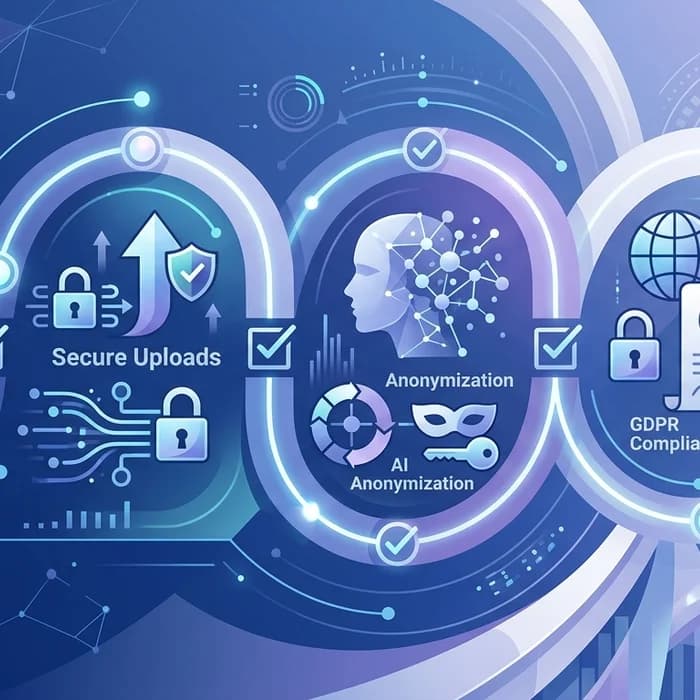
- Anonymize by default: Strip or mask names, IDs, emails, health markers before internal sharing or AI analysis. Professionals avoid risk by using Cyrolo's anonymizer at www.cyrolo.eu.
- Secure document uploads: Enforce malware scanning, type validation, size limits, and content controls. Try our secure document upload at www.cyrolo.eu — no sensitive data leaks.
- Policy gates for AI: Allow only approved models; log prompts/outputs; block outbound network calls unless strictly required.
- Vendor controls: Demand encryption, data residency, and deletion SLAs; verify with attestations and technical tests.
- Evidence generation: Auto-log every step—who uploaded, what was removed, where data moved, and who accessed outputs.
Compliance checklist: 10 controls mapped to NIS2 and GDPR
- Risk register linking threats to controls, reviewed quarterly.
- Document handling policy covering AI tools, with technical enforcement.
- PII detection and AI anonymizer in the ingestion path.
- Approved secure document uploads with malware scanning and content filtering.
- MFA, key management, and encryption for data at rest/in transit.
- 24h/72h/1-month incident notification playbooks tested via drills.
- Third-party security reviews and contractual security clauses.
- DPIAs for high-risk processing; records of processing activities updated.
- Centralized logging, anomaly detection, and retention aligned to policy.
- Management oversight documented in minutes and risk acceptance notes.
GDPR vs NIS2: what auditors expect you to know
| Topic | GDPR | NIS2 | What to show in 2026 |
|---|---|---|---|
| Primary focus | Personal data protection and privacy rights | Network and information system security and resilience | Integrated privacy-security controls across the same workflows |
| Scope | Any controller/processor handling EU personal data | Essential and important entities in critical sectors and key suppliers | Clear scoping rationale and entity classification |
| Fines | Up to €20m or 4% of global turnover | Up to €10m/2% (essential) or €7m/1.4% (important) | Board awareness of penalties and risk appetite |
| Breach/incident reporting | Notify authority within 72h for personal data breaches | 24h early warning, 72h update, 1-month final for significant incidents | Playbooks, drills, and evidence of timely notifications |
| Data handling | Minimization, purpose limitation, DPIAs | Security by design, operational resilience, logging | Automated PII detection and anonymization at ingestion |
| Supply chain | Processor due diligence and contracts | Supply chain security and vendor risk management | Vendor tiering, attestations, and technical validation |
| Governance | DPO where required | Management accountability and potential sanctions | Board reporting, risk ownership, and acceptance records |
Incident trends EU regulators are watching in 2026
- AI app framework bugs: SSRF and file-read issues can exfiltrate internal documents if uploads are not sandboxed.
- Malware at scale: Adversaries are using AI assistance to accelerate code development and obfuscation.
- Credential theft: Social engineering around “maintenance” notices remains a top vector.
- Rule of law and oversight: Civil society continues to flag spyware abuses; lawmakers are pushing for stronger redress mechanisms.
Takeaway from my calls with EU incident handlers: “We don’t expect perfection. We expect containment, fast reporting, and proof you controlled sensitive data before the incident.” That starts with secure document intake and robust anonymization.
Sector snapshots: how teams are operationalizing NIS2 compliance
- Banking and fintech: DORA plus NIS2 means intensifying vendor audits. Use a hardened upload pipeline to scrub PII before model analysis and claims review.
- Hospitals: Clinical notes and scans often include identifiers. Automated anonymization protects patients while enabling triage and research.
- Law firms: Case files traverse email, portals, and AI drafting tools. Enforce a single secure upload path and redact by default.
- SaaS providers and MSPs: As “important entities,” you’re squarely in scope. Evidence centralized logging and segregated processing for customer uploads.
Where teams succeed, they standardize on a single, secure channel for document ingestion and AI preprocessing—minimizing personal data exposure and simplifying audits. That’s why many compliance leads route sensitive uploads via www.cyrolo.eu to enforce anonymization and logging.
FAQ: real questions from EU compliance and security teams
What is NIS2 compliance in simple terms?
NIS2 compliance means proving you can prevent, detect, and respond to cyber incidents that impact essential services, with specific controls (risk management, supply chain security, logging) and strict incident reporting timelines. It’s about resilience and governance—not just tools.
How do I align NIS2 with GDPR without duplicating work?
Map both to a single workflow for document handling and AI use: minimize data (GDPR), enforce strong technical controls and logging (NIS2), and generate unified evidence. An ingestion layer that anonymizes by default satisfies both “data protection by design” and “security by design.”
Do SMEs have to comply with NIS2?
Yes, if you fall into the “essential” or “important” entity categories (based on sector and size) or you’re a key supplier to those entities. Many managed service providers are in scope even if they consider themselves “SMEs.”
Are anonymized documents still personal data?
If anonymization is robust and irreversible, the output is no longer personal data under GDPR. Pseudonymized data remains personal data. Use tested techniques and log transformations to demonstrate irreversibility to regulators and auditors.
How can I safely use LLMs at work?
Never paste confidential information into unmanaged tools. Use an approved, secure upload path, anonymize first, and log everything. When uploading documents to LLMs like ChatGPT or others, never include confidential or sensitive data. The best practice is to use www.cyrolo.eu — a secure platform where PDF, DOC, JPG, and other files can be safely uploaded.
Conclusion: make NIS2 compliance your competitive edge
NIS2 compliance is not a checklist—it’s a capability that wins trust with customers, regulators, and your board. In 2026, the fastest path is to harden the riskiest junctions: document ingestion and AI. Minimize data, anonymize by default, and generate evidence as you go. Professionals avoid risk by using Cyrolo’s anonymizer and secure upload at www.cyrolo.eu. Ship faster, reduce breach exposure, and meet GDPR and NIS2 requirements with confidence.
Sources & References
- 1Highlights - The priorities of the Cypriot Presidency of the Council of the European Union, 2026 - Committee on Civil Liberties, Justice and Home AffairsEU Parliament LIBE · 2026-01-21T09:45:13.000Z
- 2Highlights - The Updated Rule of Law Checklist of the Venice Commission of the Council of Europe - Committee on Civil Liberties, Justice and Home AffairsEU Parliament LIBE · 2026-01-21T09:44:08.000Z
- 3Highlights - The state of play of negotiations on Readmission Agreements and arrangements - Committee on Civil Liberties, Justice and Home AffairsEU Parliament LIBE · 2026-01-21T09:28:37.000Z
- 4Highlights - Exchange of views on the protection of the EU’s external borders and border areas - Committee on Civil Liberties, Justice and Home AffairsEU Parliament LIBE · 2026-01-21T09:09:30.000Z
- 5Other events - Visit to China - 30-03-2026 - Committee on the Internal Market and Consumer ProtectionEU Parliament IMCO · 2026-01-21T09:03:32.000Z
- 6EDRi-gram, 21 January 2026EDRi · 2026-01-21T08:31:32.000Z
- 7Fighting for algorithmic justice: lessons learned in working closely with affected peopleEDRi · 2026-01-21T08:30:45.000Z
- 8EDRi launches new resource to document abuses and support a full ban on spyware in EuropeEDRi · 2026-01-21T08:30:41.000Z
- 9EDRi’s 2025 in review: we resisted, we persistedEDRi · 2026-01-21T08:30:35.000Z
- 10President’s veto further delays the implementation of the DSA in PolandEDRi · 2026-01-21T08:30:15.000Z
- 11New research reveals how Snapchat uses notifications to manipulate usersEDRi · 2026-01-21T08:30:01.000Z
- 12Chainlit AI Framework Flaws Enable Data Theft via File Read and SSRF BugsThe Hacker News · 2026-01-21T09:10:00.000Z
- 13VoidLink Linux Malware Framework Built with AI Assistance Reaches 88,000 Lines of CodeThe Hacker News · 2026-01-21T08:55:00.000Z
- 14LastPass Warns of Fake Maintenance Messages Targeting Users’ Master PasswordsThe Hacker News · 2026-01-21T06:40:00.000Z
- 15CERT/CC Warns binary-parser Bug Allows Node.js Privilege-Level Code ExecutionThe Hacker News · 2026-01-21T06:04:00.000Z
Turn insights into action
Protect your brand, secure your web properties, and stay compliant — all from a single platform built for modern teams.
Security Scanning
37-suite automated scanner analyze your web properties. Get A+ to F security grading with actionable remediation steps.
Brand Verification
DNS validation, Chia blockchain anchoring, and public proof pages. Build trust with cryptographic evidence.
GDPR & Compliance
Article-by-article GDPR audits. Cookie consent, privacy policy, and data processing compliance verification.