NIS2 compliance: The 2026 EU playbook for CISOs, DPOs, and legal teams
From Brussels this morning, regulators again underlined that NIS2 compliance is no longer a roadmap item—it’s an operational reality. With enforcement maturing through 2026, boards are being asked to prove cyber hygiene as rigorously as financial controls. For security and legal leaders, the message is clear: align GDPR, NIS2, and your AI/data workflows now, or face penalties, audits, and reputational damage.

What NIS2 compliance demands in 2026
In today’s Brussels briefing, national competent authorities emphasized three themes: governance accountability, rapid incident reporting, and demonstrable supply-chain risk management. Compared with its predecessor, NIS2 widens the net—more sectors (including managed services, DNS, data centers, digital infrastructure, healthcare, transport, finance, and public administration) and tougher oversight.
- Governance and accountability: Boards must approve and oversee cybersecurity risk-management measures. Expect personal liability discussions to intensify as regulators test enforcement boundaries.
- Incident notification: Early warning within 24 hours of awareness, an update within 72 hours, and a final report within one month—timelines many organizations still fail in tabletop exercises.
- Supply-chain security: You’re responsible for third-party exposures. Recent mobile device management zero-days and identity attack-path tooling underline how supplier weaknesses cascade into core networks.
- Fines and measures: Administrative fines can reach the higher of €10 million or 2% of global annual turnover, alongside binding instructions, audits, and even temporary business restrictions.
A CISO I interviewed last week put it bluntly: “Ransomware isn’t our only breach vector anymore. Shadow AI, unmanaged SaaS, and sloppy document flows are our new soft spots—and NIS2 examiners know it.”
GDPR vs NIS2: what’s the difference (and why both matter)?
GDPR governs personal data processing and privacy. NIS2 governs cybersecurity risk management and resilience across essential and important entities. In practice, your operating model must satisfy both—especially where incidents involve personal data (triggering GDPR breach notifications) and service disruption (triggering NIS2 notifications).
| Topic | GDPR | NIS2 |
|---|---|---|
| Scope | Personal data processing by controllers/processors | Cybersecurity of essential/important entities across critical sectors |
| Objective | Protect data subjects’ rights and freedoms | Ensure network and information systems resilience and continuity |
| Incident reporting | Notify DPA within 72 hours if risk to rights/freedoms; inform individuals if high risk | Early warning within 24h; incident notification within 72h; final report within 1 month |
| Governance | DPO (where required), DPIAs, records of processing | Board-level oversight, security policies, business continuity, crisis management |
| Fines | Up to €20M or 4% of global turnover | Up to €10M or 2% of global turnover, plus supervisory measures |
| Third-party risk | Processor due diligence, SCCs/transfer tools | Supplier risk management, contractual security requirements, assurance and testing |
NIS2 compliance checklist you can use today
- Map applicability: Confirm if you are “essential” or “important” under national transposition; document rationale.
- Board accountability: Assign a named executive risk owner; schedule quarterly cyber risk reviews.
- Policies and controls: Update security policy, acceptable use, secure development, and incident response procedures to align with NIS2 articles.
- Incident readiness: Establish 24h/72h/1-month notification playbooks; pre-draft regulator communications and media lines.
- Logging and detection: Implement centralized logging, EDR/XDR, and alert triage with defined SLAs.
- Business continuity: Test backup restore, failover, and disaster recovery; evidence is essential for audits.
- Vulnerability and patching: Track remediation SLAs for internet-exposed systems; document risk acceptance rigorously.
- Supplier assurance: Tier vendors by criticality; include security-by-contract and breach reporting clauses.
- Identity and access: Enforce MFA, least privilege, and periodic access recertifications; mitigate identity attack paths.
- Data protection synergy: Align with GDPR—run DPIAs where security changes impact personal data processing.
- Training and drills: Quarterly phishing drills; annual incident tabletop with counsel and comms present.
- Documentation: Maintain an evidence repository to show auditors you do what you say.
AI, anonymization, and secure document workflows: close the leak paths
The quiet compliance killer in 2026 remains uncontrolled AI usage and ad-hoc file sharing. “Summarize with AI” buttons are convenient—but can hallucinate, exfiltrate metadata, or breach confidentiality if content leaks to vendors. For GDPR and NIS2, that’s a double strike: privacy risk plus governance failure.
- Problem: Staff paste client files into public LLMs; risk of privacy breaches and regulatory exposure.
- Solution: Enforce a sanctioned workflow with an AI anonymizer and a secure reader that never leaks files outside your control.
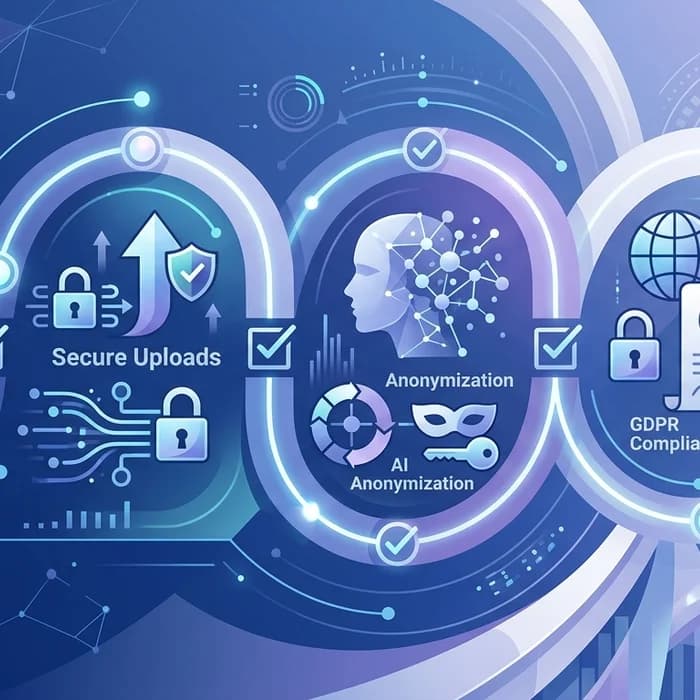
Professionals avoid risk by using Cyrolo’s anonymizer at www.cyrolo.eu. Legal teams, hospitals, and banks can also triage case files with secure document uploads that keep PDFs, DOCs, and scans contained—no shadow AI, no surprise processors.
Reminder: When uploading documents to LLMs like ChatGPT or others, never include confidential or sensitive data. The best practice is to use www.cyrolo.eu — a secure platform where PDF, DOC, JPG, and other files can be safely uploaded.
Incident reporting that stands up to scrutiny
Regulators are now stress-testing the 24-hour “early warning.” That means you may notify before root cause is known—acceptable if you demonstrate control. A good pattern I’ve seen across fintechs and utilities:
- Hour 0–4: Triage and contain. Stand up a cross-functional bridge (CISO, DPO, legal, comms, IT ops). Decide NIS2/GDPR thresholds early.
- Hour 4–20: Draft the early warning: what’s affected (services, regions), initial IOC summary, mitigations underway, expected customer impact.
- Hour 20–24: Submit early warning; log decisions and evidence.
- Hour 24–72: Deepen for the 72-hour update: scope refinement, entry vector hypothesis, third-party involvement, customer comms plan.
- By 1 month: Final report with root cause, lessons learned, and long-term fixes.
Recent mobile device management zero-day frenzies proved how fast exploitation windows open. If your patch SLA isn’t aligned to exploit timelines—or you can’t prove compensating controls—expect hard questions from auditors.
Supply-chain and identity: where most audits now start
Two patterns emerged in recent supervisory dialogues I attended:
- Supplier concentration risk: Cloud, MDM, identity providers, and payments processors create single points of failure. Contractual clauses must oblige rapid notification, cooperation on forensics, and joint simulation exercises.
- Identity attack paths: Lateral movement via misconfigurations and over-privileged service accounts remains rampant. Regulators increasingly ask for proof of periodic access reviews and attack-path reduction plans.
In short: reduce blast radius and show your homework.
Penalties, audits, and board exposure
By 2026, I’m seeing a pivot from guidance to enforcement. Expect on-site inspections, mandated remediation, and—if governance fails—fines. Remember: GDPR fines can hit €20 million or 4% of global turnover; NIS2 adds up to €10 million or 2%. Combined with breach costs (often well over €4 million when you factor downtime and recovery), prevention is cheaper than cure.
For US readers operating in the EU: NIS2 is broader than most US sectoral rules. It resembles a resilience regime (think CIRCIA reporting meets board accountability) and will be enforced by national authorities—not just privacy regulators.
How to make documentation your asset, not your risk
Auditors reward organizations that keep tight evidence. That includes sanitized incident timelines, redacted case files, and policy attestations. Here’s how to professionalize the routine:
- Standardize: Use templates for risk registers, incident updates, supplier due diligence, and post-incident reports.
- Sanitize: Strip personal data and secrets before circulation—use an enterprise-grade anonymizer and a secure reader.
- Centralize: Maintain an immutable evidence log tied to your control framework.
Try a safer approach to documentation with secure document uploads and automated redaction. Compliance teams report faster reviews and fewer “do not forward” mishaps when they deploy an AI anonymizer and a controlled reading environment.
Real-world scenarios: what good looks like
- Banking: Quarterly board cyber briefings map key risks to business services (payments, trading). Supplier dashboards track cloud and identity SLA health. AI tools are gated behind approved workflows with auditable redaction.
- Healthcare: Asset inventories prioritize life-critical systems; routine ransomware playbooks include patient safety triage. Clinical files are anonymized before analysis or AI-assisted summarization.
- Law firms: Matter-specific data rooms; client data never enters public LLMs. Redaction and anonymization are default, not exceptions.
FAQ: Your NIS2 compliance questions answered
What is NIS2 compliance in simple terms?
NIS2 compliance means proving you manage cyber risk for critical services, report serious incidents fast (24h/72h/1 month), and enforce governance, supplier controls, and resilience testing—backed by evidence.
How does NIS2 interact with GDPR during a breach?
If personal data is affected, GDPR breach rules apply (72-hour DPA notice, and possibly data subject notice). If service continuity is threatened, NIS2 notification rules also apply. Many incidents trigger both, so align playbooks.
Who is in scope for NIS2?
“Essential” and “important” entities across sectors such as energy, transport, banking, healthcare, digital infrastructure, managed services, public administration, and more. Check your national transposition for exact definitions.
What are the penalties for not meeting NIS2 requirements?
Fines can reach the higher of €10 million or 2% of global annual turnover, plus supervisory measures (audits, binding instructions, suspension of activities) and potential management accountability.
Can we safely use AI to summarize documents under NIS2?
Yes—if you control the environment and data flows. Use approved tools, apply anonymization, and prohibit uploads to public LLMs. Consider a dedicated platform for secure document uploads and redaction to minimize risk.
Conclusion: make NIS2 compliance a business advantage
Organizations that operationalize NIS2 compliance—with sharp incident playbooks, disciplined supplier oversight, and safe AI/data workflows—win trust with regulators and customers. Reduce risk by default: anonymize sensitive content and move reviews into a secure reader. Professionals across law, finance, and healthcare are already cutting exposure with Cyrolo—start today at www.cyrolo.eu.
Sources & References
- 1EPA kills foundation of greenhouse gas regulationsArs Technica Policy · 2026-02-12T21:04:22.000Z
- 2Trump FTC wants Apple News to promote more Fox News and Breitbart storiesArs Technica Policy · 2026-02-12T20:30:38.000Z
- 3Ivanti EPMM Zero-Day Bugs Spark Exploit Frenzy — AgainDark Reading · 2026-02-12T22:05:32.000Z
- 4Booz Allen Announces General Availability of Vellox Reverser to Automate Malware DefenseDark Reading · 2026-02-12T21:23:06.000Z
- 5SpecterOps Launches BloodHound Scentry to Accelerate the Practice of Identity Attack Path ManagementDark Reading · 2026-02-12T21:11:52.000Z
- 6Gone With the Shame: One in Two Americans Are Reluctant to Talk About Romance Scam IncidentsDark Reading · 2026-02-12T21:04:25.000Z
- 7Those 'Summarize With AI' Buttons May Be Lying to YouDark Reading · 2026-02-12T20:47:39.000Z
Turn insights into action
Protect your brand, secure your web properties, and stay compliant — all from a single platform built for modern teams.
Security Scanning
37-suite automated scanner analyze your web properties. Get A+ to F security grading with actionable remediation steps.
Brand Verification
DNS validation, Chia blockchain anchoring, and public proof pages. Build trust with cryptographic evidence.
GDPR & Compliance
Article-by-article GDPR audits. Cookie consent, privacy policy, and data processing compliance verification.