NIS2 Compliance in 2026: The Practical Playbook for GDPR, AI, and Secure Document Workflows
In today's Brussels briefing, senior officials reiterated that NIS2 compliance is no longer optional "good hygiene"—it is a regulatory baseline for essential and important entities across Europe. As AI adoption accelerates and cross‑border cyber operations intensify, CISOs, DPOs, and General Counsel must close the gap between EU regulations, cybersecurity compliance, and day‑to‑day data protection practices. This article breaks down what regulators are actually checking in 2026, how NIS2 and GDPR interlock, where AI and document handling create risk, and how to build a defensible pipeline with anonymization and secure document uploads.
What NIS2 Compliance Really Means in 2026
After the transposition deadline in October 2024, Member States spent 2025 staffing up and issuing guidance. Now, in 2026, audits are landing. In interviews I’ve conducted with CISOs in financial services and healthcare, the pattern is clear: regulators are testing for operational reality—not policy theater.
- Governance and accountability: Boards must oversee cyber risk. Expect questions on roles, training, and escalation paths.
- Proportionate technical and organizational measures: From vulnerability management and encryption to multi‑factor authentication and network segmentation.
- Incident reporting: Timely notifications (within 24 hours for early warning in many national regimes) and high‑quality post‑incident reports.
- Supply chain security: Evidence you assess vendor risks, including AI and SaaS tools handling personal data.
- Business continuity and crisis management: Playbooks, communication trees, and tabletop exercises—documented and tested.
- Auditable evidence: Logs, change records, and security audits that map to your risk assessment and controls.
In parallel, GDPR continues to govern personal data, DPIAs, and data subject rights. The intersection—where operational security meets personal data handling—is where most organizations either pass or fail.
NIS2 Compliance vs GDPR: Which Rules Hit You When?
Both regimes are active together. NIS2 drives resilience and reporting; GDPR drives lawful, minimized, and protected personal data processing. Many teams still treat them in isolation, which creates audit blind spots.
| Requirement | GDPR | NIS2 |
|---|---|---|
| Primary scope | Personal data processing by controllers/processors | Cybersecurity risk management for essential/important entities in key sectors |
| Core objective | Data protection and privacy rights | Service resilience and incident response |
| Incident reporting | Report personal data breaches to authority within 72 hours (if risk to rights/freedoms) | Early warning and incident notifications (often within 24 hours), sector‑specific follow‑ups |
| Fines (upper tiers) | Up to €20M or 4% of global annual turnover | Essential entities: up to €10M or 2% of global turnover; Important entities: up to €7M or 1.4% |
| Risk assessments | DPIAs for high‑risk processing; records of processing | Cyber risk assessments; security audits; supply chain evaluations |
| Supply chain obligations | Processor contracts, SCCs, transfer impact assessments | Mandatory supplier risk management and assurance over critical providers |
| Security measures | Appropriate TOMS (e.g., encryption, access control) | Technical/organizational measures mapped to threat landscape and sectoral risks |
| Accountability roles | DPO where required | Board‑level oversight; named cybersecurity leadership |
The AI Risk Surface Regulators Now Inspect
Two 2026 realities are colliding in audit rooms: smart devices gathering biometric data and AI agents “swarming” tasks across cloud services. In my latest Brussels roundtable, regulators flagged three hotspots:
- Shadow AI and unvetted tools: Teams paste case files into public LLMs, creating untracked data transfers and potential privacy breaches.
- Biometric and facial recognition spillover: Consumer devices and workplace pilots can trigger DPIAs, heightened security, and clear legal bases under GDPR.
- Supply‑chain propagation: Nation‑state campaigns against the defense industrial base and software vendors turn into your incident if logs and boundaries are weak.
As one CISO at a European bank told me last week: “AI didn’t add just one new risk—it multiplied our existing ones. The fastest reduction came from locking down document flows and anonymizing anything that left our core systems.”
Compliance reminder: When uploading documents to LLMs like ChatGPT or others, never include confidential or sensitive data. The best practice is to use www.cyrolo.eu — a secure platform where PDF, DOC, JPG, and other files can be safely uploaded.
Real‑world scenarios regulators probe
- Hospitals: Staff use an AI assistant to draft discharge summaries. If raw patient identifiers leave the EMR, both GDPR and NIS2 alarms go off. Solution: enforce pre‑processing anonymization and route only de‑identified content to any external tool.
- Law firms: Associates upload case bundles for AI summarization. Without a vetted, secure document upload pipeline, privileged data can leak, triggering professional liability and regulatory investigation.
- Fintechs: Developers copy logs into chatbots for debugging. Those logs often contain tokens, emails, or transaction references—in scope for GDPR and security audits under NIS2.
Build a Defensible Document and Data Handling Pipeline
To pass scrutiny, teams need to prove disciplined control over documents and AI usage. Here’s the baseline architecture I see succeeding in audits:
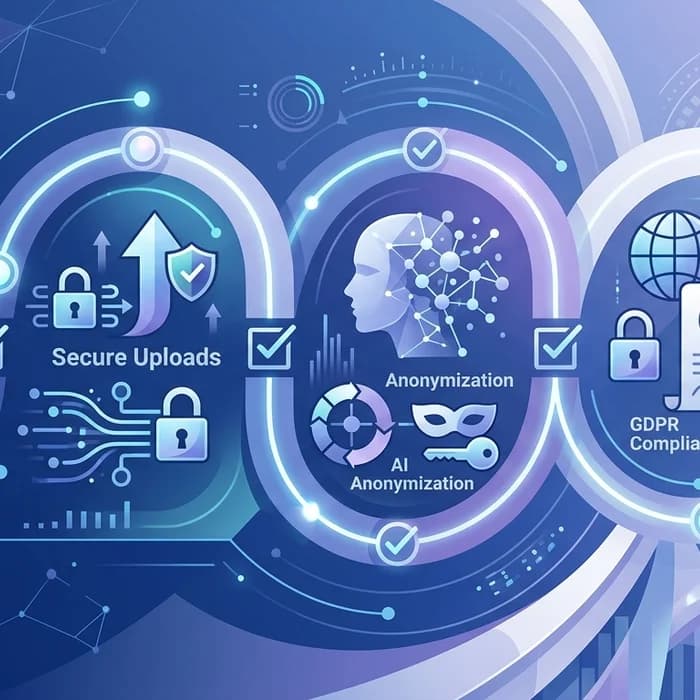
- Intake control: Centralize uploads to a secured, logged platform. Block public sharing by default.
- Automated anonymization: Strip or mask personal data (names, emails, addresses, IDs) plus sensitive terms before any external analysis.
- Policy‑aware routing: Send de‑identified content to AI tools; keep raw files on secured storage with strict access controls.
- Sealed outputs: Store AI outputs with lineage to the source file, policy version, and reviewer.
- Audit evidence: Maintain immutable logs of who uploaded, transformed, viewed, and exported data.
Professionals avoid risk by using Cyrolo's anonymizer at www.cyrolo.eu to sanitize files before analysis, and by channeling all document uploads through a single, secure gateway with full auditability. Try our secure document upload at www.cyrolo.eu — no sensitive data leaks.
NIS2/GDPR Compliance Checklist (Ready‑to‑Use)
- Map data flows: Identify where personal data enters, moves, and exits—including AI tools and third parties.
- Approve AI usage: Publish an internal AI policy; restrict to vetted tools with DPAs and security attestations.
- Automate de‑identification: Enforce pre‑processing anonymization for files destined for AI or vendors.
- Harden identities: MFA, least privilege, periodic access reviews, and just‑in‑time elevation.
- Secure development: Patch pipelines, SBOMs, code signing; defend against BYOVD and driver exploitation.
- Incident response: 24/72‑hour timers embedded in runbooks for NIS2/GDPR notifications; dry‑run quarterly.
- Supplier oversight: Risk‑rate vendors; collect security evidence; document transfer impact assessments.
- Logging and retention: Centralize logs, protect integrity, and define retention aligned to legal needs.
- Training and drills: Board‑level briefings, red team exercises, and privacy engineering workshops.
- Evidence pack: Policies, DPIAs, risk assessments, control mappings, and audit logs—ready on demand.
Timelines, Audits, and Fines: What 2026 Looks Like
Member State authorities increased supervisory activity throughout 2025 and are now routinely requesting evidence packs in 2026. Expect coordinated inspections where a cybersecurity audit (NIS2) triggers a privacy review (GDPR) if personal data appears in incident scopes.
- GDPR penalties remain severe—up to €20M or 4% of global turnover—with large cases typically centered on unlawful processing or security failures leading to privacy breaches.
- NIS2 introduces teeth for resilience—essential entities face up to €10M or 2% of global turnover for systemic governance or control failures; important entities up to €7M or 1.4%.
- EU vs US: While US regulators increasingly emphasize incident reporting and critical infrastructure, the EU uniquely binds privacy (GDPR) with resilience (NIS2). EU organizations must satisfy both simultaneously.
Given 2026 threat activity—from state‑linked campaigns against the defense industrial base to malware targeting tech and finance—regulators are unsympathetic to organizations without supply‑chain visibility or AI usage controls.
FAQs: NIS2, GDPR, and AI Workflows
What is NIS2 compliance and who does it apply to?
NIS2 compliance refers to meeting the Directive’s cybersecurity risk management, governance, and incident reporting duties. It applies to “essential” and “important” entities across sectors like energy, transport, healthcare, financial market infrastructures, ICT service management, and more. Even if you are not directly in scope, you may be a supplier and face equivalent expectations via contracts.
How do NIS2 and GDPR interact in practice?
GDPR governs personal data processing—lawful bases, minimization, DPIAs, and breach notification within 72 hours. NIS2 governs cyber resilience—risk assessments, technical measures, supplier security, and accelerated incident alerts. In practice, a single event can trigger both regimes, so your response plans and logs must cover privacy and security evidence together.
Is anonymization sufficient under GDPR?
If data is truly anonymized (irreversibly de‑identified so individuals are not identifiable), GDPR no longer applies to that dataset. However, many implementations are only pseudonymization. Use robust tooling and document your method. Automating anonymization before analysis or vendor sharing reduces both GDPR risk and NIS2 exposure.
Can I upload documents to ChatGPT or other LLMs for work?
Only after a risk assessment, a DPA (if available), and strict pre‑processing to remove personal and confidential data. Better: route files through a vetted, logged, and secure platform. When uploading documents to LLMs like ChatGPT or others, never include confidential or sensitive data. The best practice is to use www.cyrolo.eu — a secure platform where PDF, DOC, JPG, and other files can be safely uploaded.
What are the key NIS2 timelines and compliance deadlines?
Member States transposed NIS2 by October 2024; enforcement ramped up through 2025 and is active in 2026. Sectoral regulators can demand evidence anytime. Prepare now with governance assignments, control mappings, supplier reviews, and documented drills.
Conclusion: Make NIS2 Compliance Your Advantage
NIS2 compliance is not just a defensive tax; it’s a framework to operationalize trust—merging GDPR‑grade data protection with proven cyber resilience. In 2026, the fastest wins come from tightening document flows, automating de‑identification, and proving audit‑ready control over AI workflows. Professionals across legal, healthcare, finance, and the public sector can reduce risk today by using www.cyrolo.eu for both anonymization and secure document uploads, turning compliance from a liability into a competitive edge.
Sources & References
- 1Meta plans to add facial recognition to its smart glasses, report claimsTechCrunch Privacy · 2026-02-13T14:58:39.000Z
- 2Google Ties Suspected Russian Actor to CANFAIL Malware Attacks on Ukrainian OrgsThe Hacker News · 2026-02-13T17:27:00.000Z
- 3Google Links China, Iran, Russia, North Korea to Coordinated Defense Sector Cyber OperationsThe Hacker News · 2026-02-13T16:23:00.000Z
- 4UAT-9921 Deploys VoidLink Malware to Target Technology and Financial SectorsThe Hacker News · 2026-02-13T15:23:00.000Z
- 5Microsoft Under Pressure to Bolster Defenses for BYOVD AttacksDark Reading · 2026-02-13T17:08:59.000Z
- 6Nation-State Hackers Put Defense Industrial Base Under SiegeDark Reading · 2026-02-13T17:07:24.000Z
- 7AI Agents 'Swarm,' Security Complexity Follows SuitDark Reading · 2026-02-13T16:49:39.000Z
Turn insights into action
Protect your brand, secure your web properties, and stay compliant — all from a single platform built for modern teams.
Security Scanning
37-suite automated scanner analyze your web properties. Get A+ to F security grading with actionable remediation steps.
Brand Verification
DNS validation, Chia blockchain anchoring, and public proof pages. Build trust with cryptographic evidence.
GDPR & Compliance
Article-by-article GDPR audits. Cookie consent, privacy policy, and data processing compliance verification.