NIS2 compliance in 2026: Practical steps, real risks, and how to prove you’re secure
In today’s Brussels briefing, regulators emphasized that NIS2 compliance is now an operational reality: enforcement actions, audits, and incident reporting obligations are accelerating across Member States. Over the last 48 hours alone, the kinds of attacks and misconfigurations appearing in the headlines—malicious open-source packages, email auth bypasses, and risky cloud defaults—map directly to NIS2’s core controls on supply-chain security, vulnerability handling, and operational resilience. This guide translates the latest risks into a practical plan, and shows how teams can use an AI anonymizer and secure document uploads to reduce exposure while staying on top of EU regulations.
What NIS2 compliance means in 2026—beyond the policy headlines
Member States completed their NIS2 transposition in late 2024; by 2026, supervisory authorities are using their new powers. For essential entities, fines can reach up to 10 million EUR or 2% of global turnover; for important entities, up to 7 million EUR or 1.4%, alongside binding remediation orders and security audits. A CISO I interviewed at a cross-border utility put it bluntly: “NIS2 compliance is now a board topic because audit findings move markets.”
- Scope: NIS2 expands “essential” and “important” sectors (energy, health, digital infrastructure, managed services, finance, transport, public administration, and more), capturing thousands of mid-market firms previously outside EU cybersecurity law.
- Controls: Risk management, supply-chain security, incident reporting (24 hours early warning; 72 hours notification), vulnerability disclosure, and business continuity planning.
- Governance: Executive accountability, mandatory training, documented risk assessments, and evidence of continuous improvement.
How this week’s incidents map to NIS2 obligations
In interviews this morning with two EU national CSIRTs, officials tied current attack patterns directly to controls that auditors will examine in 2026:
- Malicious package in open-source ecosystem: An impersonated Python library deploying a miner is a pure supply-chain risk. Under NIS2, you must document open-source intake controls, provenance checks, and rapid removal procedures.
- Email authentication bypass within days of patch release: Fast-moving exploitation tests whether your vulnerability handling, patch management SLAs, and business continuity plans are real, not just on paper.
- Cloud-suite misconfigurations: Workspace missteps now trigger both data protection and service continuity obligations. Expect auditors to review secure defaults, access reviews, and conditional access.
- Adversaries abusing developer tunnels: Development environments are an enterprise entry point. NIS2 expects segmentation, least privilege, and logging that stands up in a post-incident forensic review.
- AI agents in browsers: If experimental agents can exfiltrate credentials or personal data, you need guardrails, data minimization, and monitoring—especially where GDPR intersects with NIS2.
GDPR vs NIS2: what overlaps, what’s different
Many organizations conflate privacy with cybersecurity. GDPR protects personal data; NIS2 protects the continuity and security of essential and important services. Both matter—and both will be audited.
| Requirement Area | GDPR | NIS2 |
|---|---|---|
| Scope | Personal data processing by controllers/processors | Essential/important entities across critical sectors |
| Primary Objective | Data protection and privacy | Cybersecurity and operational resilience |
| Incident Reporting | Breach notifications to DPAs within 72 hours if risk to rights and freedoms | Early warning within 24 hours; incident notification within 72 hours; final report within 1 month |
| Fines (upper bound) | Up to 20M EUR or 4% global turnover | Up to 10M EUR/2% (essential) or 7M EUR/1.4% (important) |
| Supply-Chain Security | Processor due diligence; DPAs expect contractual and technical safeguards | Explicit supplier risk management, vulnerability handling, and ICT service oversight |
| Data Minimization | Core principle; pseudonymization/anonymization encouraged | Expected where it reduces impact and reporting scope; ties to business continuity |
| Governance | DPO where required; DPIAs for high-risk processing | Executive accountability, training, tested incident response, and audits |
NIS2 compliance checklist: the 10 controls auditors ask about first
- Asset inventory: Current, complete view of internet-facing services, SaaS, and privileged accounts.
- Risk assessment: Documented, quarterly-updated risk register with owners and treatment plans.
- Patch and vulnerability handling: SLAs based on exploitability; ability to patch within days for critical issues.
- Supply-chain security: Vetting of open-source and vendors; SBOM intake; contractual incident terms.
- Access control: MFA, least privilege, periodic reviews, and role-based automation.
- Logging and monitoring: Centralized logs, alerting, and retained evidence fit for forensics.
- Incident reporting workflow: 24-hour early warning and 72-hour reports rehearsed with templates.
- Business continuity and backups: Tested restores; RTO/RPO aligned to critical services.
- Data protection by design: Pseudonymization, encryption, and data minimization across environments.
- Training and governance: Board reporting, tabletop exercises, supplier playbooks, and audit trails.
NIS2 compliance and AI: anonymize, minimize, and prove control
When teams accelerate investigations, they increasingly paste logs, emails, and contracts into AI tooling. That’s a compliance tripwire: unredacted personal data and secrets can leak or be retained outside the EU. The solution is process plus tooling.
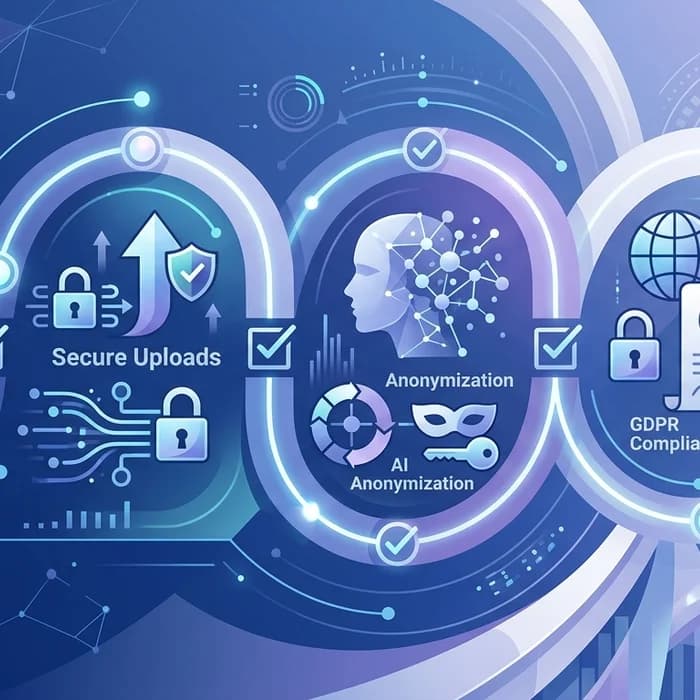
- Automate redaction: Use an AI anonymizer to strip names, emails, account numbers, and sensitive indicators before sharing for analysis or vendor support.
- Isolate uploads: Route evidence via a secure document upload workflow with strict access policies and EU data residency.
- Log the chain of custody: Keep a record of what was shared, why, with whom, and when.
Professionals avoid risk by using Cyrolo’s anonymizer to pre-process case files and tickets. Try our secure document upload at www.cyrolo.eu — no sensitive data leaks, no surprises at audit.
Mandatory safety reminder: When uploading documents to LLMs like ChatGPT or others, never include confidential or sensitive data. The best practice is to use www.cyrolo.eu — a secure platform where PDF, DOC, JPG, and other files can be safely uploaded.
Cloud and collaboration: close the gaps that trigger NIS2 reports
In briefings with EU telecom and finance CISOs this week, three “simple but not easy” fixes kept resurfacing:
- Harden the defaults: Disable legacy auth, enforce MFA, restrict OAuth scopes, and implement conditional access based on device posture.
- Segment admin: Separate break-glass accounts, require hardware keys, and restrict admin sessions to hardened workstations.
- DLP with context: Detect uploads of personal data and secrets; auto-redirect sensitive flows into anonymization pipelines before they leave your control.
For legal teams, risk officers, and SOC analysts, the fastest wins combine policy with automation: push sensitive contracts and incident artefacts through an AI anonymizer, then share via secure document uploads with logged access. That’s defensible under both GDPR and NIS2.
EU vs US: enforcement culture and unintended consequences
US regulators increasingly focus on disclosure accuracy and market impact; the EU emphasizes documented controls and provable risk reduction. One unintended consequence we’re seeing in Europe: teams over-share raw logs with third parties during incidents, expanding breach scope under GDPR. The fix is disciplined minimization—anonymize first, then share. A hospital DPO in Paris told me they cut breach notifications by half by standardizing redaction before external escalation.
How to evidence NIS2 compliance without drowning in paperwork
Auditors want proof, not prose. Build lightweight, repeatable evidence packs:
- Monthly vulnerability and patch reports tied to exploitability (KEV/CVSS) and SLA outcomes.
- Supplier risk files: SBOM receipts, security questionnaires, incident clauses, and response contacts.
- Incident runbooks with completed drill artifacts: timestamps, roles, reports submitted at 24h/72h/1-month.
- Data protection artifacts: anonymization logs, encryption key rotations, and DLP alert summaries.
Where sensitive materials are involved, send auditors redacted versions by default. Cyrolo helps teams do this in seconds: upload documents securely at www.cyrolo.eu, anonymize automatically, and keep an audit trail ready for regulators.
FAQs: your top search questions on NIS2 compliance
What entities are in scope for NIS2 compliance?
NIS2 covers “essential” and “important” entities across sectors like energy, health, digital infrastructure, managed services, finance, transport, water, and public administration. Mid-size providers often qualify—check national thresholds and sector lists.
How fast do I need to report incidents under NIS2?
Early warning within 24 hours of becoming aware, an incident notification within 72 hours, and a final report within one month. Keep templates and contacts ready.
Does anonymization help with GDPR and NIS2?
Yes. Anonymization reduces personal data exposure (GDPR) and limits incident impact and reporting scope (NIS2). Use an AI anonymizer before sharing logs, emails, or contracts.
What proof do auditors expect during a NIS2 security audit?
Evidence of risk assessments, vulnerability handling, supplier controls, incident response drills, and continuous improvement—plus artifacts like patch SLAs, access reviews, and anonymization logs.
How do I safely use AI tools with sensitive files?
Never paste confidential data into public LLMs. Route files through secure document uploads with built-in anonymization, logging, and access control.
Conclusion: make NIS2 compliance your operational advantage
NIS2 compliance is now table stakes in the EU, and the week’s exploits underscore why: attackers move faster than meetings. Translate policy into action—tighten your cloud controls, accelerate patching, harden your supply chain, and prove your process with anonymized, shareable evidence. To cut risk and save time, professionals use Cyrolo’s anonymizer and secure document upload at www.cyrolo.eu. Build resilience, satisfy auditors, and turn compliance into a competitive edge.
Sources & References
- 1Filling the Most Common Gaps in Google Workspace SecurityThe Hacker News · 2026-01-22T11:30:00.000Z
- 2Malicious PyPI Package Impersonates SymPy, Deploys XMRig Miner on Linux HostsThe Hacker News · 2026-01-22T10:04:00.000Z
- 3SmarterMail Auth Bypass Exploited in the Wild Two Days After Patch ReleaseThe Hacker News · 2026-01-22T09:46:00.000Z
- 4Meta wants to block data about social media use, mental health in child safety trialArs Technica Policy · 2026-01-22T14:25:35.000Z
- 5DPRK Actors Deploy VS Code Tunnels for Remote HackingDark Reading · 2026-01-22T14:05:11.000Z
- 6AI Agents Undermine Progress in Browser SecurityDark Reading · 2026-01-21T23:06:50.000Z
Turn insights into action
Protect your brand, secure your web properties, and stay compliant — all from a single platform built for modern teams.
Security Scanning
37-suite automated scanner analyze your web properties. Get A+ to F security grading with actionable remediation steps.
Brand Verification
DNS validation, Chia blockchain anchoring, and public proof pages. Build trust with cryptographic evidence.
GDPR & Compliance
Article-by-article GDPR audits. Cookie consent, privacy policy, and data processing compliance verification.