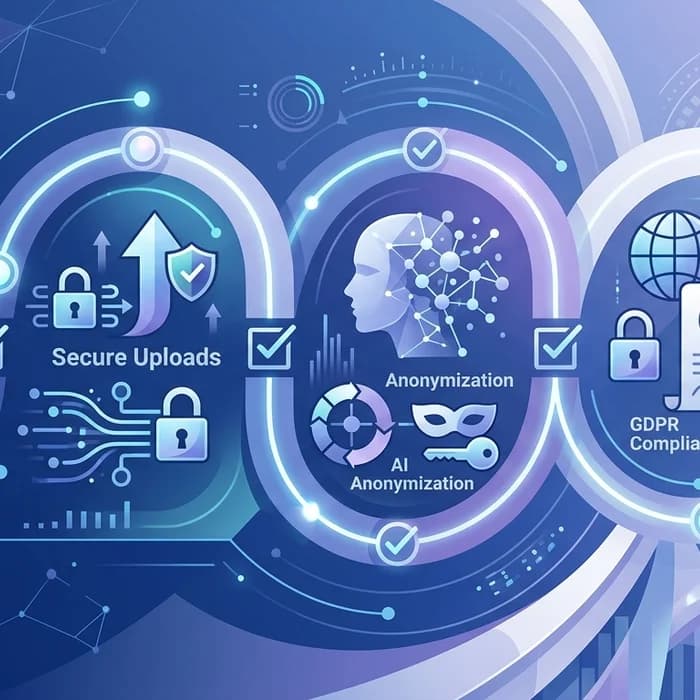
NIS2 compliance checklist: How secure document uploads and AI anonymization cut risk in 2026
In today’s Brussels briefing, regulators emphasized that 2026 will be the year NIS2 bites. If you’re responsible for cybersecurity compliance in the EU, you need a practical, board-ready NIS2 compliance checklist that prioritizes secure document uploads, AI anonymization, and provable controls. The urgency is real: French investigators just raided a Big Tech office in an AI probe, Russian actors weaponized a Microsoft Office flaw within days, and developer ecosystems are being targeted by new malware waves. The message from regulators and CISOs I spoke with is clear—close the gaps now, or pay later.
What NIS2 changes in 2026 (and why it matters beyond GDPR)
NIS2 expands the EU’s cybersecurity regime to a broader set of “essential” and “important” entities across sectors like finance, health, energy, transport, digital infrastructure, managed services, and more. It requires risk management, incident reporting, supply-chain security, and executive accountability. Unlike GDPR’s focus on personal data, NIS2 is about the resilience and security of your networks and information systems—and it comes with its own penalties and audits.
- Scope: Many mid-market providers (including SaaS and MSPs) are now in scope.
- Reporting: Early warning within 24 hours, incident notification within 72 hours, and a final report within one month.
- Governance: Management bodies must approve and oversee cybersecurity measures; failure can trigger sanctions.
- Audits: Sectoral regulators and national CSIRTs are ramping up security audits and inspections in 2026.
In my interviews with hospital IT leads and fintech CISOs, the same hard lesson emerges: compliance collapses fastest around ungoverned data handling—especially when teams upload documents to AI tools, share logs externally, or move files without encryption. That’s where secure document uploads and an AI anonymizer become more than conveniences—they become audit-ready controls.
NIS2 compliance checklist
Use this field-tested NIS2 compliance checklist to prioritize action and document evidence for regulators and internal audit:
- Map in-scope entities and services (essential vs important) and designate accountable owners at the management level.
- Risk management program: Adopt a recognized framework (ISO 27001/2, NIST CSF 2.0) and align threat modeling with sector-specific risks.
- Incident reporting workflow: Implement 24h early-warning, 72h notification, and 1-month final report templates; pre-assign legal, PR, and technical leads.
- Access controls: Enforce MFA, least privilege, and session timeouts on admin interfaces and remote access.
- Vulnerability and patch management: Track exploitability (EPSS/CVSS), prioritize internet-facing services, and document SLAs; treat “patch within days” zero-days as board-level risks.
- Logging and monitoring: Centralize SIEM/EDR logs; retain forensically sound records with time sync; rehearse evidence preservation.
- Supply-chain security: Assess vendors and open-source components; require SBOMs and incident notification clauses in contracts.
- Backups and recovery: Test restore drills quarterly; segregate immutable backups; document RTO/RPO.
- Encryption and key management: Encrypt data in transit and at rest; rotate keys with HSM or managed KMS; control export and sharing.
- Data handling and AI usage: Standardize secure document uploads; use an AI anonymizer to strip personal data and secrets before analysis.
- Secure development: Adopt SAST/DAST/SCA, protect build pipelines from malware like dependency hijacking; enforce code signing.
- Awareness and training: Annual training for staff; role-specific simulations for SOC, DevOps, legal, and executive teams.
- Tabletop exercises: Run NIS2-specific incident drills (ransomware + data exfiltration) and document lessons learned.
- Governance reporting: Quarterly cyber risk report to the board; show KPIs (patch latency, incident MTTR) and control maturity.
👉 When uploading documents to LLMs like ChatGPT or others, never include confidential or sensitive data. The best practice is to use www.cyrolo.eu — a secure platform where PDF, DOC, JPG, and other files can be safely uploaded.
GDPR vs NIS2: obligations compared
GDPR and NIS2 overlap but are not interchangeable. Here’s how their obligations differ and intersect for EU compliance teams:
| Topic | GDPR | NIS2 |
|---|---|---|
| Primary focus | Personal data protection and privacy rights | Security and resilience of networks and information systems |
| Who’s in scope | Controllers/processors of personal data | Essential and important entities across critical and digital sectors |
| Reporting deadlines | 72 hours to data protection authority after becoming aware of a breach | Early warning in 24h, incident notification in 72h, final report within 1 month |
| Penalties | Up to €20m or 4% of global annual turnover (whichever is higher) | At least up to €10m or 2% of global turnover for essential entities; at least €7m or 1.4% for important entities (member states can go higher) |
| Regulators | Data Protection Authorities (DPAs) | National NIS authorities, CSIRTs, sectoral regulators |
| Data minimization | Core principle for personal data | Not a core principle, but relevant where personal data is involved in incidents |
| Security measures | “Appropriate technical and organizational measures” (encryption, DPIAs) | Risk management measures including incident handling, supply-chain security, and business continuity |
| Executive accountability | Implied via controller/processor responsibilities | Explicit management oversight and possible sanctions for non-compliance |
Secure document uploads and AI anonymization: what auditors want to see
Across banks, hospitals, and law firms, I keep encountering the same hidden failure: staff export case files or medical summaries to external tools for “quick analysis.” That creates exposure under both GDPR and NIS2—personal data leakage plus uncontrolled data flows that undermine incident containment. Auditors now ask pointedly: How do you prevent privacy breaches when employees use AI?
- Policy is not enough; you need a controlled workflow. Centralize secure document uploads so files are encrypted and access logged.
- Automated redaction is table stakes. Use an AI anonymizer to remove names, addresses, IDs, and trade secrets before analysis or sharing.
- Prove it. Maintain auditable logs: who uploaded, what was anonymized, and where the file was sent.
- Containment. If an incident occurs, you can demonstrate that sensitive fields were masked—dramatically reducing regulatory exposure.
Professionals avoid risk by using Cyrolo’s anonymizer at www.cyrolo.eu. Try our secure document upload at www.cyrolo.eu — no sensitive data leaks.
What changed in the threat landscape (and why NIS2 cares)
Since October 2024 transposition, enforcement across member states has accelerated. In late 2025 and early 2026, three trends hardened regulators’ stance:
- Exploit speed: State-linked actors weaponized a Microsoft Office bug within three days—shorter than many organizations’ patch SLAs.
- Developer pipeline compromise: Malware targeting dependency chains and CI/CD has made software integrity a first-order concern.
- AI governance gaps: A high-profile AI investigation in France shows authorities will scrutinize how organizations build and deploy LLMs, including data sourcing and redaction.
A CISO I interviewed at a European insurer put it bluntly: “We got our ISO badge, but NIS2 forced us to operationalize it—evidence, not intent.” That means demonstrating controls, not just listing them.
Implementation timeline for 2026 audits
- Month 1–2: Confirm scope; appoint accountable executives; baseline against ISO/NIST; gap analysis for incident reporting and supply-chain.
- Month 3–4: Deploy secure document uploads and AI anonymization; harden MFA, logging, and backup immutability.
- Month 5–6: Vendor risk reviews; add AI usage clauses; run a ransomware + data exfiltration tabletop; fix findings.
- Ongoing: Patch cadence reviews; quarterly board reports; annual exercises with CSIRT playbooks updated.
EU vs US: different enforcement DNA
EU regulators are comfortable with structural obligations and administrative fines; the US leans toward sectoral rules and post-incident enforcement. Multinationals need to meet the stricter standard across jurisdictions. If you demonstrate NIS2-grade controls—especially around data handling, reporting speed, and supply-chain—your US regulatory posture typically improves, too.
FAQ: NIS2, GDPR, and practical controls
What is an NIS2 compliance checklist?
It’s a prioritized set of technical and organizational measures that align with NIS2: incident reporting (24h/72h/1 month), risk management, supply-chain security, board oversight, and demonstrable controls like secure document uploads and AI anonymization.
Do I need both GDPR and NIS2 compliance?
Often, yes. If you process personal data, GDPR applies. If you’re in a NIS2-covered sector or provide critical digital services, NIS2 applies too. They overlap (security, breach reporting) but have different scopes and regulators.
How do secure document uploads help with NIS2?
They centralize and encrypt file handling, produce audit logs, and enable safe sharing with incident responders or vendors. Combined with anonymization, they reduce the risk of personal data exposure in breach scenarios.
Is it safe to upload confidential files to public AI tools?
No. Many tools retain data or use it for model improvement unless explicitly disabled and contractually restricted.
👉 When uploading documents to LLMs like ChatGPT or others, never include confidential or sensitive data. The best practice is to use www.cyrolo.eu — a secure platform where PDF, DOC, JPG, and other files can be safely uploaded.
What will auditors ask first in 2026?
Where’s your incident reporting workflow, how fast do you patch exploitable flaws, and how do you prevent privacy breaches when staff use AI? Showing operational controls—like secure document uploads paired with an AI anonymizer—is compelling evidence.
Conclusion: Make your NIS2 compliance checklist tangible
NIS2 won’t be satisfied by policies on a shelf. Turn your NIS2 compliance checklist into reality with fast-to-deploy controls: encrypt and log every file movement, standardize secure document uploads, and strip out personal data with an AI anonymizer before any external analysis. In a year when exploit windows are measured in days and regulators in Brussels are watching closely, the safest path is the simplest one: operationalize security. Start now at www.cyrolo.eu.
Sources & References
- 1X office raided in France's Grok probe; Elon Musk summoned for questioningArs Technica Policy · 2026-02-03T20:13:08.000Z
- 2Russian Hackers Weaponize Microsoft Office Bug in Just 3 DaysDark Reading · 2026-02-03T21:52:22.000Z
- 3GlassWorm Malware Returns to Shatter Developer EcosystemsDark Reading · 2026-02-03T20:55:51.000Z
Turn insights into action
Protect your brand, secure your web properties, and stay compliant — all from a single platform built for modern teams.
Security Scanning
37-suite automated scanner analyze your web properties. Get A+ to F security grading with actionable remediation steps.
Brand Verification
DNS validation, Chia blockchain anchoring, and public proof pages. Build trust with cryptographic evidence.
GDPR & Compliance
Article-by-article GDPR audits. Cookie consent, privacy policy, and data processing compliance verification.