NIS2 compliance after Europe’s GCVE: what CISOs need to do now
In today’s Brussels briefing, regulators emphasized that Europe’s push for a homegrown vulnerability catalog—often referenced as GCVE—won’t delay enforcement. Instead, it adds urgency to NIS2 compliance for essential and important entities. As EU teams juggle CVE references, national CSIRTs, and sector supervisors, the risk is clear: fragmented identifiers can slow patch prioritization, complicate incident reporting, and increase exposure to GDPR pitfalls when personal data slips into security logs, tickets, or proof-of-concept files.
As I heard from a CISO of a pan‑EU telco this week, “Fragmentation isn’t theoretical. If engineering tracks MITRE CVEs while legal cites a European ID in a regulator notice, mean-time-to-understand goes up, and so does risk.” The practical response is disciplined governance, secure document handling, and built-in anonymization for anything that might include personal data.
- GCVE may coexist with CVE; duplicate or divergent IDs are possible.
- NIS2 elevates vulnerability handling into board-level accountability with fines and audits.
- GDPR applies when logs, screenshots, and tickets contain personal data—anonymization is essential.
- Use secure workflows for uploads and review of vulnerability evidence to avoid privacy breaches.
NIS2 compliance: aligning vulnerability workflows in a multi-database world
GCVE’s emergence reflects Europe’s desire for autonomy over vulnerability information. That’s strategically sound, but it can create overlap with MITRE’s CVE program. For security teams, the operational risk is mismatched identifiers across scanners, SOC playbooks, and supplier advisories. Under NIS2, this matters because:
- Risk-management measures must include timely vulnerability handling and patching.
- Incident reporting timelines are tight; ambiguity about the referenced vulnerability can slow triage and regulator communications.
- Supply chain security demands consistent references when you ask vendors for remediation status.
A practical mitigation is to maintain an internal equivalence map (CVE ↔ GCVE ↔ vendor IDs) in your vulnerability management platform. Your change advisory board (CAB) should also standardize a “primary reference” field and a “cross-reference” field so reports to national CSIRTs are unambiguous.
GDPR vs NIS2 obligations: what changes when personal data enters vulnerability files
When vulnerability tickets include screenshots of dashboards, user emails, or logs with IP addresses tied to natural persons, GDPR obligations kick in alongside NIS2. The table below summarizes differences and overlaps I’ve seen during security audits across hospitals, banks, and fintechs.
| Area | GDPR | NIS2 | Practical takeaway |
|---|---|---|---|
| Scope | Personal data of EU residents | Security and resilience of networks/services for essential and important entities | Vulnerability evidence often touches both regimes |
| Legal basis | Processing must be lawful, necessary, proportionate | Risk management, incident reporting, governance | Limit personal data in tickets; anonymize where possible |
| Reporting timelines | 72-hour breach notification (if personal data breach) | Early warning/notification windows for significant incidents | Harmonize clocks; don’t let ID confusion delay reports |
| Fines | Up to €20m or 4% global turnover | At least up to €10m or 2% (essential) and €7m or 1.4% (important), depending on Member State | Board visibility and budget for controls are non‑negotiable |
| Data minimization | Must collect and store the least data necessary | Not explicit, but aligns with secure-by-design | Use an AI anonymizer before sharing logs or PoCs |
| Third-party sharing | DPIAs, processor contracts, transfer safeguards | Supplier security oversight, SBOMs, coordinated disclosure | Scrub personal data before supplier tickets or CSIRT uploads |
Compliance checklist: keep NIS2 and GDPR in sync
- Adopt a unified vulnerability ID policy (CVE as primary, map to GCVE and vendor IDs).
- Tag tickets that may contain personal data; route them through an AI anonymizer workflow.
- Maintain evidence vaults with role-based access; avoid email attachments.
- Set joint clocks for NIS2 incident notifications and GDPR breach assessments.
- Update supplier SLAs to require cross-references and remediation ETAs.
- Train engineers: never paste PII into public issue trackers or LLMs.
- Run quarterly security audits to verify mapping, patch SLAs, and log hygiene.
Handle sensitive evidence safely: anonymize and control uploads
Most privacy breaches I review do not come from the zero-day itself; they come from how teams handle evidence. Screenshots of admin portals, PDF exports of SIEM alerts, and mobile app crash logs frequently include personal data. That’s where process—and tooling—matters.
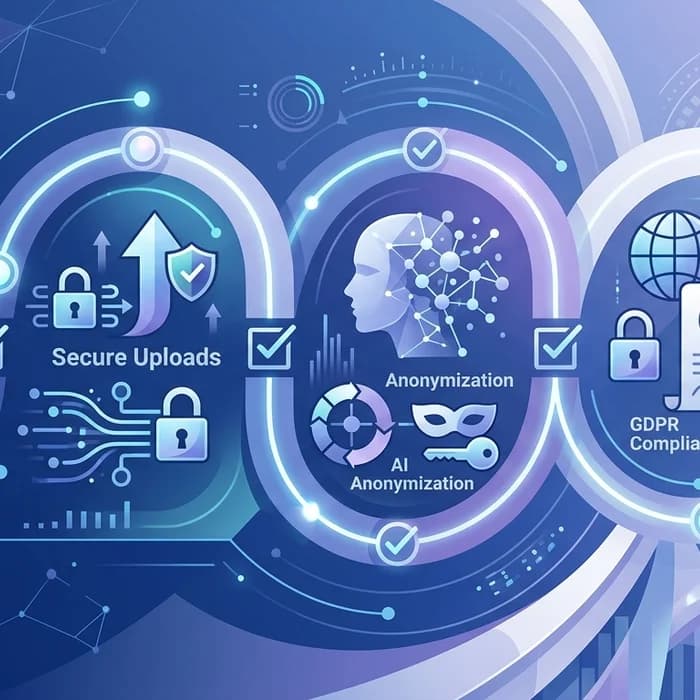
Professionals avoid risk by using Cyrolo’s anonymizer to automatically redact names, emails, ticket IDs, and other identifiers before files are shared with vendors or attached to regulator reports. When your SOC or legal team must exchange evidence, try our secure document upload at www.cyrolo.eu — no sensitive data leaks.
Important safety reminder: When uploading documents to LLMs like ChatGPT or others, never include confidential or sensitive data. The best practice is to use www.cyrolo.eu — a secure platform where PDF, DOC, JPG, and other files can be safely uploaded.
Recommended workflow
- Collect evidence (logs, screenshots, config diffs) into a staging folder.
- Run automated anonymization and verify redactions for accuracy.
- Assign the correct primary vulnerability ID (CVE) and add GCVE/vendor cross-references.
- Upload to a secure portal with access controls and audit logs, not email.
- Share only the minimally necessary excerpt with external parties.
EU vs US: two models for vulnerability catalogs
Europe’s GCVE initiative signals strategic autonomy. The US leans on MITRE CVE with strong CISA coordination and a Known Exploited Vulnerabilities (KEV) list to drive patch deadlines. Expect the EU to align with ENISA and national CSIRTs while retaining local stewardship of identifiers.
- Strength (EU): Closer alignment with EU regulators and sector specifics.
- Strength (US): Single, globally entrenched CVE namespace and KEV urgency.
- Risk (Both): Fragmentation if products, advisories, and regulators reference different IDs without mapping.
The pragmatic path for multinational firms is dual-tracking: keep CVE as your backbone, map to GCVE when present, and ensure your SBOMs and advisories include both.
2026 reality check: audits, deadlines, and penalties
With NIS2 transposed into national law, 2026 is when “show me” replaces “tell me.” Supervisory authorities are requesting:
- Documented risk assessments and vulnerability management policies.
- Evidence of timely patching for KEV-like items and sector alerts.
- Incident reports that cite clear, consistent vulnerability identifiers.
- Proof of staff training on data minimization and secure handling of evidence.
Administrative fines are already being calibrated. For essential entities, Member States set ceilings of at least €10 million or 2% of global turnover; for important entities, at least €7 million or 1.4%. Add GDPR exposure—up to €20 million or 4%—if personal data is mishandled during incident response. In short, governance around vulnerability evidence is board-level risk.
How Cyrolo reduces your exposure today
I’ve sat through too many post-incident debriefs where a preventable privacy leak compounded the original outage. Two controls make a measurable difference:
- Automated anonymization: Before a file leaves your environment, scrub personal data, case notes, and identifiers. Use www.cyrolo.eu to anonymize security logs, screenshots, and PDFs with an AI anonymizer that respects data protection by design.
- Secure evidence exchange: Replace ad hoc email threads with secure document uploads that support PDF, DOC, and image formats with auditability—critical when regulators ask “who saw what, when.”
These steps align with NIS2’s risk-management duties and GDPR’s data minimization principle, giving your legal and security teams shared guardrails.
FAQ
What is GCVE and how does it relate to CVE?
GCVE is a European initiative to catalog vulnerabilities, complementing the longstanding global CVE program. Some vendors and regulators may reference both. To avoid confusion, designate a primary ID (often the CVE) and store cross-references to GCVE and vendor advisories in your tooling.
Does NIS2 require a specific vulnerability database?
No. NIS2 requires robust risk management, timely patching, reporting, and supply chain oversight. It doesn’t mandate a single database, but your processes must handle multiple identifiers consistently and traceably.
How can I anonymize personal data in security logs under GDPR?
Use automated redaction before logs or screenshots are shared outside your core incident team. Professionals rely on www.cyrolo.eu to anonymize names, emails, device IDs, and case numbers, preserving forensic value while protecting privacy.
Is it safe to upload audit PDFs to ChatGPT or other LLMs?
Not with sensitive content. When uploading documents to LLMs like ChatGPT or others, never include confidential or sensitive data. The best practice is to use www.cyrolo.eu — a secure platform where PDF, DOC, JPG, and other files can be safely uploaded.
What fines apply if I mishandle vulnerability evidence?
NIS2 allows fines of at least up to €10m/2% (essential) or €7m/1.4% (important), depending on the entity class and national transposition. If personal data is involved, GDPR fines can reach €20m or 4% of global turnover. Good hygiene around identifiers, access controls, and anonymization reduces that risk.
Conclusion: make NIS2 compliance your advantage
GCVE may raise questions, but it shouldn’t derail NIS2 compliance. Standardize your vulnerability IDs, anonymize evidence by default, and move sensitive sharing into controlled channels. The fastest way to cut risk is to adopt tooling that makes the secure way the easy way—start with Cyrolo’s anonymizer and secure document uploads at www.cyrolo.eu, and turn regulatory pressure into operational discipline.
Sources & References
- 1Europe's GCVE Raises Concerns Over Fragmentation in Vulnerability DatabasesDark Reading · 2026-01-23T20:31:58.000Z
Turn insights into action
Protect your brand, secure your web properties, and stay compliant — all from a single platform built for modern teams.
Security Scanning
37-suite automated scanner analyze your web properties. Get A+ to F security grading with actionable remediation steps.
Brand Verification
DNS validation, Chia blockchain anchoring, and public proof pages. Build trust with cryptographic evidence.
GDPR & Compliance
Article-by-article GDPR audits. Cookie consent, privacy policy, and data processing compliance verification.