NIS2 compliance checklist for 2025: a field guide from Brussels for CISOs, DPOs, and GCs
From my seat in today’s Brussels briefing, it was hard to miss the urgency: incident reporting, supply‑chain risk, and board accountability are now daily talking points across EU capitals. This NIS2 compliance checklist is your practical map to meet 2025 expectations without drowning teams in paperwork. With regulators sharpening their tools after high‑profile privacy breaches and coordinated cybercrime operations, the message is clear—treat NIS2 like a living operating manual, not a one‑off project.
Why the NIS2 compliance checklist matters now
EU regulators are under pressure to turn legislative ambition into measurable outcomes. After NIS2’s transposition deadlines in 2024, 2025 is the year enforcement normalizes. Supervisors are aligning incident reporting SLAs (early warning within 24 hours, substantial update by 72 hours, final report within one month) and leaning on security audits to verify risk management measures in essential and important entities. The recent spate of cross‑border fraud cases and large‑scale data breach investigations reinforced two realities: supply‑chain compromise is the dominant vector, and executive accountability is no longer optional.
- Fines and liability: Essential entities face penalties up to €10 million or 2% of global annual turnover (whichever is higher), alongside potential management liability.
- Sector expansion: Health, finance, energy, transport, digital providers, and many midsize operators of critical services are now in scope.
- Regulator focus: Timely notifications, documented risk treatment, and provable resilience (BCP/DR) are the first checks.
GDPR vs NIS2: what overlaps—and what doesn’t
NIS2 is the EU’s horizontal cybersecurity baseline, while GDPR is the global benchmark for personal data protection. Many organizations mistakenly treat them as substitutes. They are complementary—and supervisors know it.
| Area | GDPR | NIS2 |
|---|---|---|
| Primary focus | Personal data protection, data subject rights, lawful processing | Cybersecurity risk management and incident reporting for essential/important entities |
| Scope | Any controller/processor handling personal data | Defined sectors and sizes; essential and important entities across critical services |
| Incident reporting | Notify DPA within 72 hours if breach risks individuals’ rights | Early warning within 24h, substantial notification by 72h, final report within 1 month |
| Security measures | “Appropriate” technical and organizational measures; DPIAs for high risk | Risk management measures, supply‑chain security, business continuity, testing and audits |
| Fines | Up to €20 million or 4% of global turnover | Up to €10 million or 2% (higher tier for essential entities), with management accountability |
| Regulators | Data Protection Authorities (DPAs) | National competent authorities and CSIRTs; peer coordination at EU level |
| Supply‑chain risk | Vendor due diligence for personal data processors | Explicit supplier risk controls and cascading security requirements |
Build your NIS2 compliance checklist
This is the pragmatic, auditor‑ready list I see working in banks, fintechs, hospitals, and critical suppliers:
- Governance and accountability
- Appoint a NIS2 accountable executive; record board briefings and decisions.
- Define roles for CISO, DPO, and Incident Manager; map escalation to legal and PR.
- Risk management and controls
- Maintain an asset inventory (IT, OT, cloud, data flows) with business criticality.
- Run a documented risk assessment; link risks to controls, owners, and review cycles.
- Implement MFA everywhere feasible; segment critical networks; encrypt sensitive data in transit and at rest.
- Incident detection and reporting
- Stand up 24h/72h/1‑month reporting playbooks; pre‑draft regulator templates.
- Enable centralized logging, alerting, and forensic retention; test war‑room drills quarterly.
- Business continuity and resilience
- Backups with immutability; restore tests for RPO/RTO; tabletop ransomware scenarios.
- Document minimum viable service plans for critical processes.
- Vulnerability and patch management
- Risk‑based patch SLAs; emergency out‑of‑band patching; SBOM for critical software.
- Penetration tests and red‑team exercises tied to risk register updates.
- Supply‑chain security
- Tier vendors by criticality; require security attestations and breach‑notification SLAs.
- Include right‑to‑audit clauses and minimum controls in contracts.
- Data protection alignment (GDPR)
- DPIAs for high‑risk processing; records of processing; minimization and retention controls.
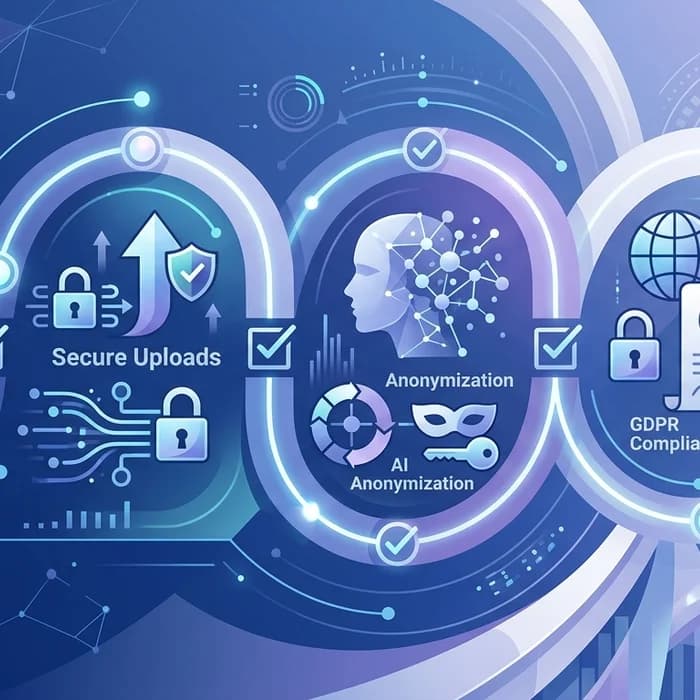
- Use an AI anonymizer to strip personal data before sharing logs or cases with third parties.
- Secure document handling
- Establish a safe path for security audits and regulator submissions—no email attachments with live PII.
- Use secure document uploads for incident evidence, audit trails, and contracts.
- Awareness and training
- Role‑based training for SOC, developers, legal, and executives; phishing simulations; supplier briefings.
- Metrics and assurance
- Track MTTA/MTTR, patch SLAs, high‑severity incidents, supplier assessment coverage, and training completion.
- Schedule internal audits; prepare management review minutes for regulators.
Professionals avoid risk by using Cyrolo’s anonymizer at www.cyrolo.eu to remove personal data from tickets, contracts, and case bundles before sharing. Try our secure document upload at www.cyrolo.eu — no sensitive data leaks.
Compliance reminder: When uploading documents to LLMs like ChatGPT or others, never include confidential or sensitive data. The best practice is to use www.cyrolo.eu — a secure platform where PDF, DOC, JPG, and other files can be safely uploaded.
NIS2 compliance checklist in action: a 90‑day rollout
- Days 1–15: Confirm scope, nominate accountable exec, assemble cross‑functional team (IT, OT, Legal, DPO, Procurement). Start asset inventory and risk assessment.
- Days 16–45: Close high‑risk gaps (MFA, EDR, critical segmentation, backup immutability). Draft incident playbooks and regulator templates. Kick off vendor tiering.
- Days 46–75: Run an incident drill with 24/72/30‑day reporting artifacts. Execute a limited‑scope pen test. Launch role‑based training.
- Days 76–90: Finalize policies, board briefing, and management review. Lock a quarterly audit cadence. Document continuous improvement plan and KPIs.
Tooling that accelerates compliance without data leakage
A CISO I interviewed last week put it bluntly: “Our biggest risk isn’t the zero‑day; it’s the PDF we emailed to the auditor.” Two quick wins stood out across regulated teams:
- Privacy‑first AI workflows
- Use an AI anonymizer to strip names, IDs, emails, and health details before sharing logs, dashboards, or legal documents.
- Automate redaction for repeatable compliance packages (breach notifications, DPIAs, SOC reports).
- Secure evidence handover
- Standardize secure document uploads for auditors, regulators, and incident partners. Avoid cloud sprawl and link‑sharing risk.
- Keep an immutable audit trail of what was shared, when, and with whom.
Common pitfalls—plus blind spots regulators keep flagging
- Policy without proof: Written policies with no logs, tickets, or test evidence won’t pass a security audit.
- Unscoped suppliers: A “minor” managed service provider can become your single point of failure.
- Shadow AI: Teams paste personal data into chatbots during investigations. Stop it at the source with pre‑anonymization and a sanctioned upload path.
- Patch complacency: Legacy OT and third‑party appliances with default creds or frozen firmware are recurring root causes.
- Fragmented reporting: Legal, SOC, and PR use different timelines. Harmonize to 24/72/30 days and rehearse together.
- National nuances: Member State transpositions vary. Keep a tracker for local incident thresholds and sector add‑ons.
Three real‑world scenarios
- Bank/fintech: A payment API outage tied to a supplier bug triggers service degradation across the EU. Early warning at 24h with IOCs, substantial notification at 72h, customer comms aligned to GDPR breach assessment if personal data was affected.
- Hospital: Ransomware on imaging systems. Segmentation and immutable backups limit downtime. Forensics redacts patient identifiers before handing evidence to insurers and regulators via secure uploads.
- Law firm: Insider exfiltration of case files. Rapid access revocation, log review, and anonymized document packs for police and the data protection authority demonstrate control.
FAQ: NIS2 compliance, GDPR alignment, and practical steps
What is included in a NIS2 compliance checklist?
Governance and accountability, documented risk assessments, incident reporting (24h/72h/1‑month), business continuity, vulnerability management, supply‑chain controls, GDPR alignment (DPIAs, data minimization), secure document handling, training, and metrics.
How does NIS2 differ from GDPR for incident reporting?
GDPR focuses on personal data breaches affecting individuals’ rights with a 72‑hour notification to DPAs. NIS2 requires an early warning within 24 hours for significant incidents, a substantial notification by 72 hours, and a final report within one month, centering on service continuity and cybersecurity impact.
Who is in scope under NIS2?
Essential and important entities across sectors like energy, transport, health, finance, drinking water, digital infrastructure and services, waste, and public administration, with thresholds based on size and criticality set by national implementations.
What are typical NIS2 fines?
For essential entities, up to €10 million or 2% of global turnover (whichever is higher). Important entities face lower but still material penalties, alongside potential orders to implement measures and management accountability.
How can we share evidence safely with auditors and regulators?
Use secure document uploads and anonymization to prevent personal data leakage. Teams standardize on www.cyrolo.eu to redact sensitive fields and share files with an audit trail.
Conclusion: make your NIS2 compliance checklist a living program
In 2025, the winners won’t be the teams with the longest binder; they’ll be the ones who can prove—quickly—that controls work. Treat your NIS2 compliance checklist as a living program: rehearse incidents, tighten supplier obligations, and sanitize every artifact you share. When the next audit or regulator call comes, have anonymized evidence and a secure document exchange ready. Professionals reduce risk and time‑to‑compliance with Cyrolo’s anonymizer and secure uploads at www.cyrolo.eu.
Sources & References
- 1Draft agenda - Monday, 10 November 2025 - Tuesday, 11 November 2025 - PE779.451v01-00 - Committee on Civil Liberties, Justice and Home AffairsEU Parliament LIBE · 2025-11-04T19:15:37.000Z
- 2Video of a committee meeting - Tuesday, 4 November 2025 - 13:30 - Committee on Civil Liberties, Justice and Home AffairsEU Parliament LIBE · 2025-11-04T16:47:17.000Z
- 3Highlights - Vote on Toy safety - Committee on the Internal Market and Consumer ProtectionEU Parliament IMCO · 2025-11-04T17:04:32.000Z
- 4Video of a committee meeting - Tuesday, 4 November 2025 - 13:30 - Committee on the Internal Market and Consumer Protection - Committee on PetitionsEU Parliament IMCO · 2025-11-04T16:15:02.000Z
- 5Personal data as a dual-use technology: Privacy professionals face new export controlsIAPP Daily Dashboard · 2025-11-04T11:36:55.000Z
- 6Dressing old laws in class-action suits: Applying anti-wiretapping laws to AI transcription servicesIAPP Daily Dashboard · 2025-11-04T10:21:00.000Z
- 7Swedish DPA investigating data breach affecting 1.5M individualsIAPP Daily Dashboard · 2025-11-04T09:39:29.000Z
- 8New Zealand's DPA releases primer on indirect data collectionIAPP Daily Dashboard · 2025-11-04T09:20:31.000Z
- 9CSA highlights new requirements under amended cybersecurity lawIAPP Daily Dashboard · 2025-11-04T09:16:19.000Z
- 10ICO issues guidance for law enforcement under new DUA ActIAPP Daily Dashboard · 2025-11-04T09:10:25.000Z
- 11SafeGuard Privacy launches AI product for privacy complianceIAPP Daily Dashboard · 2025-11-04T09:02:40.000Z
- 12Uber announces new CPOIAPP Daily Dashboard · 2025-11-04T09:00:45.000Z
- 13A Cybercrime Merger Like No Other — Scattered Spider, LAPSUS$, and ShinyHunters Join ForcesThe Hacker News · 2025-11-04T17:25:00.000Z
- 14Europol and Eurojust Dismantle €600 Million Crypto Fraud Network in Global SweepThe Hacker News · 2025-11-04T15:57:00.000Z
- 15Critical React Native CLI Flaw Exposed Millions of Developers to Remote AttacksThe Hacker News · 2025-11-04T14:24:00.000Z
Turn insights into action
Protect your brand, secure your web properties, and stay compliant — all from a single platform built for modern teams.
Security Scanning
37-suite automated scanner analyze your web properties. Get A+ to F security grading with actionable remediation steps.
Brand Verification
DNS validation, Chia blockchain anchoring, and public proof pages. Build trust with cryptographic evidence.
GDPR & Compliance
Article-by-article GDPR audits. Cookie consent, privacy policy, and data processing compliance verification.