NIS2 Compliance Checklist 2025: EU Cybersecurity Actions, GDPR Overlaps, and Safe AI Document Workflows
In today’s Brussels briefing, regulators repeated a message I’ve heard all autumn: “NIS2 is now enforceable—show your work.” If your board wants a crisp plan, this NIS2 compliance checklist sets out what’s required in 2025, how it interacts with GDPR, and how to fix the most obvious failure point I see in audits: unsecured document flows and AI use. Whether you’re a bank, hospital, manufacturer, or law firm, this is your field manual for EU regulations, cybersecurity compliance, and practical steps that stand up to scrutiny.
Why 2025 Is Different: NIS2 Enforcement Moves From Paper to Proof
After the 17 October 2024 transposition deadline, 2025 is the first full year where national authorities in the EU are actively assessing compliance. Expect formal requests for risk management policies, evidence of board oversight, incident reporting drills, and supplier risk files. Fines are no longer theoretical: essential entities face up to €10 million or 2% of global turnover, while important entities face up to €7 million or 1.4%—plus the reputational damage of public supervisory notices.
What I’m hearing from Brussels and CISOs
- Supervisors are asking for “traceability”: show the log of decisions, the audit trail, and the chain of custody for sensitive documents.
- Incident reporting under NIS2 is a muscle: early warning in 24 hours, significant incident report in 72 hours, and a final report in one month. Teams that haven’t rehearsed this timeline are missing deadlines.
- Active exploitation is assumed. The year started with zero-days in Cisco ISE, Citrix NetScaler, and a Windows kernel flaw under active attack—investigators expect proof of patch cadence and emergency change procedures.
NIS2 Compliance Checklist: What to Do This Quarter
Use this NIS2 compliance checklist as a living document your CISO, DPO, and procurement can adopt immediately.
- Governance and leadership
- Assign board-level responsibility for cybersecurity risk. Record briefings and decisions in minutes.
- Approve a risk management policy that covers network security, access control, incident response, and supply chain.
- Run an annual security audit and document remediation timelines.
- Asset and identity management
- Maintain a real-time asset inventory, including shadow IT and third-party SaaS.
- Harden identity: MFA for admins and remote access, privileged access management, and continuous monitoring of Active Directory.
- Segment networks; restrict lateral movement; baseline critical services.
- Patch and vulnerability management
- Implement emergency patching procedures for zero-days; document time-to-patch SLAs.
- Threat-led testing: internal red teaming or external penetration tests at least annually.
- Data protection and secure document workflows
- Classify data; apply encryption in transit and at rest; enforce DLP rules on endpoints and email.
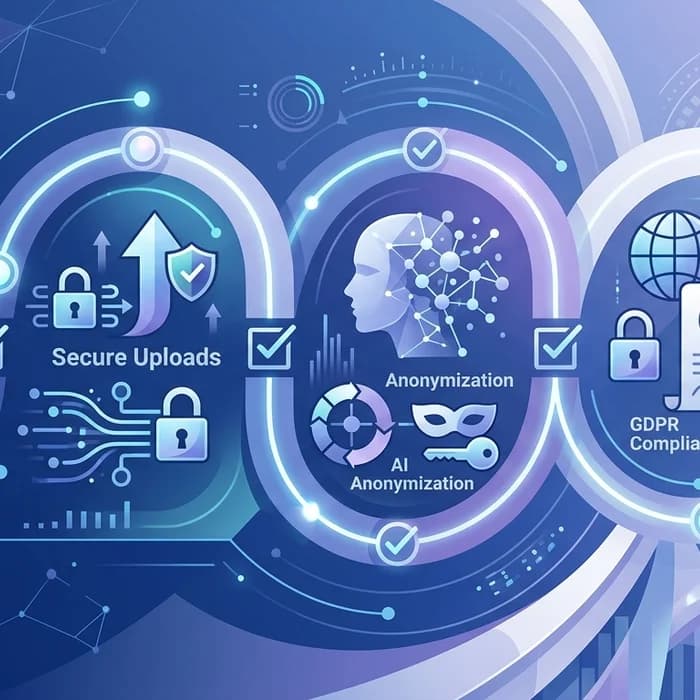
- Eliminate sensitive data in free-text uploads by using an AI anonymizer before analysis or sharing.
- Standardize secure document uploads for contracts, patient files, and audit evidence to reduce shadow copying.
- Incident reporting readiness
- Rehearse the 24h/72h/1-month NIS2 timeline with comms, legal, and IT.
- Pre-draft templates for early warnings and significant incident notifications.
- Supply chain and procurement
- Risk-rate suppliers; collect security attestations; require breach notification clauses.
- For AI/LLM vendors, require contractually binding data-handling, retention, and location controls.
- Logging and monitoring
- Centralize logs; keep tamper-evident audit trails; retain forensically sound evidence.
- Detect and isolate account takeover and data exfiltration patterns.
- Training and drills
- Run phishing and AI misuse simulations; measure completion and effectiveness.
- Update staff guidance on safe document sharing and anonymization.
Professionals avoid risk by using Cyrolo’s anonymizer at www.cyrolo.eu. Try our secure document upload at www.cyrolo.eu — no sensitive data leaks.
AI, LLMs, and Document Safety Under EU Regulations
The fastest-growing root cause of privacy breaches I’m seeing isn’t a firewall misconfiguration—it’s knowledge workers pasting personal data into AI tools or emailing unredacted PDFs. Under GDPR, that’s a high-risk processing activity; under NIS2, it’s a governance failure if unmanaged.
- Before sending anything to an AI tool, strip or mask personal data, contract clauses, case numbers, and identifiers using an AI anonymizer.
- Use standardized, secure document uploads to control where sensitive files live. This reduces data sprawl and supports eDiscovery and audit readiness.
- Log who accessed what and when; maintain deletion schedules aligned to data minimization principles.
Compliance note: When uploading documents to LLMs like ChatGPT or others, never include confidential or sensitive data. The best practice is to use www.cyrolo.eu — a secure platform where PDF, DOC, JPG, and other files can be safely uploaded.
GDPR vs NIS2: What Changes for CISOs and DPOs
DPOs and CISOs increasingly sit at the same table. Here’s how GDPR and NIS2 compare on core obligations.
| Area | GDPR | NIS2 | What it means for you |
|---|---|---|---|
| Scope | Personal data processing by controllers and processors | Security and resilience of network and information systems in essential/important entities | Even if non-personal data, NIS2 obligations still apply |
| Accountability | Records of processing, DPIAs, data minimization | Risk management measures, policies, board oversight, supply chain controls | Merge privacy and cyber risk registers; show clear ownership |
| Incident reporting | Notify supervisory authority within 72 hours for personal data breaches | Early warning in 24h; incident notification in 72h; final report in 1 month | Build one playbook to satisfy both timelines without duplication |
| Fines | Up to €20m or 4% global turnover | Up to €10m/2% (essential) or €7m/1.4% (important) | Combined exposure is material; brief the audit committee |
| Vendors | Processor contracts, SCCs for transfers | Supplier risk management, security clauses, oversight | Upgrade contracts to cover both privacy and resilience |
Sector Snapshots: How Teams Apply the Checklist
- Banks and fintechs
- Problem: complex third-party stacks and API exposure.
- Solution: asset inventory of microservices; PAM for admin interfaces; redact KYC data before model testing via anonymization.
- Hospitals and health providers
- Problem: clinical data in PDFs and images shared across departments.
- Solution: centralized secure document uploads with role-based access; AI-driven masking of patient IDs and scans before analytics.
- Law firms and in-house legal
- Problem: discovery sets sent to external counsel; AI drafting with unredacted contracts.
- Solution: automated redaction of names, numbers, and clauses; logged transfers; off-net sharing disabled by default.
- Manufacturers and critical infrastructure
- Problem: OT-IT convergence and vendor remote access.
- Solution: network segmentation; emergency patching for zero-days (e.g., edge gateways); attest vendor MFA and session recording.
EU vs UK/US: The Regulatory Weather Map
The EU’s approach in 2025 is clear: resilience plus accountability. The UK is moving in parallel on online safety, proposing AI-powered CSAM prevention duties—expect stronger guidance on scanning obligations and safeguards. In the US, sectoral rules dominate; boards face pressure from regulators and litigators, but fewer uniform, NIS2-style duties across all critical sectors. For multinationals, the safest path is to implement NIS2-grade controls globally: one governance framework, region-specific reporting add-ons.
Timelines, Audits, and the One Thing Not to Miss
- Key dates
- Now: National transposition completed; sectoral authorities issuing guidance and questionnaires.
- Quarterly: Expect supervisory requests for evidence, not just policies.
- Anytime: Report significant incidents on the NIS2 timeline; align with GDPR for personal data breaches.
- Audit focus areas I see repeatedly
- Board minutes evidencing cybersecurity decisions and budget.
- Proof of supply-chain due diligence and contract clauses.
- Logging that actually reconstructs incidents, not just collects data.
- Controls for AI and document handling—this is the blind spot that triggers privacy breaches.
Close the document risk gap today: run sensitive files through Cyrolo’s anonymizer and standardize secure document uploads. Your legal, compliance, and SOC teams will thank you when the regulator calls.

FAQ: Your Questions on the NIS2 Compliance Checklist
What entities are in scope of NIS2?
Essential and important entities across sectors like energy, transport, banking, financial market infrastructure, health, water, digital infrastructure, ICT service management, public administration, and more. If you’re medium or large and operate in these sectors or provide critical digital services, assume you’re in scope.
How fast do we have to report incidents under NIS2?
Submit an early warning within 24 hours, a significant incident notification within 72 hours, and a final report within one month. Rehearse this with legal and communications to avoid conflicting disclosures.
Does NIS2 change GDPR obligations?
No, it complements them. GDPR still governs personal data; NIS2 adds system resilience and governance duties. Many incidents trigger both regimes, so create one integrated playbook.
What’s the most common NIS2 audit finding?
Weakness in supplier risk management and ungoverned AI/document use. Regulators expect evidence of anonymization, secure uploads, and data minimization in daily workflows.
How do I prove board oversight?
Keep signed minutes, risk dashboards, budget decisions, and training records. Show periodic briefings and approval of the cybersecurity strategy and incident response plan.
Conclusion: Make the NIS2 Compliance Checklist Your Daily Routine
NIS2 isn’t a binder—it’s a habit. Put this NIS2 compliance checklist into your quarterly cadence, integrate GDPR controls, and fix document and AI workflows where breaches actually happen. Standardize secure document uploads, and anonymize first with Cyrolo to cut exposure without slowing the business. If regulators asked tomorrow, could you prove resilience, not just intent? Start today at www.cyrolo.eu.
Sources & References
- 1
- 2REPORT on the protection of minors online - A10-0213/2025EU Parliament IMCO · 2025-11-12T11:16:40.000Z
- 3IAPP releases Organizational Digital Governance Report 2025IAPP Daily Dashboard · 2025-11-12T09:25:28.000Z
- 4UK proposes adding AI CSAM prevention rules to online crime billIAPP Daily Dashboard · 2025-11-12T09:16:49.000Z
- 5US Chamber alleges misrepresentation of proposed App Store Freedom ActIAPP Daily Dashboard · 2025-11-12T09:15:27.000Z
- 6Amazon Uncovers Attacks Exploited Cisco ISE and Citrix NetScaler as Zero-Day FlawsThe Hacker News · 2025-11-12T14:00:00.000Z
- 7[Webinar] Learn How Leading Security Teams Reduce Attack Surface Exposure with DASRThe Hacker News · 2025-11-12T11:55:00.000Z
- 8Active Directory Under Siege: Why Critical Infrastructure Needs Stronger SecurityThe Hacker News · 2025-11-12T11:07:00.000Z
- 9Microsoft Fixes 63 Security Flaws, Including a Windows Kernel Zero-Day Under Active AttackThe Hacker News · 2025-11-12T10:21:00.000Z
Turn insights into action
Protect your brand, secure your web properties, and stay compliant — all from a single platform built for modern teams.
Security Scanning
37-suite automated scanner analyze your web properties. Get A+ to F security grading with actionable remediation steps.
Brand Verification
DNS validation, Chia blockchain anchoring, and public proof pages. Build trust with cryptographic evidence.
GDPR & Compliance
Article-by-article GDPR audits. Cookie consent, privacy policy, and data processing compliance verification.