NIS2 Compliance Checklist: The 2025 Guide for EU Security Leaders
In today’s Brussels briefing, regulators confirmed that 2025 will be the year they harden supervisory actions on NIS2 — which makes a practical, field-tested NIS2 compliance checklist indispensable for CISOs, DPOs, and legal teams. From blockchain-driven malware campaigns to stealthy eBPF rootkits, the threat landscape has leapt ahead while compliance deadlines from EU regulations like GDPR, NIS2, and DORA keep converging. This guide distills what I’ve seen during audits, interviews with security leaders, and hands-on policy tracking — and shows how to operationalize anonymization and secure document uploads safely.
Why NIS2 matters in 2025
NIS2 now applies across the EU through national laws, covering “essential” and “important” entities across energy, transport, health, finance, digital infrastructure, managed services, and more. If your organization fits the criteria (often mid-sized and above, or with sectoral criticality), you face elevated expectations on risk management, incident reporting, supply chain security, and governance — with fines that can reach up to €10 million or 2% of worldwide turnover for essential entities (and up to €7 million or 1.4% for important entities).
- Broader scope than NIS1: many digital providers and managed service providers are now clearly in scope.
- Harmonized baseline: common security measures, incident reporting timelines, and oversight mechanisms.
- Leadership accountability: management can be held liable; recurring training and oversight duties are explicit.
- Synergy with GDPR and DORA: NIS2 dovetails with GDPR’s personal data protection and DORA’s ICT resilience obligations for financial services, in force since January 2025.
A CISO I interviewed in Frankfurt put it plainly: “With NIS2, the ‘paper compliance’ era is over. Supervisors want evidence, and fast.”
NIS2 Compliance Checklist: What to put in your 90-day plan
Use this NIS2 compliance checklist to build momentum and show tangible progress to regulators and your board:
- Scope and governance
- Confirm your entity classification (essential vs important) and register if your Member State requires it.
- Appoint accountable executives; refresh board oversight and training plans.
- Define risk ownership and set up a cross-functional NIS2 task force (security, legal, procurement, operations).
- Risk management and controls
- Refresh enterprise risk assessment with threat-led scenarios (e.g., supply chain compromise, ransomware, data exfiltration via cloud plugins).
- Implement multi-factor authentication (MFA), least privilege, asset inventory, and vulnerability management with documented SLAs.
- Harden endpoints and servers against kernel-level stealth (e.g., eBPF rootkit detection and integrity checks).
- Incident detection and reporting
- Define thresholds for “significant incidents,” align with national reporting timelines (often 24 hours for early notice).
- Run tabletop exercises with legal and comms; simulate regulator notifications and stakeholder updates.
- Ensure forensic readiness: centralize logs, time-sync systems, and pre-contract an incident response provider.
- Supply chain security
- Risk-rate suppliers (especially MSPs, hosting, and software with plugin ecosystems like CMS/WordPress).
- Add NIS2-aligned clauses: incident notification, logging, right to audit, secure SDLC, and SBOM transparency.
- Continuously monitor third-party posture; validate patch cadence on internet-facing assets.
- Data protection, anonymization, and AI governance
- Map personal data flows; minimize and anonymize where feasible to reduce breach impact and GDPR exposure.
- Control AI/LLM usage policies; segregate sensitive documents; prefer secure, EU-aligned tools.
- Professionals avoid risk by using Cyrolo’s AI anonymizer to strip identifiers before sharing or analysis.
- Auditability and evidence
- Maintain a single source of truth for policies, risk registers, control mappings, and change logs.
- Archive test results (MFA coverage, phishing drills, backup restores, disaster recovery tests).
- Document incident post-mortems and mitigation tracking for supervisory inspections.
Secure handling of documents and AI: reduce breach risk, boost compliance

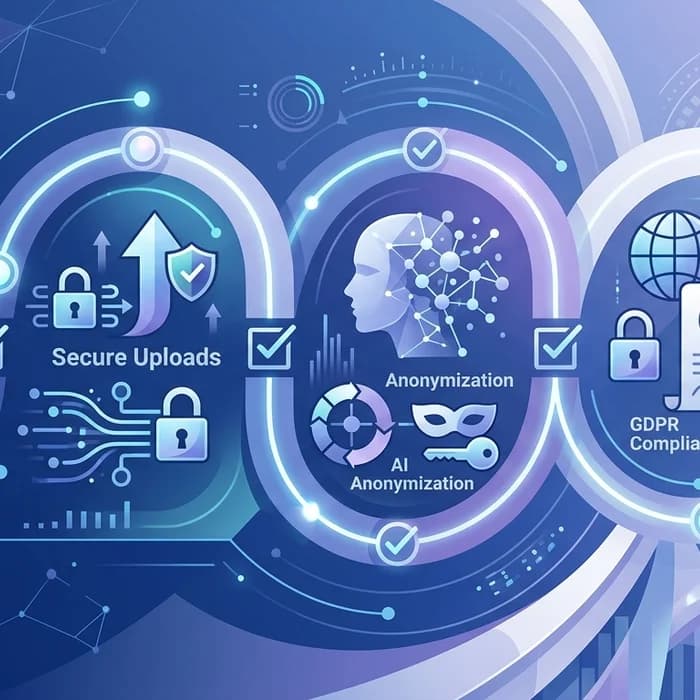
Two recurring failure points in NIS2 and GDPR audits are uncontrolled document sharing and ad-hoc AI usage. I’ve seen investigation files, customer IDs, and contracts end up in unsanctioned tools, creating privacy breaches and discovery nightmares during security audits. The low-friction solution is to centralize workflows where documents are
- Anonymized before external or AI processing
- Uploaded via a secure, access-controlled channel
- Logged for audit trails and retention policy compliance
Try a secure document upload at www.cyrolo.eu — no sensitive data leaks. Legal teams, investigators, and clinical researchers can also reduce GDPR exposure by running files through an anonymization workflow first.
Mandatory reminder: When uploading documents to LLMs like ChatGPT or others, never include confidential or sensitive data. The best practice is to use www.cyrolo.eu — a secure platform where PDF, DOC, JPG, and other files can be safely uploaded.
GDPR vs NIS2: What’s the difference and where they intersect
GDPR protects personal data; NIS2 secures network and information systems for critical and important sectors. In practice, incidents often trigger both regimes. Here’s a quick comparison to align your program:
| Area | GDPR | NIS2 |
|---|---|---|
| Scope | Personal data processing by controllers/processors | Security of network and information systems for essential/important entities |
| Core obligation | Lawful, fair, transparent processing; data minimization; rights | Risk management, incident prevention/detection/response, supply chain security |
| Incident reporting | Supervisory authority within 72 hours if likely risk to rights and freedoms | Early warning and reporting to CSIRTs/authorities (often within 24 hours for significant incidents) |
| Penalties | Up to €20M or 4% global turnover | Up to €10M or 2% (essential); up to €7M or 1.4% (important) |
| Examples of evidence | DPIAs, RoPA, DPA agreements, anonymization logs | Risk register, incident runbooks, supplier clauses, security test results |
Threat landscape 2025: What auditors expect you to have covered
Three trends came up repeatedly in my conversations with EU regulators and national CSIRTs this quarter:
- Malware staged via smart contracts and web plugins
- Attackers are abusing blockchain-backed hosting to rotate payloads, then delivering them through compromised CMS/WordPress ecosystems. Expect domain rotation, script smuggling, and delayed activation.
- NIS2 tie-in: strengthen software composition analysis (SCA), integrity checks, CSP rules, and rapid takedown processes. Keep third-party plugin risk under continuous review.
- Stealth on Linux via eBPF and kernel-level hiding
- Modern rootkits leverage eBPF to hide processes and network activity, evading simple agents.
- NIS2 tie-in: deploy EDR with kernel telemetry, integrity verification, and golden image baselines; log tamper detection and regular offline scans.
- AI-optimized attack chains
- We’re seeing faster phishing iteration, targeted exfil paths, and synthetic identities. Adversaries shorten their dwell time by automating reconnaissance.
- NIS2 tie-in: continuous phishing simulations, identity-proofing for high-risk access, and strict AI usage policies for staff and suppliers.
Industry studies peg the average data breach cost in the €4–5 million range — but supervisory scrutiny can add months of follow-up and remediation demands. Cutting exposure starts with better handling of personal data and sensitive docs. Professionals avoid risk by using Cyrolo’s anonymizer at www.cyrolo.eu.
How audits unfold in 2025: What to show and how to show it
During recent onsite inspections, I saw three patterns separate mature programs from the rest:
- Control-to-evidence mapping
- Maintain a simple matrix that maps each NIS2 requirement to your policy, control owner, and the latest proof (e.g., MFA coverage screenshots, SIEM correlation rules, supplier audit reports).
- Incident lifecycle traceability
- Keep a complete thread: detection alert, triage notes, containment timeline, communications, regulator reports, and post-incident actions with due dates.
- Data minimization by design
- Show that sensitive documents are anonymized and uploaded through controlled channels. Try our secure document upload at www.cyrolo.eu — build a defensible audit trail while reducing GDPR risk.
Quick compliance checklist you can paste into your tracker
- We have confirmed our NIS2 classification and reporting lines.
- Board and executives have received NIS2/GDPR training in the last 6 months.
- MFA is enforced for all users, admins, and third parties.
- Critical assets and internet-facing systems are inventoried and patched within defined SLAs.
- We have a tested incident response plan with 24-hour reporting playbooks.
- Third-party contracts include NIS2 clauses and incident notification obligations.
- We anonymize personal data in documents before external sharing or AI processing.
- We centralize secure document uploads and maintain access logs.
- EDR/monitoring covers Linux eBPF abuse and kernel tampering.
- We run quarterly phishing simulations and measure time-to-detect KPIs.
- Controls are mapped to NIS2 articles with dated evidence.
FAQ: NIS2 compliance, GDPR overlap, and practical steps
What is the fastest way to start a NIS2 compliance checklist?
Begin with scoping (are you essential or important), assign executive ownership, and run a 2-week gap assessment across risk management, incident reporting, and supply chain. Stand up anonymization and secure document uploads early — it reduces both GDPR and NIS2 exposure from day one. Use www.cyrolo.eu to streamline both.
How does NIS2 interact with GDPR?
They’re complementary: GDPR addresses lawful personal data processing and breach notification to DPAs; NIS2 covers system security, resilience, and reporting to national CSIRTs/competent authorities. A single cyber incident can trigger both regimes, so harmonize your playbooks and evidence.
Do we need to change supplier contracts under NIS2?
Yes. Add clauses for incident notification, logging, right to audit, secure development lifecycle, and SBOM transparency. Prioritize MSPs, hosting, CMS/plugin providers, and any vendor processing personal data or operating critical workloads.
Is anonymization required under NIS2?
NIS2 doesn’t mandate anonymization explicitly, but it expects risk reduction and data security by design. Anonymizing personal data in documents and tickets dramatically cuts breach impact and downstream GDPR risk. Consider an AI anonymizer to operationalize this at scale.
What about AI and LLM tools in regulated environments?
Set policy boundaries, segregate sensitive data, and keep audit logs. When uploading documents to LLMs like ChatGPT or others, never include confidential or sensitive data. The best practice is to use www.cyrolo.eu — a secure platform where PDF, DOC, JPG, and other files can be safely uploaded.
Conclusion: Make your NIS2 compliance checklist actionable — and defensible
The organizations winning 2025 audits treat the NIS2 compliance checklist as a living program: measurable controls, supplier rigor, rapid incident playbooks, and disciplined data handling. With regulators escalating oversight and attackers innovating through blockchain payloads and AI-optimized chains, the safest path is to minimize sensitive data exposure and prove your controls with evidence. Start today: anonymize files and centralize secure document uploads at www.cyrolo.eu, and turn compliance into resilience.
Sources & References
- 1Data privacy and the Brazilian public sectorIAPP Daily Dashboard · 2025-10-16T09:37:11.000Z
- 2North Korean Hackers Use EtherHiding to Hide Malware Inside Blockchain Smart ContractsThe Hacker News · 2025-10-16T14:56:00.000Z
- 3Hackers Abuse Blockchain Smart Contracts to Spread Malware via Infected WordPress SitesThe Hacker News · 2025-10-16T14:52:00.000Z
- 4LinkPro Linux Rootkit Uses eBPF to Hide and Activates via Magic TCP PacketsThe Hacker News · 2025-10-16T14:28:00.000Z
- 5Sony tells SCOTUS that people accused of piracy aren’t “innocent grandmothers”Ars Technica Policy · 2025-10-16T19:50:58.000Z
- 6OpenAI thinks Elon Musk funded its biggest critics—who also hate MuskArs Technica Policy · 2025-10-16T16:32:36.000Z
- 7China Hackers Test AI-Optimized Attack Chains in TaiwanDark Reading · 2025-10-16T17:02:24.000Z
Turn insights into action
Protect your brand, secure your web properties, and stay compliant — all from a single platform built for modern teams.
Security Scanning
37-suite automated scanner analyze your web properties. Get A+ to F security grading with actionable remediation steps.
Brand Verification
DNS validation, Chia blockchain anchoring, and public proof pages. Build trust with cryptographic evidence.
GDPR & Compliance
Article-by-article GDPR audits. Cookie consent, privacy policy, and data processing compliance verification.