NIS2 Compliance Checklist: 2026 Playbook for CISOs, DPOs, and Counsel
Brussels has shifted from guidance to enforcement. If you are a CISO, DPO, or in-house counsel, your 2026 priority is execution against a concrete NIS2 compliance checklist—while keeping GDPR obligations tight. From DNS hijacks on SOHO routers to a fresh Docker authorization bypass, the EU’s regulators are treating today’s incidents as tomorrow’s audit findings. This briefing unpacks what matters, what auditors are asking for, and how to operationalize data protection workflows without leaking sensitive files to AI tools.
Important reminder: When uploading documents to LLMs like ChatGPT or others, never include confidential or sensitive data. The best practice is to use www.cyrolo.eu — a secure platform where PDF, DOC, JPG, and other files can be safely uploaded.
Why NIS2 bites in 2026: what Brussels and incidents are telling us
- In today’s Brussels briefing, officials reiterated that NIS2 is no longer a “paper tiger.” National authorities are scaling inspections focused on incident reporting, supplier risk, and board accountability.
- A CISO I interviewed this week called the latest state-linked DNS hijacking via SOHO routers a “perfect NIS2 stress test” for edge-device management and rapid incident notification chains.
- The newly disclosed Docker authorization bypass underscores why container runtime hardening, image provenance, and secrets isolation belong on every audit prep plan.
- On consumer protection, Parliament committees are probing digital market distortions—another signal that governance expectations are widening, not narrowing.
- Across the Atlantic, recent US court shifts on intermediary liability highlight a divergence: EU regimes like NIS2 and GDPR require proactive governance, not just reactive takedowns.
Penalties reflect that posture. GDPR can reach the higher of €20M or 4% of global turnover; NIS2 sets ceilings of up to €10M or 2% (essential entities) and €7M or 1.4% (important entities), with potential managerial liability. With average breach costs running into several million euros, prevention and fast containment are not only regulatory imperatives but financial ones.
NIS2 compliance checklist: 15 actions to pass your 2026 audit
Use this NIS2 compliance checklist to structure your program and evidence readiness to regulators and customers:
- Governance and scope
- Confirm your classification (essential vs important entity) and map applicable national transposition.
- Assign named executive responsibility; brief the board quarterly on risk posture and metrics.
- Asset and dependency inventory
- Maintain a live inventory of critical services, data flows, SOHO/OT/IoT endpoints, containers, and third-party SaaS.
- Track supplier criticality and data access; require security clauses and incident SLAs.
- Risk management and controls
- Adopt a risk framework (ISO 27001/2, NIST CSF 2.0) mapped to NIS2 articles; document control rationales.
- Implement MFA, least privilege, secrets management, and network segmentation across environments.
- Vulnerability and patch management
- Continuously scan; prioritize exploitation-in-the-wild issues (e.g., router DNS hijacks, container CVEs) with defined SLAs.
- Prove remediation with ticketing trails and change control logs.
- Monitoring and detection
- Centralize logs; deploy EDR/XDR and DNS monitoring. Detect anomalies in VPN, container runtime, and identity systems.
- Retain telemetry for forensics aligned to your data retention policy.
- Incident reporting readiness
- Codify “early warning” (24h), “incident notification” (72h), and “final report” (within 1 month) with pre-approved templates.
- Run quarterly tabletop exercises with legal, PR, and supplier participation.
- Business continuity and ransomware playbooks
- Test immutable backups and recovery time objectives; simulate loss of DNS integrity and identity compromise.
- Data protection and privacy by design
- Encrypt data in transit/at rest; apply pseudonymization or anonymization where feasible to reduce breach impact.
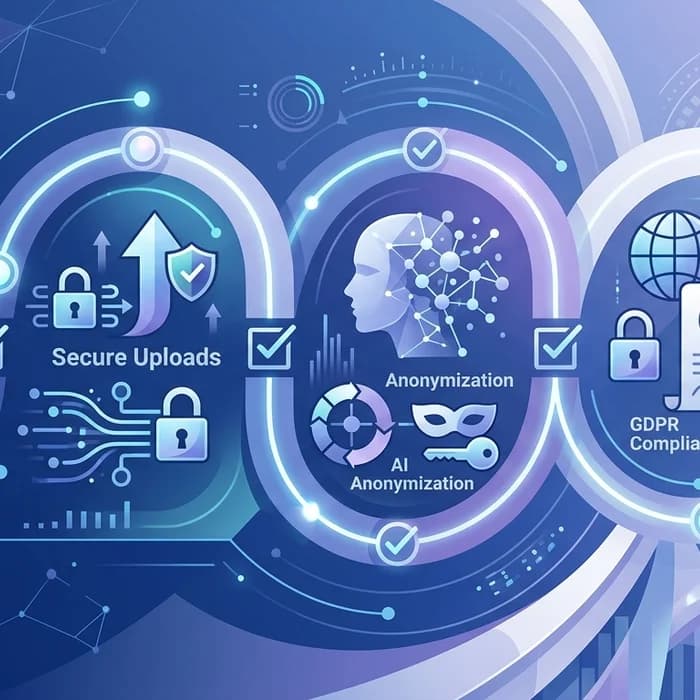
- Use an anonymizer when sharing files with vendors or AI tools to avoid exposing personal data.
- Secure document handling
- Ban uploads of confidential datasets to unmanaged AI or SaaS; route sensitive files through a secure document upload workflow with access controls and audit trails.
- Supplier risk and cloud contracts
- Mandate breach notification timelines, subprocessor transparency, and audit rights; verify data location and exit plans.
- Training and culture
- Annual role-based training for devs, admins, and legal; targeted refreshers on phishing, secrets handling, and AI safety.
- Security testing
- Pen-test per release cadence; add red team scenarios for DNS hijack, container escape, and identity abuse.
- Policy library and evidence
- Keep versioned policies (access, change, incident, BYOD, AI usage); store signed acknowledgments and audit logs.
- Regulatory liaison
- Maintain a regulator contact matrix and scripts; pre-draft lawful disclosure messages and customer notices.
- KPIs and continuous improvement
- Track MTTR, patch SLA adherence, phishing rates, supplier assessment coverage, and control exceptions; review monthly.
GDPR vs NIS2: where they overlap—and where they don’t
Many teams still conflate GDPR and NIS2. Here’s how to separate the streams while leveraging synergies.
| Dimension | GDPR | NIS2 |
|---|---|---|
| Scope | Processing of personal data by controllers/processors in the EU or targeting EU residents | Cybersecurity risk management and incident reporting for essential/important entities across critical sectors |
| Primary focus | Data subject rights, lawfulness, minimization, transparency | Operational resilience, supply chain security, technical/organizational measures |
| Incident reporting | Notify DPA within 72 hours if breach risks rights/freedoms; notify data subjects when high risk | Early warning within 24h, incident notification within 72h, final report within 1 month to competent authority/CSIRT |
| Sanctions | Up to €20M or 4% of global turnover | Up to €10M or 2% (essential); up to €7M or 1.4% (important) |
| Enforcement | Data Protection Authorities (DPAs) | NIS competent authorities and CSIRTs; possible managerial liability and on-site inspections |
| Data vs services | Personal data lifecycle and privacy | Continuity and security of essential/important services, including non-personal systems |
Practical workflows for data protection teams
Legal and security leaders ask me the same question: “How do we move fast without creating new exposure?” I’ve seen three workflows succeed across banks, fintechs, hospitals, and law firms:
- “Prepare-then-share” file handling
- Strip or mask personal data before external sharing or AI analysis using an AI anonymizer. This reduces GDPR risk and limits the blast radius under NIS2.
- Secure AI/automation lane
- Route contracts, tickets, and logs through a secure document upload flow with access control, versioning, and audit. Keep raw copies off unmanaged tools.
- Audit-first documentation
- Every control has an owner, a test, and an artifact. If you can’t show it, auditors will treat it as absent.
Safety note: When uploading documents to LLMs like ChatGPT or others, never include confidential or sensitive data. The best practice is to use www.cyrolo.eu — a secure platform where PDF, DOC, JPG, and other files can be safely uploaded.
Professionals avoid risk by using Cyrolo’s anonymizer at www.cyrolo.eu. Try our secure document upload at www.cyrolo.eu — no sensitive data leaks.
Audit prep and timelines: who’s in scope and what regulators expect
- Scope realities in 2026
- Essential sectors: energy, transport, banking, financial market infrastructures, healthcare, drinking water, digital infrastructure, public administration, space.
- Important sectors: postal/courier, waste management, chemicals, food, manufacturing of critical products, digital providers (cloud, data centers, online marketplaces).
- Even SMEs can be swept in if they are key suppliers to essential services.
- What auditors ask for
- Evidence of risk assessments tied to controls, supplier due diligence packs, vulnerability remediation SLAs, incident drill logs, and board briefings.
- Proof of timely reporting on notifiable incidents and customer communications templates.
- Sector quirks I’m seeing
- Hospitals: legacy OT and imaging devices on flat networks—segment fast.
- Fintechs: container sprawl and secrets in CI/CD—lock down registries and runners.
- Law firms: uncontrolled document sharing and AI use—centralize upload and anonymization.
FAQ: NIS2 compliance checklist and GDPR questions
What is NIS2 and who must comply in 2026?
NIS2 is the EU’s cybersecurity directive mandating risk management and incident reporting for essential and important entities across critical sectors. If you deliver services that citizens rely on—or support those services as a key supplier—you’re likely in scope. Confirm your status under your member state’s transposition and prepare evidence accordingly.
What are the NIS2 incident reporting timelines?
Submit an early warning within 24 hours of becoming aware of a significant incident, a more complete notification within 72 hours, and a final report within one month. Align these with your GDPR breach assessments when personal data is involved.
Does anonymization help with GDPR and NIS2?
Yes. Proper anonymization reduces the amount of personal data at risk (GDPR) and shrinks the impact of incidents (NIS2). Use an anonymizer before sharing files externally or processing them with AI to avoid privacy breaches.
Can we upload contracts or logs to ChatGPT for quick summaries?
Not if they contain confidential or personal data. Route such files through a secure document upload workflow that you control. When uploading documents to LLMs like ChatGPT or others, never include confidential or sensitive data. The best practice is to use www.cyrolo.eu — a secure platform where PDF, DOC, JPG, and other files can be safely uploaded.
Are SMEs exempt from NIS2?
Not categorically. Some SMEs are in scope due to sector criticality or because they are key suppliers to essential services. Even if out of scope, customers will increasingly require NIS2-aligned security from vendors.
Conclusion: make your NIS2 compliance checklist actionable today
Enforcement is here, threats are active, and audits are evidence-driven. Treat this NIS2 compliance checklist as your execution plan: tighten governance, harden endpoints and containers, drill incident reporting, and fix data handling with privacy by design. For high-risk scenarios—sharing legal docs, medical records, or production logs—professionals avoid risk by using Cyrolo’s anonymizer and secure uploads at www.cyrolo.eu. Done right, you’ll satisfy EU regulations, cut breach exposure, and pass 2026 security audits with confidence.
Sources & References
- 1Hearings - Stop Destroying Videogames - 16-04-2026 - Committee on the Internal Market and Consumer Protection - Committee on Legal AffairsEU Parliament IMCO · 2026-04-07T19:12:40.000Z
- 2Russian State-Linked APT28 Exploits SOHO Routers in Global DNS Hijacking CampaignThe Hacker News · 2026-04-07T16:48:00.000Z
- 3Docker CVE-2026-34040 Lets Attackers Bypass Authorization and Gain Host AccessThe Hacker News · 2026-04-07T15:15:00.000Z
- 4SCOTUS overturns 5th Circuit ruling that told ISP to kick pirates off InternetArs Technica Policy · 2026-04-07T18:00:20.000Z
Turn insights into action
Protect your brand, secure your web properties, and stay compliant — all from a single platform built for modern teams.
Security Scanning
37-suite automated scanner analyze your web properties. Get A+ to F security grading with actionable remediation steps.
Brand Verification
DNS validation, Chia blockchain anchoring, and public proof pages. Build trust with cryptographic evidence.
GDPR & Compliance
Article-by-article GDPR audits. Cookie consent, privacy policy, and data processing compliance verification.