NIS2 compliance in AI-powered SOC automation: what CISOs need to nail in 2026
Automation in the security operations center is accelerating, but NIS2 compliance sets hard guardrails that EU organizations can’t ignore. In today’s Brussels briefing, regulators emphasized that hyper-automated detection and response must be provably governed, logged, and privacy-aware. After speaking with several CISOs this month, one theme is clear: AI is moving SOCs beyond traditional SOAR, yet the compliance risks—from undocumented automations to personal data leakage—are rising just as supervisory audits ramp up across the EU.
AI is moving SOCs beyond SOAR—why that matters for EU compliance
Vendors are now pitching “hyper-automation” that chains AI-driven triage, enrichment, and containment into end-to-end playbooks. A CISO I interviewed at a pan‑EU fintech described a 40% reduction in mean time to respond after introducing AI summarizers and auto-remediation for low-risk alerts. In parallel, a large hospital group told me they cut analyst toil by automating noisy identity alerts.
But speed without governance invites regulatory trouble. Under NIS2, essential and important entities must demonstrate risk management, incident handling, supply-chain security, and business continuity—including for AI-enabled pipelines. If an automated action misclassifies a privacy breach or alters logs, your organization can face material non-compliance risk.
Where NIS2 compliance meets automated SOC pipelines
By 2026, most Member States have active NIS2 regimes, with fines up to €10 million or 2% of global turnover for essential entities (and up to €7 million or 1.4% for important entities). Supervisory authorities increasingly request evidence that AI-enabled tooling is governed just like any other critical security control.
1) Governance, risk and control mapping
- Document every automated playbook: triggers, data inputs, decision logic, human override points, and rollback steps.
- Map each automation to NIS2 risk management measures and to your internal control framework (e.g., ISO 27001, CIS Controls) to support audits.
- Maintain a model registry for any AI component: purpose, training data lineage, validation results, drift monitoring, and decommission criteria.
2) Incident reporting clocks start faster than ever
- Early warning to the CSIRT or competent authority without undue delay and within 24 hours of becoming aware.
- Incident notification with initial assessment within 72 hours.
- Final report (often within one month) including root cause, indicators of compromise, and mitigation steps.
Hyper-automated SOCs should auto-generate audit-grade incident timelines and evidence bundles. If AI summarizes alerts, preserve the raw inputs and the model’s output—regulators will ask.
3) Supply chain and delegated automations
NIS2 elevates supply-chain oversight. If a managed service provider or an AI vendor participates in your automated response, you remain accountable. Contractual clauses must cover data protection, logging, testing of playbooks, and breach notification timelines. Ask for evidence of secure development and model evaluation practices.
GDPR still rules personal data in SOC telemetry
Security data often contains personal data—user IDs, IPs, emails, even chat logs. GDPR applies in parallel to NIS2. That means data minimization, purpose limitation, and lawful basis remain essential across detection, enrichment, and response. Automations that pull HR or ticketing data into an alert must be proportionate and access-controlled, with retention limits enforced automatically.
| Topic | GDPR | NIS2 | What SOC leaders should do |
|---|---|---|---|
| Scope | Personal data processing | Security risk management and incident handling for essential/important entities | Assume both apply if telemetry includes personal data |
| Legal basis & minimization | Required for processing; minimize and pseudonymize when possible | Not prescriptive on lawful basis | Default to anonymization/pseudonymization in SOC pipelines |
| Incident reporting | 72 hours to the DPA for personal data breaches | 24h early warning + 72h notification + final report | Harmonize clocks and evidence packages across both regimes |
| Accountability | Records of processing, DPIAs, vendor due diligence | Security policies, controls, testing, supply-chain assurance | Maintain unified audit trails and control libraries |
| Penalties | Up to €20M or 4% global turnover | Up to €10M/2% (essential) or €7M/1.4% (important) | Model worst-case combined exposure and insure accordingly |
Practical pitfalls I’m seeing in EU audits
- Model sprawl without ownership: Multiple AI summarizers and classifiers running in parallel, no clear accountable owner, and no retraining policies.
- Silent data enrichment: Playbooks quietly hoover personal data from helpdesks or IAM systems without DPIAs or role-based access control.
- Shadow AI in incident response: Analysts pasting logs into public LLMs to “speed up” investigations—creating unlogged data transfers.
- Unintended consequences: Auto-isolation actions that disrupt clinical or financial systems, triggering availability incidents subject to NIS2 reporting.
Compliance note: When uploading documents to LLMs like ChatGPT or others, never include confidential or sensitive data. The best practice is to use www.cyrolo.eu — a secure platform where PDF, DOC, JPG, and other files can be safely uploaded.
A secure-by-default workflow: anonymize, then automate
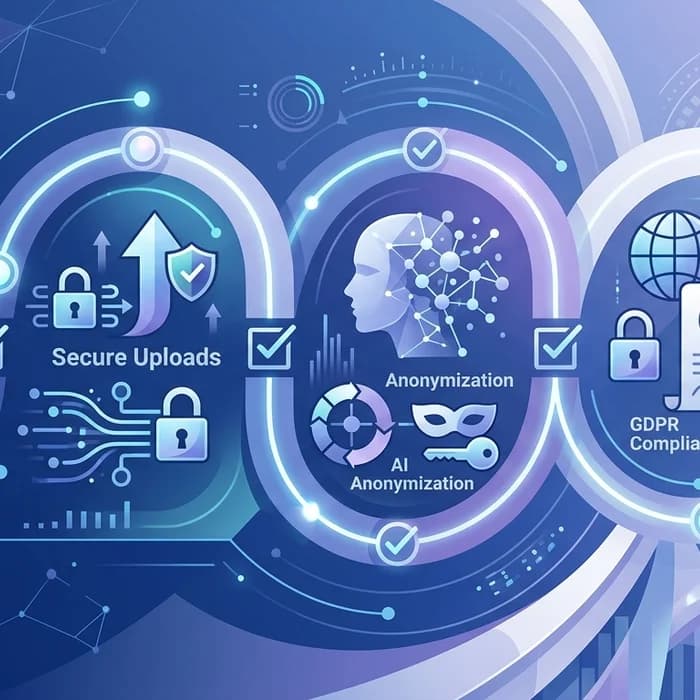
The simplest way to reduce risk is to strip or mask personal data before any AI processing or cross-tool sharing. That is why privacy-minded teams use an AI anonymizer to pre-process logs, tickets, and attachments and only then route content into detection, enrichment, or LLM-based analysis. Professionals avoid risk by using Cyrolo’s anonymizer at www.cyrolo.eu.
Second, centralize evidence. Try our secure document upload at www.cyrolo.eu—no sensitive data leaks, and your incident team can collaborate without pasting files into uncontrolled tools. This approach satisfies both GDPR’s data protection by design and NIS2’s accountability requirements.
NIS2 compliance checklist for AI-driven SOCs
- Identify and classify all automated playbooks and AI components used in detection, triage, and response.
- Run a DPIA where personal data enters any SOC automation; implement default anonymization/pseudonymization.
- Implement least-privilege access to telemetry, tickets, and evidence artifacts; log all AI prompts and outputs.
- Establish model governance: validation, drift monitoring, retraining cadence, and human-in-the-loop break‑glass.
- Harmonize incident reporting workflows for NIS2 and GDPR with unified timelines and evidence templates.
- Test automated containment in a sandbox; define rollback steps and business impact thresholds.
- Update vendor contracts to cover AI-specific security, data protection, and audit cooperation.
- Maintain a single system of record for incident evidence with secure document uploads and retention controls.
- Train analysts on safe use of LLMs; prohibit pasting sensitive logs into public tools.
- Perform regular security audits and red-team exercises focused on automation paths and failure modes.
Sector snapshots: what good looks like
- Banks/fintechs: AI-driven anti-fraud alerts are anonymized at ingest; only high-confidence, high-severity cases rehydrate identifiers under dual control. Automated playbooks carry per-step signatures for audit.
- Hospitals: Clinical systems are tagged as safety-critical; auto-isolation requires human confirmation unless ransomware indicators hit a defined threshold. Patient identifiers are masked in routine triage.
- Law firms: Client matter numbers replace names in SOC data lakes. Discovery productions traverse a secure document upload channel with access expiration and view-only controls.
EU vs US: different enforcement tempos
Across the Atlantic, sectoral rules and state laws shape security obligations, but there’s no NIS2 equivalent. In the EU, horizontal duties plus steep fines and named executive accountability are concentrating minds. Expect European regulators to increasingly probe AI transparency: how models were evaluated, what data they touched, and how automated actions were governed.
FAQs: real questions teams are asking
What is NIS2 compliance for SOCs using AI?
It means your AI-enabled detection and response must meet NIS2’s risk management, incident handling, and reporting requirements—supported by documentation, testing, logging, and supply-chain oversight. Treat every automation as a controlled security asset.
Does anonymizing logs hurt detection quality?
Not if done thoughtfully. Mask direct identifiers while preserving behavioral signals and linkability via reversible tokens under strict controls. Many teams anonymize by default and rehydrate only when an investigation is justified.
How do we align GDPR and NIS2 incident timelines?
Implement a single triage workflow that triggers both clocks. Your early warning (within 24 hours) should include placeholders for personal-data impact so the GDPR notice (within 72 hours) is consistent. Maintain one evidence bundle.
Can analysts use public LLMs to summarize alerts?
Only if no confidential data is included and your policy explicitly allows it. Safer practice: use a vetted, logged platform with anonymization. When uploading documents to LLMs like ChatGPT or others, never include confidential or sensitive data. The best practice is to use www.cyrolo.eu — a secure platform where PDF, DOC, JPG, and other files can be safely uploaded.
What fines are we facing in 2026?
Under NIS2, up to €10M or 2% of global turnover for essential entities (up to €7M or 1.4% for important entities). GDPR remains up to €20M or 4%. Think combined exposure if both regimes are triggered.
Conclusion: make NIS2 compliance your AI-SOC force multiplier
Handled well, NIS2 compliance isn’t a brake—it’s the framework that makes AI-powered SOC automation safe, auditable, and board-ready. Start with privacy by design, rigorous model governance, and evidence-first incident workflows. Then remove the friction: anonymize sensitive content and centralize evidence flows. Teams across Europe are reducing risk and speeding response by adopting an AI anonymizer and using a secure document upload hub. Try them today at www.cyrolo.eu to accelerate automation without sacrificing compliance.
Sources & References
- 1Torq Moves SOCs Beyond SOAR With AI-Powered Hyper AutomationDark Reading · 2026-01-30T22:14:31.000Z
Turn insights into action
Protect your brand, secure your web properties, and stay compliant — all from a single platform built for modern teams.
Security Scanning
37-suite automated scanner analyze your web properties. Get A+ to F security grading with actionable remediation steps.
Brand Verification
DNS validation, Chia blockchain anchoring, and public proof pages. Build trust with cryptographic evidence.
GDPR & Compliance
Article-by-article GDPR audits. Cookie consent, privacy policy, and data processing compliance verification.