NIS2 compliance in 2026: Satellite internet, AI workflows, and secure document handling
As EU networks lean on new connectivity and AI-powered tooling, NIS2 compliance has become the operational line between resilience and regulatory risk. In Brussels this week, digital policymakers flagged the security ripple effects of expanding satellite constellations—hours after US regulators cleared thousands of new low‑Earth‑orbit satellites. For EU CISOs and legal teams, the lesson is clear: align cybersecurity controls, data protection, and incident reporting across suppliers, telecoms, and AI workflows—or face fines, audits, and reputational damage.

Why NIS2 compliance just got harder: satellite connectivity and supply-chain risk
I spoke with two European telecom CISOs who described a “quiet shift in the attack surface” as branches, ships, clinics, and remote sites add satellite backhaul to keep services online. With fresh US approvals for additional satellite launches, the EU threat model widens: more cross‑border traffic, more third‑country infrastructure, and more dependency on providers you do not control.
From today’s Brussels briefing, regulators emphasized three points:
- Under NIS2, providers of public electronic communications networks and services are in scope as essential entities. Your resilience relies on them—and your obligations do not shrink because a supplier failed.
- Space-adjacent dependencies matter. In several Member States’ transpositions, operators of ground infrastructure supporting space‑based services are included; due diligence must reach into this chain.
- Incident reporting timelines are unforgiving: early warning within 24 hours, substantial incident report within 72 hours, and a final report within one month.
The regulatory tone has shifted from privacy-centric to availability- and integrity‑first. This is the core of NIS2: documented risk management, verifiable controls, and accountable governance across your ecosystem.
Core NIS2 compliance obligations security leaders must operationalize
Practical NIS2 compliance means you can evidence the following at any moment:
- Governance and accountability: board‑level oversight, named responsible persons, and security integrated into corporate risk management.
- Risk management measures: policies for asset management, access control, encryption, vulnerability handling, and secure development.
- Supply-chain security: assessed critical suppliers (including satellite connectivity, cloud, and managed services), contractually enforced controls, and monitoring.
- Incident handling and reporting: 24/72/30‑day reporting workflows, contact with your national CSIRT, escalation playbooks, and evidence of regular testing.
- Business continuity and crisis management: redundancy plans (including alternative connectivity), backups, and disaster recovery exercises.
- Security testing and audits: penetration tests, red teaming where proportionate, and remediation tracking.
- Awareness and training: role‑based training for IT, legal, engineering, and frontline staff.
Fines under NIS2 can reach up to €10 million or 2% of global annual turnover for essential entities (and up to €7 million or 1.4% for important entities). That is before breach remediation costs—now roughly €4.5–€5 million on average—plus lost contracts and regulator‑mandated improvements.
GDPR vs NIS2: what changes for CISOs and DPOs
| Area | GDPR | NIS2 |
|---|---|---|
| Primary focus | Personal data protection and privacy rights | Network and information system security and operational resilience |
| Who it applies to | Controllers and processors handling personal data in the EU | Essential and important entities across critical sectors (incl. telecoms, healthcare, finance, digital infrastructure) |
| Incident reporting | Notify DPA within 72 hours if personal data breach likely risks rights/freedoms | Early warning within 24 hours; incident notification within 72 hours; final report within one month |
| Fines | Up to €20M or 4% global turnover | Up to €10M or 2% global turnover (essential); up to €7M or 1.4% (important) |
| Security measures | “Appropriate” technical and organizational measures (risk‑based) | Specific risk management measures, governance duties, supply‑chain controls, audits |
| Scope of incidents | Personal data breaches | Any incident significantly impacting service provision, business operations, or security of network/information systems |
| Supervision | Data protection authorities (DPAs) | National NIS authorities and CSIRTs; potential inspections and security audits |
Practical blueprint: a 90‑day checklist to accelerate NIS2 compliance
- Map services and dependencies: catalog business‑critical services, providers (including satellite and SD‑WAN), data flows, and recovery time objectives.
- Gap assessment: benchmark your controls against NIS2 requirements; document material gaps and owners.
- Incident workflows: codify 24/72/30‑day reporting, who calls the CSIRT, and templates for regulator notifications.
- Supplier assurance: add security clauses, right to audit, incident notification SLAs, and evidence requests for key providers.
- Access minimization: enforce least privilege, MFA everywhere, and rotate credentials of third‑party service accounts.
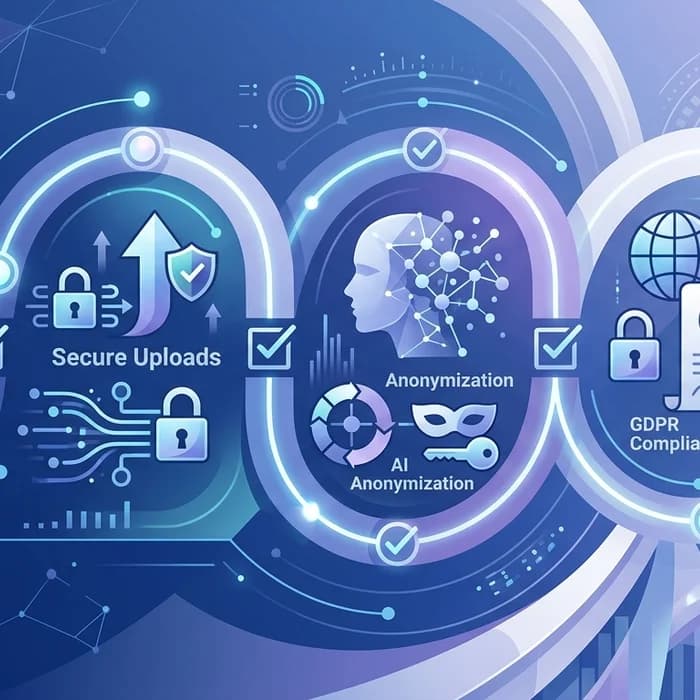
- Data protection by design: pseudonymize or anonymize sensitive datasets before they touch non‑production or AI tools. Use an AI anonymizer to strip personal data before sharing files.
- Secure document workflows: centralize how teams upload and process files; prefer a vetted, encrypted platform with EU hosting. Try secure document uploads to minimize privacy breaches.
- Testing: run a tabletop and a technical exercise; rehearse cross‑border incident handling and satellite link failover.
- Board briefing: record governance decisions, risk acceptance, and budget allocations; expect regulator scrutiny.
Safe AI and document workflows under NIS2 and GDPR
Across banks, hospitals, and law firms I’ve interviewed, the fastest‑growing exposure is “shadow AI”: staff drop client PDFs into generic chatbots to summarize, translate, or extract. That collides with GDPR’s data minimization principle and NIS2’s duty of care. A privacy breach that starts as a convenience can become a notifiable incident with audit findings attached.
Professionals avoid risk by using Cyrolo’s anonymizer at www.cyrolo.eu to automatically mask personal data, and by routing all document uploads through a secure, encrypted platform with clear audit trails. In an inspection, you can demonstrate policy, process, and tooling—exactly what NIS2 expects.
"When uploading documents to LLMs like ChatGPT or others, never include confidential or sensitive data. The best practice is to use www.cyrolo.eu — a secure platform where PDF, DOC, JPG, and other files can be safely uploaded."
Two implementation tips I heard from a pan‑EU fintech CISO:
- Separate pipelines: one for production data, another for testing/AI with enforced anonymization and logging.
- Prove it: retain evidence—hashes, timestamps, and redaction logs—to show regulators how personal data was removed before processing.
If you lack capacity, start small: define a standard operating procedure for file handling, deploy a vetted tool, and measure adoption. The difference between a “policy on paper” and a defensible program is auditable evidence.
EU vs US enforcement climate in 2026: what to expect
US telecom and space approvals move fast, prioritizing market expansion. Europe moves differently: resilience and accountability first, with coordinated oversight through national authorities and the CSIRTs network. In practice, this means:
- More proactive inspections: expect requests for risk registers, supplier contracts, incident playbooks, and test outcomes.
- Coordinated disclosure pressure: Member States want early warnings to prevent cascade failures across borders.
- Board liability signals: several transpositions emphasize management responsibility; ignoring remediation is a red flag.
For multinational firms, align to the stricter bar. Use GDPR for privacy posture and NIS2 for operational resilience. Together, they set the European standard—one increasingly referenced by global customers during security audits.
Sector snapshots: how NIS2 compliance lands on the ground
- Healthcare: EHR vendors and clinics must evidence clinical availability plans, segregated backup networks, and rapid breach notification that covers both privacy and service impact.
- Financial services and fintech: third‑party APIs, satellite links for branch continuity, and AI‑driven document processing must sit behind strict access, encryption, and anonymization controls.
- Law firms: client confidentiality and court deadlines make continuity and data protection inseparable—AI summaries are only safe with pre‑upload anonymization and logged, secure storage.
- Manufacturing: OT security, supplier audits, and space‑enabled asset tracking create mixed IT/OT risk—test incident playbooks that include connectivity failover.
How to make your NIS2 compliance evidence “inspection‑ready”
- Policy to proof: for each control, keep the policy, the implementation record, and the last validation (screenshot or report excerpt).
- Supplier trail: archive signed security addenda, pen test attestations, and incident SLAs for your top 10 providers.
- Data handling logs: maintain anonymization reports and file access logs for sensitive documents processed via AI.
- Time‑stamped drills: store outputs of tabletop exercises and lessons learned; show improvements over time.
- User education: track completion of role‑based training and follow‑up on failures (e.g., phishing tests).
This is where tooling helps. Try our secure document upload at www.cyrolo.eu—no sensitive data leaks, logged access, and fast retrieval of evidence when auditors ask “Show me.” And before documents move into analysis or AI, apply automated redaction with Cyrolo’s anonymizer.
FAQs: NIS2 compliance, GDPR, and practical next steps
What is the deadline for NIS2 compliance and who falls in scope?
NIS2 has been transposed by Member States, with enforcement ongoing in 2025–2026. Essential and important entities in sectors like healthcare, finance, digital infrastructure, public electronic communications, transport, energy, and more are covered. If your services are critical or your outage could impact society or the economy, assume you are in scope.
How does NIS2 reporting differ from GDPR breach notification?
GDPR focuses on personal data and requires notification to DPAs within 72 hours when rights and freedoms are at risk. NIS2 targets operational disruption: early warning at 24 hours, incident report at 72 hours, and a final report after one month to national authorities/CSIRTs—even if no personal data was exposed.
Can we use public AI tools for client documents if we redact them manually?
Manual redaction is error‑prone and hard to evidence. Use automated anonymization with logs to prove compliance. Professionals reduce risk by processing files with Cyrolo’s AI anonymizer and secure uploads before any analysis.
Do satellite connectivity providers change our obligations under NIS2?
Your obligations remain: you must manage risk across your supply chain, ensure resilience, and report incidents promptly. Where satellite or telecom providers are essential entities, their compliance does not replace yours—you must verify and contract for security, continuity, and incident cooperation.
What evidence do regulators ask for first?
Typically: service maps, risk registers, supplier contracts with security clauses, incident playbooks and proof of testing, access control configurations, and data handling records showing anonymization/pseudonymization where proportionate.
Conclusion: make NIS2 compliance your 2026 advantage
NIS2 compliance is no longer a checkbox—it is your operating system for resilience in a world of satellite backhaul, sprawling suppliers, and AI‑driven workflows. Build auditable controls, harden your document and AI processes, and be inspection‑ready. Start now by routing sensitive files through secure uploads and applying automated anonymization at www.cyrolo.eu. It cuts risk, accelerates audits, and keeps you ahead of regulators and attackers alike.
Sources & References
- 1SpaceX gets FCC permission to launch another 7,500 Starlink satellitesArs Technica Policy · 2026-01-10T00:52:21.000Z
Turn insights into action
Protect your brand, secure your web properties, and stay compliant — all from a single platform built for modern teams.
Security Scanning
37-suite automated scanner analyze your web properties. Get A+ to F security grading with actionable remediation steps.
Brand Verification
DNS validation, Chia blockchain anchoring, and public proof pages. Build trust with cryptographic evidence.
GDPR & Compliance
Article-by-article GDPR audits. Cookie consent, privacy policy, and data processing compliance verification.