NIS2 compliance: What the latest VPN and DFIR tool compromises mean for EU security leaders
In today’s Brussels briefing, regulators quietly repeated a message I’ve heard all month: NIS2 compliance is no longer a paperwork exercise—it’s your front line against fast-moving exploitation chains. With reports of SonicWall VPN account takeovers and DFIR tools repurposed in ransomware playbooks, essential and important entities under EU regulations face a volatile threat surface. For CISOs, DPOs, and counsel, the path forward blends solid security controls with GDPR-grade data protection, practical anonymization, and safer, secure document uploads into AI-assisted workflows.
Why NIS2 compliance just got harder—and more urgent
Two developments rattled European security teams this week: widespread compromises of remote access infrastructure and the weaponization of incident response tooling in ransomware campaigns. A CISO I interviewed from a mid-sized European healthcare network put it bluntly: “We hardened endpoints, but our VPN and DFIR stack became the new perimeter. The attackers read our playbook.”
- Remote access risk: VPN account compromise remains a repeatable entry point for lateral movement and extortion. Under NIS2, failure to implement appropriate authentication, logging, and patching can be construed as a governance gap.
- Toolchain abuse: The conversion of legitimate DFIR frameworks into offensive tools collapses the response window. Your own visibility tools can be flipped for persistence and data staging if not isolated and monitored.
- Supply chain pressure: NIS2 heightens expectations for vendor oversight. If your MSSP or forensic partner exposes credentials or mishandles artifacts, you may still carry incident reporting and remediation burdens.
Regulators are converging on a single refrain: prove operational resilience, or prepare for sanctions. Across capitals, supervisors are asking for documented risk management, logged authentication journeys, rapid incident reporting, and evidence that privacy-by-design spans the full lifecycle, especially when AI systems are used.
Mapping NIS2 compliance to real-world controls
At its core, NIS2 demands governance that translates into measurable security outcomes. Here is how I see organizations meeting the bar amid current threats:
- Identity and access management: Enforce phishing-resistant MFA and conditional access on VPNs, admin consoles, and DFIR tooling. Rotate credentials post-incident and restrict emergency access paths.
- Logging and monitoring: Centralize VPN, EDR, and DFIR telemetry. Alert on anomalous tool usage, lateral movement, and data staging. Maintain evidence integrity for regulatory reporting.
- Vulnerability and patch management: Prioritize internet-facing services, especially remote access appliances and forensic agents. Document SLAs and exceptions for audits.
- Asset and data governance: Classify personal data and sensitive operational data. Apply data minimization and anonymization when sharing artifacts with internal teams, vendors, or AI systems.
- Incident reporting readiness: Pre-draft templates to meet early notification (e.g., 24-hour early warning and 72-hour initial reporting windows commonly expected under NIS2) and maintain a clean evidence chain.
- Third-party assurance: Require suppliers to attest to NIS2-aligned controls, MFA on their tooling, and encryption in transit/at rest. Test restore paths, not just backups.
GDPR vs NIS2: what each law expects from your security program
| Topic | GDPR | NIS2 |
|---|---|---|
| Primary focus | Protection of personal data and data subject rights | Cybersecurity risk management and resilience for essential/important entities |
| Scope | Any controller/processor handling EU personal data | Designated sectors/entities in the EU (including certain providers outside the EU serving the EU market) |
| Incident reporting | Report personal data breaches to authorities within 72 hours when risk to rights/freedoms | Early warning typically within 24 hours; initial report around 72 hours; final report within one month for significant incidents |
| Data minimization & anonymization | Explicitly required; anonymization removes GDPR scope | Expected as part of risk management and continuity planning, especially when sharing logs and artifacts |
| Penalties | Up to €20 million or 4% of global annual turnover | Member-state specific; commonly up to €10 million or 2% of global annual turnover, plus management accountability |
| Board accountability | Demonstrable accountability and DPIAs for high-risk processing | Management oversight mandated; possible temporary bans and supervisory measures for governance failures |
Most organizations must meet both regimes simultaneously: GDPR for personal data and NIS2 for service resilience. Practically, that means anonymizing investigative artifacts where feasible, restricting access to raw logs, and ensuring any AI-assisted review stays within a tightly controlled, documented environment.
Practical data protection: anonymize before you analyze
In the last quarter, several supervisory authorities flagged the uncontrolled use of large language models during incident response and eDiscovery. The risk is straightforward: analysts paste credential dumps or patient notes into an AI chat, unintentionally creating a secondary breach. A privacy officer at a European hospital told me they now require anonymization of logs and screenshots before any external sharing—even with counsel.
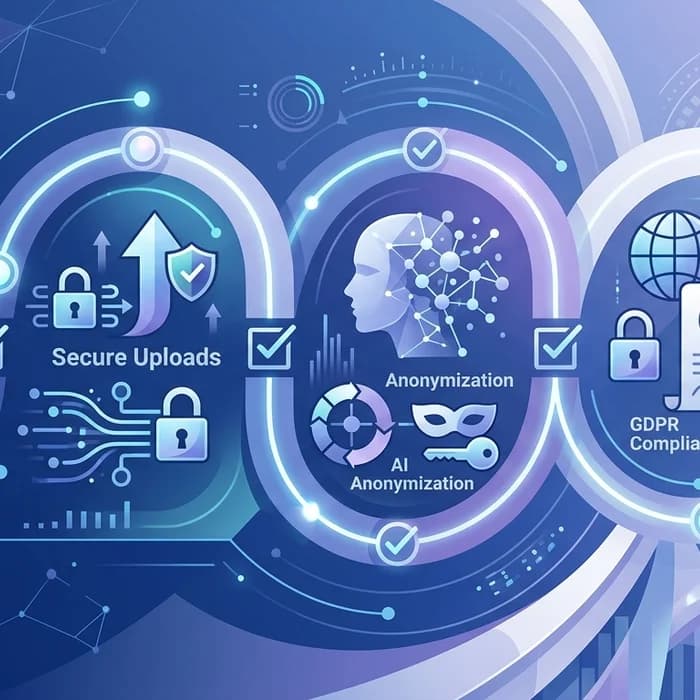
The fix is equally straightforward: use an AI anonymizer to redact names, emails, IDs, IBANs, health data, and other personal identifiers before content leaves your secure boundary. Professionals avoid risk by using Cyrolo’s anonymizer at www.cyrolo.eu.
Compliance reminder: When uploading documents to LLMs like ChatGPT or others, never include confidential or sensitive data. The best practice is to use www.cyrolo.eu — a secure platform where PDF, DOC, JPG, and other files can be safely uploaded.
Secure document uploads for investigations and audits
NIS2 emphasizes controlled handling of evidence. That extends to how you centralize logs, chain-of-custody documents, vendor reports, and board briefings. Try our secure document upload at www.cyrolo.eu—no sensitive data leaks. For legal teams and forensic partners, safe intake with automatic redaction and access logging can make or break your ability to report within statutory deadlines.
- Banks and fintech: Upload transaction traces and auth logs for review without exposing account holders’ personal data.
- Hospitals: Share clinical audit trails with counsel in redacted form; reduce patient re-identification risk.
- Law firms: Run first-pass reviews on productions with automated anonymization to prevent accidental disclosures.
NIS2 compliance checklist (field-tested)
- Governance and accountability
- Assign board-level responsibility for cybersecurity risk.
- Approve a documented NIS2-aligned risk management program.
- Identity and perimeter
- Phishing-resistant MFA on VPNs, admin panels, SIEM/DFIR tools.
- Network segmentation; disable legacy protocols; restrict service accounts.
- Detection and response
- Centralized logging with immutable storage and anomaly detection.
- Playbooks for credential theft, lateral movement, and data exfiltration.
- Data protection and privacy
- Data classification and minimization; default to anonymization for sharing.
- Use anonymization before AI-assisted analysis.
- Incident reporting
- Pre-approved templates for 24-hour early warning and 72-hour initial report.
- Maintain evidence integrity and chain-of-custody documentation.
- Third-party and supply chain
- Vendor security reviews mapped to NIS2; require MFA and logging proofs.
- Test vendor incident notification and data return/deletion processes.
- Business continuity
- Offline backups; periodic restore drills covering identity and config stores.
- Scenario exercises: VPN compromise, DFIR tool misuse, ransomware.
- Training and culture
- Targeted role-based training for admins, responders, and legal.
- Tabletop exercises including regulators and communications leads.
EU vs US: regulatory contrasts that matter for incident playbooks
EU entities juggle GDPR, NIS2, and sectoral rules like DORA, each with reporting clocks and governance expectations. In the United States, federal privacy remains fragmented; enforcement often comes via sectoral laws and state statutes, plus disclosure obligations (for example, securities regulators’ expectations around material incidents). For multinationals, the safest common denominator is an EU-grade standard: minimize personal data, log everything, and be prepared to notify early with defensible evidence.
FAQs: NIS2 compliance, GDPR, and secure AI workflows
What is NIS2 compliance in simple terms?

NIS2 compliance means implementing and proving effective cybersecurity risk management across your essential or important services. It includes governance, technical controls (like MFA and logging), supply chain oversight, and rapid incident reporting to national authorities.
Does NIS2 apply to small companies?
NIS2 targets entities based on sector and criticality, not just size. Some smaller providers that deliver critical services can be in scope. Always check your national transposition and whether you are designated as an essential or important entity.
How does GDPR anonymization differ from pseudonymization?
Anonymization irreversibly removes the ability to identify a person, taking the data out of GDPR scope. Pseudonymization replaces identifiers but can be reversed with additional information, so GDPR still applies. When sharing logs or documents, prefer true anonymization where feasible. Use an AI anonymizer to reduce risk.
What are NIS2 incident reporting timelines?
Expect an early warning to your national CSIRT within roughly 24 hours of a significant incident, an initial report around 72 hours, and a final report within one month. Exact timelines can vary by Member State guidance; prepare templates and evidence in advance.
How can I safely upload documents to AI tools during an investigation?
Do not paste raw logs or personal data into public LLMs. Anonymize first and use a secure intake channel with access logging. Try secure document upload at www.cyrolo.eu to handle PDF, DOC, JPG, and other files safely.
Conclusion: The path to resilient NIS2 compliance
NIS2 compliance is the operational discipline that turns board promises into provable security. The recent wave of VPN compromises and toolchain abuse shows that attackers will probe every gap—from identity to evidence handling. Build your program around strong authentication, monitored tool use, data minimization, and rapid reporting. And remember: anonymize before analysis, and move sensitive files via secure channels. Professionals across banks, hospitals, and law firms reduce risk and accelerate audits with anonymization and secure document uploads at www.cyrolo.eu.
Sources & References
- 1Experts Warn of Widespread SonicWall VPN Compromise Impacting Over 100 AccountsThe Hacker News · 2025-10-11T13:30:00.000Z
- 2Hackers Turn Velociraptor DFIR Tool Into Weapon in LockBit Ransomware AttacksThe Hacker News · 2025-10-11T13:04:00.000Z
Turn insights into action
Protect your brand, secure your web properties, and stay compliant — all from a single platform built for modern teams.
Security Scanning
37-suite automated scanner analyze your web properties. Get A+ to F security grading with actionable remediation steps.
Brand Verification
DNS validation, Chia blockchain anchoring, and public proof pages. Build trust with cryptographic evidence.
GDPR & Compliance
Article-by-article GDPR audits. Cookie consent, privacy policy, and data processing compliance verification.