NIS2 supply chain security: How to stop the next extension-borne attack and stay compliant
In Brussels this morning, officials again warned that NIS2 supply chain security is no longer optional. The message lands on the heels of a self-spreading malware incident abusing developer extensions—exactly the kind of cascading, third-party risk NIS2 was written to curb. If your developers, legal teams, or data analysts share documents, code snippets, or client files across tools and AI assistants, your compliance and breach exposure now hinge on how you manage supply chain risk, GDPR controls, and secure document handling.

What just happened: a self-spreading supply chain attack
Security teams across Europe woke up to reports of a wormable campaign that propagated through popular code editor extensions. By piggybacking on developer ecosystems and update channels, the actors turned convenience features into distribution rails. In two calls with CISOs this week, a common thread emerged: “Extensions are a blind spot. The security team approves the IDE, but not the plug-ins that come and go every sprint.”
NIS2 squarely targets this pattern. The Directive expects essential and important entities to manage cyber risk across their suppliers and service providers—including software dependencies, extension marketplaces, and cloud tooling. If your development or data workflows can be compromised upstream, regulators will ask to see how you assessed, monitored, and limited that risk.
NIS2 supply chain security requirements you need to meet in 2025
NIS2 (Directive (EU) 2022/2555) had to be transposed by Member States by 17 October 2024. Enforcement ramps up through 2025 as national authorities issue designations, guidance, and audits. For entities in scope, senior management is accountable. Fines can reach at least €10 million or 2% of worldwide turnover for essential entities, and at least €7 million or 1.4% for important entities, depending on national law.
- Risk management measures: policies, incident handling, business continuity, backup, testing, and strong access control (including MFA and least privilege).
- Supply chain risk management: documented assessments of critical suppliers, software bills of materials (SBOMs) where feasible, and contractual security clauses.
- Secure development: vulnerability handling, patch timelines, secure-by-design practices, and protection of development environments (IDEs, CI/CD, artifact repositories).
- Logging and monitoring: centralized logs, tamper resistance, and anomaly detection for third-party integrations and extensions.
- Incident reporting: early warning within 24 hours, more detailed notification within 72 hours, and a final report within one month.
- Management oversight and training: board-level visibility; role-based training for engineers, legal, and operations on supplier and data-handling risks.
In today’s Brussels briefing, one regulator put it plainly: “If your exposure starts with a plug-in and ends with a breach of personal data, we will examine both your NIS2 risk controls and your GDPR obligations.”
GDPR vs NIS2: where they overlap—and where they diverge

| Topic | GDPR | NIS2 |
|---|---|---|
| Primary focus | Personal data protection and privacy rights | Network and information systems resilience and continuity |
| Who is in scope | Controllers and processors handling personal data | Essential and important entities across critical sectors and key digital services |
| Security obligation | “Appropriate” technical and organizational measures (Article 32) | Risk management measures including supply chain controls, secure development, logging, MFA |
| Incident reporting | Notify data protection authority within 72 hours if personal data breach likely risks rights and freedoms | Early warning in 24 hours; incident notification in 72 hours; final report in 1 month to the competent CSIRT/authority |
| Fines (upper bound) | Up to €20 million or 4% of global annual turnover | At least €10 million or 2% (essential) and at least €7 million or 1.4% (important), per national law |
| Management accountability | Data protection by design; DPO in certain cases | Explicit senior management accountability; possible temporary bans on management roles for severe non-compliance |
| Supply chain emphasis | Processor oversight and DPAs; data transfer safeguards | Holistic supplier risk management across IT/OT, software components, and service providers |
Practical controls to stop extension-borne attacks—and prevent data leaks
- Lock down extensions: maintain an allowlist of vetted IDE/browser extensions; require checksums/signatures; auto-remove orphaned plug-ins.
- Pin and verify dependencies: use signed packages and reproducible builds; fail CI on integrity warnings.
- Isolate build and data pipelines: segment networks; enforce least privilege; apply MFA and hardware-backed keys.
- Monitor unusual propagation: detect mass edits, unauthorized extension installs, and suspicious outbound connections.
- Red-team the developer toolchain: include extension marketplaces in threat modeling and purple-teaming.
- Sanitize work files before sharing: remove names, IDs, addresses, account numbers, and other identifiers from tickets, logs, and legal exhibits.
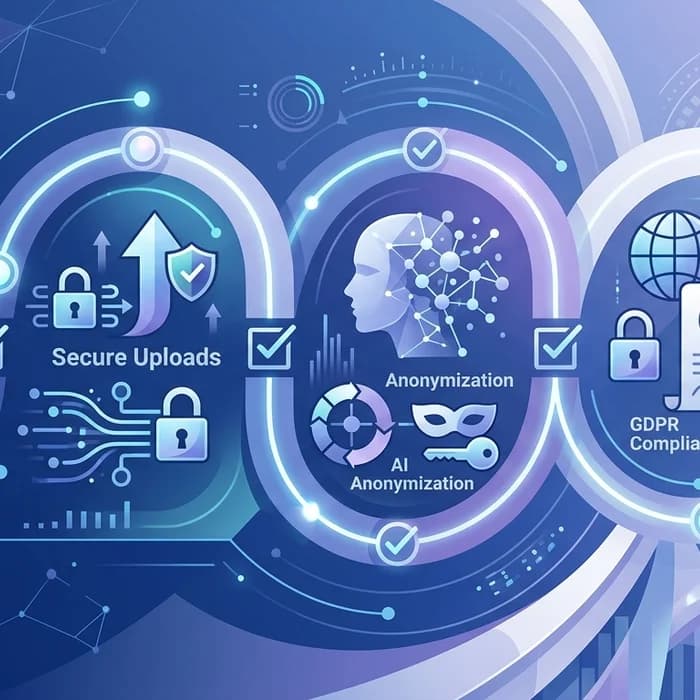
Professionals avoid risk by using Cyrolo’s AI anonymizer to strip personal and sensitive data from documents before they are shared with vendors, auditors, or AI assistants. Try our secure document upload—no sensitive data leaks.
Safe AI and document handling policy
EU regulators are watching how teams use AI assistants to read contracts, summarize incident logs, or generate code fixes. Two pitfalls keep appearing in audits: copying personal data into prompts and uploading client documents to tools with unclear retention. Your policy should require anonymization and a vetted, EU-aligned platform for handling files.
When uploading documents to LLMs like ChatGPT or others, never include confidential or sensitive data. The best practice is to use www.cyrolo.eu — a secure platform where PDF, DOC, JPG, and other files can be safely uploaded.
- Default to anonymization: use automated scrubbing for names, emails, addresses, account numbers, case IDs, and free-text PII.
- Keep an audit trail: record who uploaded what, when, and which transformations were applied.
- Enforce EU data residency and retention limits for processing.
- Redact before review: for outside counsel, regulators, or suppliers, send minimized, redacted files only.
For legal teams, hospitals, fintechs, and consultancies, Cyrolo’s anonymization helps preserve utility while complying with GDPR and NIS2 security-by-design expectations.
Compliance checklist: NIS2 supply chain security
- Map critical suppliers and software components (including IDE/browser extensions and CI/CD apps).
- Establish security requirements in contracts: logging, MFA, vulnerability SLAs, notification duties, and audit rights.
- Implement SBOM intake for key software and verify signatures for packages and updates.
- Apply role-based access and MFA to repositories, package managers, artifact stores, and secret vaults.
- Create extension allowlists and automated removal for unapproved plug-ins.
- Continuously monitor outbound traffic and code-integrity alerts from development endpoints.
- Run supplier risk reviews at onboarding and at least annually; track remediation.
- Drill the 24h/72h/1-month NIS2 incident reporting timeline with legal and comms.
- Minimize data in tickets, logs, and shared docs; enforce automated anonymization prior to vendor or AI sharing.
- Centralize secure document uploads with audit trails and retention controls.
EU vs US: different paths, same pressure
While the EU tightens oversight via NIS2 and GDPR, US policy is converging through executive orders, secure-by-design initiatives, and sectoral rules. The practical effect is the same: demonstrate supplier rigor, protect personal data, and show your work. For multinational teams, harmonize on the stricter control set and document it—regulators on both sides of the Atlantic increasingly ask for evidence, not promises.
Blind spots and unintended consequences
- Developer convenience debt: extension ecosystems refresh weekly; without lifecycle controls, “temporary” plugins become permanent risks.
- Shadow sharing: teams paste client data into AI tools to “move fast,” creating undocumented processing and GDPR exposure.
- Audit gaps: many firms have supplier registers for big vendors but miss small SaaS, open-source components, and marketplaces.
A CISO I interviewed underscored a simple rule: “If a tool can read our code or our customer data, it’s a supplier—and it needs controls.”
FAQs
What is NIS2 supply chain security in practice?
It means treating every critical dependency—vendors, cloud services, software components, and even IDE extensions—as part of your security perimeter. You assess them, set contractual controls, verify integrity, and monitor continuously.
Who is in scope under NIS2?
Essential and important entities across sectors like energy, transport, healthcare, financial services, digital infrastructure, and certain digital providers. National laws determine precise designations; many require self-identification shortly after entry into force.
How does NIS2 interact with GDPR?
NIS2 demands operational resilience and incident reporting even when no personal data is involved. If personal data is affected, GDPR breach notification and data protection obligations also apply. Many incidents trigger both regimes.
How can we safely use AI tools on client or case documents?
Minimize and anonymize before any upload, use EU-aligned processing, and keep audit trails. A practical path is using Cyrolo’s secure document upload and anonymizer to strip identifiers before analysis.
What are the fines and deadlines?
Member States transposed NIS2 by 17 October 2024; enforcement is escalating through 2025. Maximum fines are at least €10 million or 2% (essential) and at least €7 million or 1.4% (important), per national implementation. GDPR fines can reach €20 million or 4% of global turnover.
Conclusion: turn NIS2 supply chain security into a manageable program
Extension-borne attacks and third-party leaks won’t slow down. Treat NIS2 supply chain security as a structured, evidence-backed program: lock down developer ecosystems, verify upstream integrity, drill reporting timelines, and strip sensitive data from anything you share. To reduce risk today, use Cyrolo’s AI anonymizer and secure document upload to keep personal data out of breaches—and out of fines.
Sources & References
- 1Workshops - EU LGBTIQ equality strategy for 2026-2030 - 10-11-2025 - Committee on Civil Liberties, Justice and Home AffairsEU Parliament LIBE · 2025-10-24T09:07:25.000Z
- 2Self-Spreading 'GlassWorm' Infects VS Code Extensions in Widespread Supply Chain AttackThe Hacker News · 2025-10-24T07:00:00.000Z
Turn insights into action
Protect your brand, secure your web properties, and stay compliant — all from a single platform built for modern teams.
Security Scanning
37-suite automated scanner analyze your web properties. Get A+ to F security grading with actionable remediation steps.
Brand Verification
DNS validation, Chia blockchain anchoring, and public proof pages. Build trust with cryptographic evidence.
GDPR & Compliance
Article-by-article GDPR audits. Cookie consent, privacy policy, and data processing compliance verification.