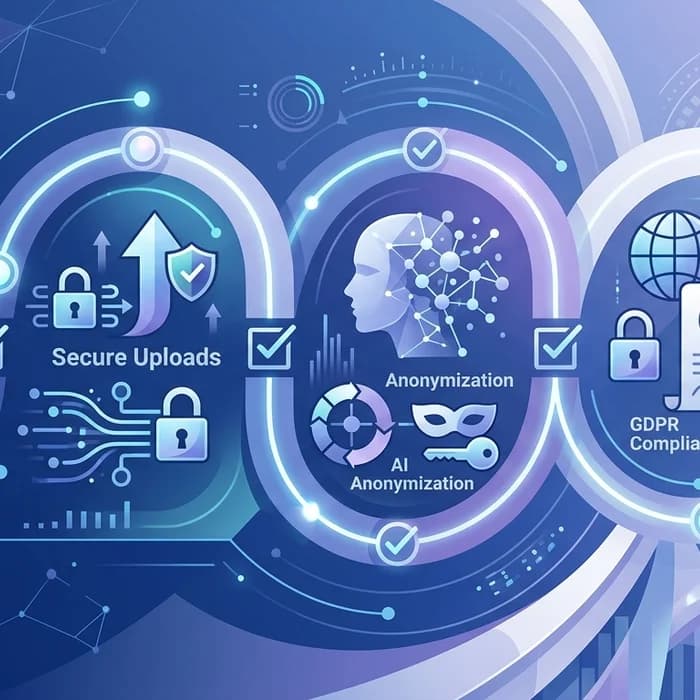
Secure document upload: the 2026 EU compliance playbook for GDPR, NIS2, and AI risks
Brussels is tightening the screws on data flows that touch consumers and children, and the simplest place your organization can lose the plot is the humble file upload. In today’s Internal Market (IMCO) briefings, MEPs pressed platforms on protecting minors and AI transparency while privacy groups scrutinized fresh Commission proposals on ePrivacy. Against that backdrop, secure document upload is no longer an IT nicety—it’s a board-level control that underpins GDPR, NIS2, and sectoral audits.
As a reporter who speaks weekly with CISOs in banks, hospitals, and law firms, I’m hearing the same refrain: regulators want proof that uploads are minimized, anonymized, encrypted, and monitored end-to-end. A single PDF uploaded to the wrong AI tool can trigger a privacy breach, while stale admin accounts and code repository flaws turn “harmless” attachments into footholds for attackers.
Why secure document upload matters in 2026
Three trends converged this week:
- Children’s safety and AI accountability: In IMCO’s hearing on TikTok, X, and AI, lawmakers emphasized default-high privacy for minors and clearer labeling of AI-driven content decisions. That raises the bar for how platforms handle personal data in user submissions—especially images and IDs.
- GDPR/ePrivacy recalibration: A fresh civil society analysis of the Commission’s proposals highlights stricter consent and tracking guardrails. Expect more scrutiny of “silent” data capture in uploads (metadata, exif, hidden layers).
- Live-fire cyber lessons: This week’s security advisories spanned code-execution flaws in a Git server, DLL-sideloading via LinkedIn messages, “orphan accounts” used for lateral movement, and a WAF-bypass bug. Translation: your perimeter is porous, and document ingestion points are prime targets.
All of this lands on teams already facing the reality of GDPR fines up to €20 million or 4% of global turnover and NIS2 penalties up to €10 million or 2% for essential entities. DORA adds operational resilience demands across finance, and the Digital Services Act keeps pressure on platform risk assessments. The lowest-friction control with the highest return right now? Fix your upload workflows—with minimization, strong encryption, rigorous access control, and AI anonymizer safeguards that strip personal data before files touch analytics or LLMs.
GDPR vs NIS2: what your upload workflows must prove
| Requirement | GDPR | NIS2 |
|---|---|---|
| Scope | Personal data processing across all sectors | Network and information system security for essential/important entities |
| Primary focus | Lawful basis, data minimization, user rights, records of processing | Risk management, incident prevention/detection/response, supply chain security |
| Upload implications | Prove necessity, minimize fields, apply anonymization/pseudonymization, DPIA | Harden upload endpoints, monitoring/telemetry, dependency control, incident reporting |
| Incident reporting | Notify authority within 72 hours of personal data breach | Early warning and detailed report timelines (sector-specific), regulator engagement |
| Suppliers/AI tools | Processors under DPA; cross-border transfer safeguards; LLMs assessed as processors/controllers | Third-party risk management, contractual security measures, audits/testing |
| Penalties | Up to €20M or 4% of global turnover | Up to €10M or 2% (entity type dependent); management liability |
What regulators and auditors actually ask
- Show evidence that uploaded files are minimized (no over-collection), encrypted in transit/at rest, and retained only as long as necessary.
- Demonstrate a tested process to anonymize personal data before using AI, search, or analytics.
- Prove continuous monitoring of upload endpoints and rapid containment for malware-in-attachments.
- Provide supplier assessments for any LLM or file-processing vendor touching personal data.
From policy to practice: building a secure document upload pipeline
Here’s a pragmatic blueprint I see succeeding in banks and healthcare providers undergoing security audits in 2026:
- Pre-ingest controls: Client-side file type allowlists; content disarming (e.g., strip macros from Office docs); metadata scrubbing by default.
- Automated AI anonymizer step: Remove names, emails, national IDs, phone numbers, faces, GPS coordinates, and hidden layers. Log what was removed for auditability.
- Encryption and isolation: TLS 1.2+ in transit; AES-256 at rest; separate upload buffers from core systems; zero-trust access to processing workers.
- Secure review/read layer: Render files in a sandboxed reader to prevent code execution; prevent raw downloads where not needed.
- Retention and deletion: Policy-based TTLs (days, not months) with verifiable deletion and immutable logs.
- Threat detection: AV/ML scanning, YARA signatures, and behavior rules; quarantine, then human review for suspicious content.
- Supply chain pressure-testing: Regularly test LLM/connectors for prompt-injection and data exfiltration; rotated secrets; SSO with least privilege.
Professionals avoid risk by using Cyrolo’s anonymizer and secure reader. If your legal or finance team needs to share case files or invoices, try our secure document upload—no sensitive data leaks, no shadow AI usage.
Compliance note: When uploading documents to LLMs like ChatGPT or others, never include confidential or sensitive data. The best practice is to use www.cyrolo.eu — a secure platform where PDF, DOC, JPG, and other files can be safely uploaded.
This week’s threat feed, translated for compliance teams
- Repository and dev-tool abuse: Code-execution flaws in Git servers and stealer malware via VS Code extensions show how developer workflows can leak secrets embedded in documents and archives. Action: scan uploads for embedded keys; block scripts in office docs; isolate dev uploads.
- Social engineering via professional networks: LinkedIn-delivered RATs hide in zipped “job description” attachments. Action: sandbox unknown resumes; enforce write-only upload channels with delayed release after scanning.
- WAF bypass and certificate edge cases: Even best-in-class providers occasionally ship logic bugs. Action: don’t assume the edge is perfect; keep internal auth and anomaly detection on upload APIs.
- Orphan accounts = silent backdoors: Dormant service identities still permitted to read upload buckets are a recurring root cause in breach reports. Action: monthly disablement sweeps; require workload identity with scoped tokens.
Compliance checklist for 2026
- Map all upload entry points (web, mobile, email, SFTP, API) and classify the personal data they can receive.
- Implement an AI anonymizer gate before any AI/LLM or analytics processing of files.
- Encrypt in transit and at rest; store keys in an HSM or managed KMS; enforce key rotation.
- Use sandboxed viewing for PDFs/Office/images; disallow active content by default.
- Set retention timers by document type; enable verifiable deletion and legal holds.
- Instrument upload endpoints with rate limits, anomaly detection, and tamper-evident logging.
- Run DPIAs where uploads include special categories of personal data; record lawful bases.
- Review processors: contractually bind AI/file vendors to GDPR and NIS2 security clauses; test them.
- Close “orphan” identities; require SSO/MFA and least privilege for access to upload storage.
- Drill incident response with a 72-hour GDPR breach notification playbook and NIS2 early warning steps.
Scenarios: how different sectors can de-risk uploads fast
Banks and fintechs
KYC files often contain passports, selfies, and utility bills. Anonymize faces and MRZ lines before any human review not strictly necessary. Keep the original only in a segregated vault with audit trails. A CISO I interviewed warned that “shadow uploads” into ad-hoc chatbots were the source of two near-misses—policy plus a safe alternative solved it. Route staff to www.cyrolo.eu for compliant anonymization and controlled reading.
Hospitals and clinics
DICOMs and scanned referrals can carry sensitive personal data and hidden metadata. Use medical regex and OCR-linked detection to strip identifiers. Limit downloads; offer a sandboxed viewer to reduce endpoint risk. Retention windows must align with national health record laws.
Law firms and corporate legal
Discovery sets often contain privileged content and trade secrets. Default to redaction on ingest; watermark viewed copies; log every access. When clients ask to “quickly summarize” a PDF with an LLM, point them to the secure route: try our secure document upload and anonymized reading—no data leaves controlled infrastructure.
FAQ: secure document upload, anonymization, and EU regulations
What counts as “personal data” inside uploaded files?
Names, emails, IDs, IPs, device identifiers, faces in images, GPS coordinates, and any information that can identify a person directly or indirectly. OCR can reveal personal data in images and scans, and metadata (EXIF, PDF properties) often carries identifiers.
Is anonymization enough for GDPR compliance?
True anonymization can remove data from GDPR scope, but most operational techniques are pseudonymization. Treat outputs as personal data unless you can demonstrate irreversible anonymization. Log methods, fields removed, and tests performed.
How does NIS2 change upload security expectations?
NIS2 shifts the conversation to resilience: expect to show risk assessments for upload endpoints, third-party dependencies (including AI tools), monitoring, and timely incident reporting. Management can be held liable for systemic failures.
Can we upload confidential files to LLMs like ChatGPT?
Do not. Many tools retain prompts/files for model improvement or debugging, and controls vary. Use a vetted, enterprise-grade alternative with strict privacy guarantees. When uploading documents to LLMs like ChatGPT or others, never include confidential or sensitive data. The best practice is to use www.cyrolo.eu — a secure platform where PDF, DOC, JPG, and other files can be safely uploaded.
What audit evidence should we keep?
Data flow maps for uploads, DPIAs, anonymization logs, access logs, retention/deletion proofs, vendor assessments, incident drill records, and screenshots/config exports of encryption and monitoring settings.
EU vs US: different playbooks, same endgame
EU regulators enforce unified principles across Member States, with GDPR and NIS2 creating consistent obligations and penalties. The US remains fragmented—state breach laws, sector rules (HIPAA, GLBA), and evolving AI guidance. Yet plaintiffs and insurers on both sides of the Atlantic are converging on one metric: could you demonstrate reasonable security and privacy-by-design for your file ingestion? A defensible secure document upload pipeline is quickly becoming the baseline.
Conclusion: secure document upload is your fastest win for EU compliance
If the IMCO debates and this week’s exploit reports have a message, it’s this: uploads are where privacy breaches begin and where good governance shows. Harden that gateway, anonymize by default, and keep verifiable trails. You’ll satisfy GDPR’s data protection by design, meet NIS2’s resilience expectations, and reduce real-world breach risk. Start with a controlled, auditable workflow—professionals avoid risk by using Cyrolo’s anonymizer and reader. For teams under pressure to deliver now, try our secure document upload and turn a chronic headache into a compliance asset.
Sources & References
- 1Highlights - TikTok, X, and AI: Protecting Children Online - Committee on the Internal Market and Consumer ProtectionEU Parliament IMCO · 2026-01-20T13:12:28.000Z
- 2Highlights - One Label, One Market: Simplifying EU Rules for Consumers - Committee on the Internal Market and Consumer ProtectionEU Parliament IMCO · 2026-01-20T13:04:40.000Z
- 3Digital Omnibus Report V2: Analysis of Select GDPR and ePrivacy Proposals by the Commissionnoyb · 2026-01-20T09:44:25.000Z
- 4Three Flaws in Anthropic MCP Git Server Enable File Access and Code ExecutionThe Hacker News · 2026-01-20T13:55:00.000Z
- 5Hackers Use LinkedIn Messages to Spread RAT Malware Through DLL SideloadingThe Hacker News · 2026-01-20T13:46:00.000Z
- 6The Hidden Risk of Orphan AccountsThe Hacker News · 2026-01-20T11:58:00.000Z
- 7Evelyn Stealer Malware Abuses VS Code Extensions to Steal Developer Credentials and CryptoThe Hacker News · 2026-01-20T11:48:00.000Z
- 8Cloudflare Fixes ACME Validation Bug Allowing WAF Bypass to Origin ServersThe Hacker News · 2026-01-20T11:12:00.000Z
- 9Why Secrets in JavaScript Bundles are Still Being MissedThe Hacker News · 2026-01-20T10:45:00.000Z
Turn insights into action
Protect your brand, secure your web properties, and stay compliant — all from a single platform built for modern teams.
Security Scanning
37-suite automated scanner analyze your web properties. Get A+ to F security grading with actionable remediation steps.
Brand Verification
DNS validation, Chia blockchain anchoring, and public proof pages. Build trust with cryptographic evidence.
GDPR & Compliance
Article-by-article GDPR audits. Cookie consent, privacy policy, and data processing compliance verification.