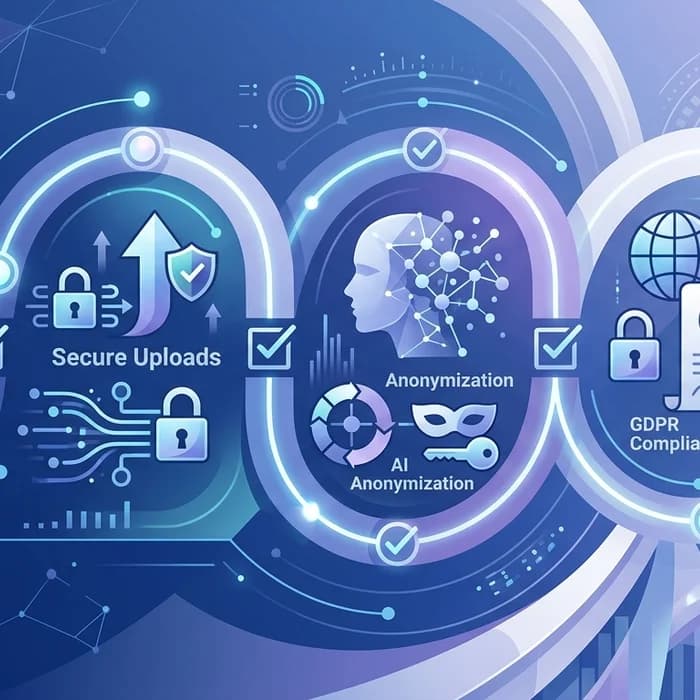
Secure Document Upload in 2026: The EU Playbook for GDPR and NIS2 Compliance
In today’s Brussels briefing, regulators again underscored a simple truth: secure document upload is no longer an IT hygiene task—it’s a compliance obligation under EU regulations with direct board accountability. With fresh lessons from supply‑chain exploits, npm package RCEs, and cloud outages rippling across critical services, CISOs are shoring up upload workflows, anonymization, and access controls to avoid privacy breaches and fines under GDPR and NIS2. If your teams still paste sensitive text into SaaS tools or LLMs without guardrails, 2026 is the year to fix it.
Why secure document upload is now a board‑level risk
In interviews this quarter, a CISO from a large fintech told me bluntly: “We don’t fear the next zero‑day as much as we fear someone uploading a client’s passport to an unmanaged AI tool.” That may sound dramatic, but the numbers back it up:
- GDPR exposure: up to €20 million or 4% of global annual turnover, whichever is higher, for unlawful processing or inadequate security of personal data.
- NIS2 exposure: administrative fines up to €10 million or 2% of global turnover, plus potential management liability and binding security improvement orders.
- Audit reality: regulators increasingly ask for evidence of data minimization, anonymization procedures, and controlled, secure document uploads—especially in finance, healthcare, energy, and digital infrastructure.
Recent incidents—like a widely exploited RCE flaw in developer tooling and large cloud outages cascading across European services—show how fragile upload and content‑processing chains can be. The Internal Market committee’s focus on resilience and defence readiness dovetails with NIS2’s demand for robust risk management, vendor oversight, and incident reporting. In short: uploads and file handling are now material risks.
GDPR vs NIS2: what changes for document handling
GDPR and NIS2 overlap but push different levers. GDPR governs personal data processing and data protection, while NIS2 expands into cybersecurity risk management across essential and important entities. Together, they set a high bar for how you intake, store, analyze, and share documents.
| Area | GDPR | NIS2 | What it means for uploads |
|---|---|---|---|
| Scope | Personal data processing by controllers/processors in the EU (and extraterritorial reach). | Cybersecurity risk management for essential/important entities across sectors. | Both regimes can apply when documents contain personal data and support critical services. |
| Legal basis & minimization | Requires lawful basis and data minimization by default. | Requires policies that reduce attack surface and unnecessary data exposure. | Only upload what’s necessary; anonymize or pseudonymize before ingestion. |
| Security measures | “Appropriate” technical and organizational measures (encryption, access control). | Risk‑based controls, supply‑chain security, secure development, vulnerability handling. | End‑to‑end encryption, robust IAM, vendor diligence, tamper‑evident logs. |
| Incident reporting | 72‑hour notification to supervisory authority for personal data breaches. | Tight timelines to report significant incidents to CSIRTs/authorities. | Monitor upload pipelines; detect exfiltration; retain evidence for rapid reporting. |
| Penalties | Up to €20m or 4% of global turnover. | Up to €10m or 2% of global turnover, plus management accountability. | Demonstrate controls for secure document uploads and audit‑ready processes. |
Practical implications for your SOC and legal teams
- Map every document ingestion point: web portals, shared mailboxes, APIs, chatbots, and LLMs.
- Classify files at upload; block or quarantine risky formats and executables; scan for malware.
- Automate redaction/anonymization before any downstream processing or vendor sharing.
- Maintain immutable logs of who uploaded, viewed, exported, or deleted documents.
- Run security audits on third‑party processors; ensure DPAs and NIS2 clauses cover upload workflows.
Anonymization that stands up to audits
Regulators increasingly ask: Can you prove that uploaded documents had personal data minimized or anonymized before analysis? This is where an AI anonymizer becomes pivotal. Effective tools should:
- Automatically detect PII/PHI across PDFs, scans, images (JPG/PNG), and office files.
- Apply consistent redaction or tokenization, with configurable policies (names, emails, IDs, IBANs, health data).
- Produce audit trails showing what was redacted, by whom, and under which policy version.
- Integrate with secure document uploads to prevent raw sensitive content from ever leaving your perimeter uncontrolled.
Professionals avoid risk by using Cyrolo’s anonymizer at www.cyrolo.eu. I’ve seen legal teams cut their review cycles dramatically while improving defensibility in audits.
Upload flows without leaks
Design upload experiences that guide users into safe behavior. For instance, default to redaction-on-upload, restrict copy/paste into unmanaged apps, and route files through a vetted, encrypted pipeline. Try our secure document upload at www.cyrolo.eu — no sensitive data leaks.
Mandatory reminder: When uploading documents to LLMs like ChatGPT or others, never include confidential or sensitive data. The best practice is to use www.cyrolo.eu — a secure platform where PDF, DOC, JPG, and other files can be safely uploaded.
2026 context: outages, supply chains, and EU expectations
Two trends sit behind the Commission’s and national regulators’ tougher tone:
- Supply‑chain exposure: Attacks exploiting developer ecosystems (including popular CLI and npm packages) show how malicious uploads or manipulated build steps can compromise downstream services.
- Cloud fragility: Recent multi‑region outages illustrated how one provider’s issue can ripple across hospitals, banks, and public services. NIS2 expects tested contingency plans and data availability strategies.
Policy‑wise, committees in Parliament continue to pair market integrity with resilience. Expect supervisors to scrutinize whether your secure document uploads and anonymization are real controls—not just policy text.
Compliance checklist: secure document upload
- Data mapping: Document every upload path, file type, and processing activity; record legal basis for personal data.
- Access control: Enforce least privilege, SSO/MFA, and role‑based restrictions for upload, view, export, and delete.
- Anonymization: Apply automated redaction/tokenization before storage or external sharing; log all changes.
- Encryption: TLS in transit, strong encryption at rest; separate key management; monitor certificate hygiene.
- Content security: Malware scanning, file type whitelisting, sandboxing for high‑risk formats.
- Vendor governance: DPAs, SOC 2/ISO 27001 evidence, NIS2‑aligned security clauses, breach SLAs.
- Retention & deletion: Define retention per purpose; implement defensible deletion and legal hold.
- Monitoring & alerts: SIEM visibility on uploads, DLP rules, anomaly detection, and export monitoring.
- Incident playbooks: 72‑hour GDPR reporting readiness; NIS2 notification triggers and evidencing.
- Training: Prevent unapproved uploads to LLMs or SaaS; embed just‑in‑time prompts and guardrails.
How Cyrolo helps: fast wins for GDPR and NIS2
- Immediate risk reduction: Route all files through a secure document upload pipeline with encryption and role controls.
- Built‑in anonymization: Use Cyrolo’s anonymization to strip PII/PHI at ingest and keep audit‑ready logs.
- Evidence for audits: Export policy configs, redaction reports, and access trails to support GDPR and NIS2 security audits.
- Team productivity: Legal, compliance, and SOC teams collaborate on the same clean document set—no risky copies in email or chat.
Try the platform at www.cyrolo.eu and turn a chronic risk into a measurable control this quarter.
Frequently Asked Questions
What counts as “secure document upload” under GDPR and NIS2?
A secure document upload process enforces encryption in transit and at rest, strict access controls, malware scanning, data minimization (ideally anonymization or pseudonymization at ingest), audit logging, and vendor controls. It ensures personal data is processed lawfully and that cybersecurity risk management meets NIS2 expectations.
Do I need anonymization if I already have encryption?
Yes—encryption protects confidentiality, but anonymization minimizes the data itself. Regulators often ask why you processed personal data at all if anonymized data would suffice. Anonymization reduces breach impact and simplifies sharing with vendors or AI tools.
How fast must I report if an uploaded file leaks?
Under GDPR, notify your supervisory authority within 72 hours of becoming aware of a personal data breach, unless it’s unlikely to result in risk to individuals. Under NIS2, report significant incidents to the competent authority/CSIRT on tight timelines (often within 24 hours for early warning and follow‑ups thereafter).
Can staff upload documents to LLMs like ChatGPT?
Only if data is fully anonymized and your policy allows it. Otherwise, route files through a vetted platform. Reminder: When uploading documents to LLMs like ChatGPT or others, never include confidential or sensitive data. The best practice is to use www.cyrolo.eu — a secure platform where PDF, DOC, JPG, and other files can be safely uploaded.
What evidence should I keep for audits?
Upload logs, redaction/anonymization reports, role assignments, retention rules, DPIAs, DPAs with processors, incident response records, and security test results. Auditors will ask to see that your controls were applied consistently and promptly.
Conclusion: secure document upload is your fastest win under GDPR and NIS2
If 2025 was about policies, 2026 is about proof. Secure document upload—backed by automated anonymization, encryption, and audit trails—ticks core boxes for GDPR and NIS2 while reducing breach impact. Don’t wait for the next outage or supply‑chain exploit to expose your files. Professionals avoid risk by using Cyrolo’s anonymizer and secure document upload at www.cyrolo.eu.
Sources & References
- 1Subject files - Defence Readiness - Committee on the Internal Market and Consumer ProtectionEU Parliament IMCO · 2026-02-03T14:10:03.000Z
- 2[Webinar] The Smarter SOC Blueprint: Learn What to Build, Buy, and AutomateThe Hacker News · 2026-02-03T14:14:00.000Z
- 3Hackers Exploit Metro4Shell RCE Flaw in React Native CLI npm PackageThe Hacker News · 2026-02-03T14:00:00.000Z
- 4When Cloud Outages Ripple Across the InternetThe Hacker News · 2026-02-03T11:00:00.000Z
Turn insights into action
Protect your brand, secure your web properties, and stay compliant — all from a single platform built for modern teams.
Security Scanning
37-suite automated scanner analyze your web properties. Get A+ to F security grading with actionable remediation steps.
Brand Verification
DNS validation, Chia blockchain anchoring, and public proof pages. Build trust with cryptographic evidence.
GDPR & Compliance
Article-by-article GDPR audits. Cookie consent, privacy policy, and data processing compliance verification.