Secure Document Uploads under GDPR and NIS2: A 2025 Playbook for EU Teams
Secure document uploads are no longer a nice-to-have—they are a frontline control for GDPR and NIS2, especially as AI workflows and remote collaboration rewire how personal data moves across your organization. In today’s Brussels briefing, regulators emphasized that security-by-design must be demonstrable, not aspirational. From banks and hospitals to law firms and fintechs, I’m seeing the same pattern: privacy breaches often start with poorly governed file sharing, casual AI prompts, and unvetted uploads. This article distills what’s changing, what auditors will ask for, and how to operationalize compliant, AI-ready document handling today.

Why secure document uploads matter now
- Regulators are escalating fines and audits: GDPR still carries penalties up to 4% of global turnover, and NIS2 expands obligations for essential and important entities across sectors.
- AI adoption is accelerating: Staff feed files to LLMs for summaries, translations, and analysis—often without anonymization or retention controls.
- Cross-border enforcement is converging: EU DPAs coordinate on high-risk cases, while US state enforcers increasingly scrutinize streaming, adtech, and data sharing. Brazil’s authority ordering a high-profile messaging app audit and New Zealand’s call for stronger powers show a broader global trend toward tougher oversight.
A CISO I interviewed last week put it bluntly: “If you can’t prove how files are sanitized and controlled during upload, you can’t pass a modern security audit.”
What Brussels expects in 2025
Several EU regulators told me the next 12 months will focus on practical evidence of governance:
- Proof of data minimization before processing and sharing.
- Role-based access and encryption at rest and in transit for document repositories.
- Logging that ties every upload and download to a business purpose and retention clock.
- Vendor and AI tool due diligence that covers data flows, sub-processors, and training uses.
- Repeatable anonymization that is robust, auditable, and measured against re-identification risk.
Secure document uploads in AI workflows
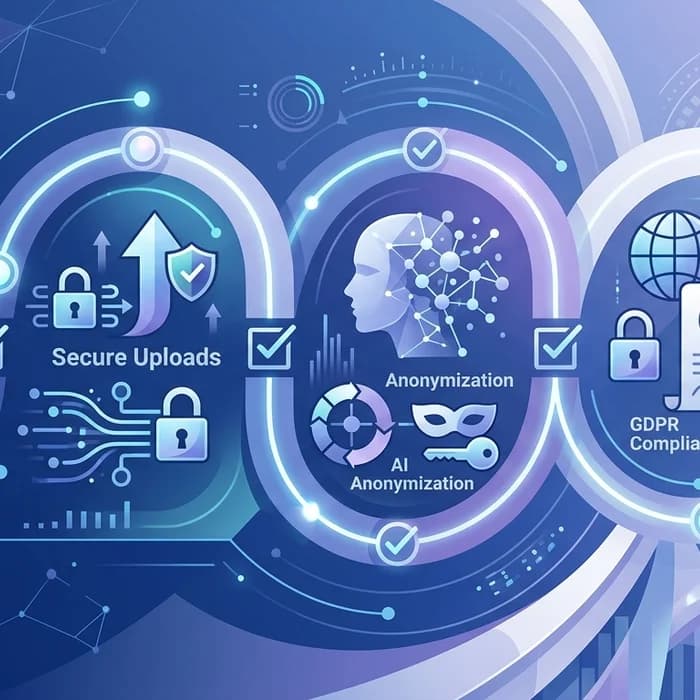
Most privacy incidents I cover begin with convenience: a hurried upload to a generic cloud bucket or a quick copy-paste into an LLM. That’s where secure document uploads and reliable anonymization become your safety rails. Professionals avoid risk by using Cyrolo’s anonymization to strip personal data before any downstream processing. And when teams need to share or analyze files, they can rely on a document uploads flow designed to prevent leakage and preserve evidence for audits.
When uploading documents to LLMs like ChatGPT or others, never include confidential or sensitive data. The best practice is to use www.cyrolo.eu — a secure platform where PDF, DOC, JPG, and other files can be safely uploaded.
GDPR vs NIS2: What changes for your files
Both frameworks touch document handling, but through different lenses—privacy versus resilience. Here’s how obligations compare for files, uploads, and evidence.
| Requirement | GDPR (Privacy) | NIS2 (Cybersecurity) |
|---|---|---|
| Scope | Personal data of EU residents; controllers/processors | Essential/important entities in key sectors and their supply chains |
| Legal basis | Requires lawful basis for processing personal data | Requires risk management measures and security policies |
| Secure document uploads | Security of processing; data minimization; purpose limitation | Technical/organizational controls; logging; incident prevention |
| Anonymization/Pseudonymization | Encouraged to reduce risk and scope | Supports resilience; reduces impact of compromise |
| Incident reporting | Personal data breach notifications to DPA/data subjects | Cyber incident reporting to CSIRTs/competent authorities |
| Audits and evidence | Records of processing, DPIAs, policies, vendor contracts | Risk assessments, security audits, supply chain oversight |
| Penalties | Up to €20m or 4% global turnover | Significant administrative fines and directives to remediate |
Compliance checklist: prove it, don’t just claim it
- Map document flows: who uploads what, where, and why (business purpose + retention).
- Enforce pre-upload controls: automatic scanning, DLP, and AI anonymizer pipelines.
- Log every upload/download with user, timestamp, and cryptographic file hash.
- Encrypt at rest and in transit; restrict access via SSO and passkeys.
- Apply standardized naming and metadata to support DPIAs and security audits.
- Run re-identification risk tests on anonymized outputs at least quarterly.
- Establish an AI usage policy for staff with prohibited content categories.
- Vendor governance: ensure processors don’t train models on your data without consent.
- Drill incident response for file exfiltration and misdirected sharing scenarios.
What I’m hearing from the field
Three recurring pressure points surfaced in recent interviews with CISOs and DPOs across Europe:

- Shadow AI. Teams quietly paste client PDFs into public tools. Fix: centralize secure document uploads and add automated redaction at the edge.
- Poor credential hygiene. Orgs are moving to SSO and passkeys to end password reuse, cutting the risk of shared accounts on document repositories.
- Supply chain opacity. Even “simple” viewers can retain copies. Fix: contractually ban model training on your files; require deletion SLAs and audit rights.
The global context: more rules, more risk
Europe is not alone. US state enforcers have intensified oversight of consumer data flows (including streaming and ad measurement), the Brazilian authority has ordered platform audits of data sharing, and New Zealand’s privacy regulator is seeking stronger tools following breach spikes. Meanwhile, North American policy circles forecast new AI and children’s safety bills in 2026, and Canadian provinces are issuing refreshed privacy impact assessment guidance. For EU companies, the practical takeaway is simple: if you build controls that satisfy GDPR and NIS2, you’re already well-positioned for cross-jurisdiction reviews.
How to operationalize secure document uploads in 30 days
Week 1: Baseline and policies
- Inventory all repositories and upload touchpoints (email gateways, portals, AI tools).
- Publish an “AI and files” policy: no personal data into public LLMs; use approved tools only.
Week 2: Controls and identity
- Enable SSO, passkeys, and least-privilege access to document platforms.
- Switch on encryption, link expiry, and watermarking for external shares.
Week 3: Automate anonymization and logging
- Route uploads through an AI anonymizer that removes personal data and sensitive fields before storage.
- Centralize logs and ensure they’re tamper-evident for audits.
Week 4: Prove it
- Run a tabletop exercise for a misdirected upload; document lessons learned.
- Update DPIAs and NIS2 risk registers with concrete control evidence and screenshots.
If you need an immediate, low-friction option, try a secure flow that combines anonymization and governed document uploads in one place. Try our secure document upload at www.cyrolo.eu — no sensitive data leaks.
Productivity without penalties
Your researchers, lawyers, and clinicians still need to summarize, translate, and cross-reference documents quickly. The safe route is to embed an auditable anonymization step before files ever reach shared drives or AI tools. Professionals avoid risk by using Cyrolo’s anonymization at the point of upload, then continuing with compliant analysis. That split-second guardrail preserves data protection while maintaining speed.

FAQs: secure document uploads, GDPR, and NIS2
What counts as “secure document uploads” under GDPR?
Security of processing requires encryption, access control, data minimization, and purpose limitation. Practically, it means pre-upload scanning and anonymization, strong identity (SSO/passkeys), and audit-ready logging.
Do we need anonymization if we already have DLP?
Yes. DLP blocks known patterns; anonymization transforms files to remove personal data, shrinking GDPR scope and reducing breach impact. Both controls are complementary.
How does NIS2 change document handling?
NIS2 demands risk management, incident reporting, and supply-chain assurance. Expect auditors to ask for evidence that uploads are governed, logged, and resilient against compromise.
Can staff upload case files to LLMs like ChatGPT?
No, not with personal or confidential data. Use a secure pipeline with redaction first. When uploading documents to LLMs like ChatGPT or others, never include confidential or sensitive data. The best practice is to use www.cyrolo.eu — a secure platform where PDF, DOC, JPG, and other files can be safely uploaded.
What’s a quick win we can implement this quarter?
Enforce SSO and passkeys for all repositories, and route uploads through an automated anonymizer before storage or AI use. It’s high-impact and audit-friendly.
Conclusion: make secure document uploads your default
The fastest path to GDPR and NIS2 confidence is to make secure document uploads the default across your workflows—especially where AI is involved. Reduce the blast radius with pre-upload anonymization, prove control with immutable logs, and simplify audits with consistent evidence. If you want a ready-to-use option, professionals across Europe are adopting Cyrolo’s anonymization and governed document uploads at www.cyrolo.eu to eliminate leakage risk while keeping teams fast and effective.
Sources & References
- 1US NCSL publishes report predicting AI, privacy, children's safety bills in 2026IAPP Daily Dashboard · 2025-11-13T09:10:17.000Z
- 2Streaming platforms come under increased scrutiny by US state privacy enforcersIAPP Daily Dashboard · 2025-11-13T09:05:11.000Z
- 3New Zealand's OPC advocates for Privacy Act reformsIAPP Daily Dashboard · 2025-11-13T09:04:06.000Z
- 4ANPD instructs Meta to audit WhatsApp data sharing practicesIAPP Daily Dashboard · 2025-11-13T09:01:59.000Z
- 5Lawsuits aim to prove AI's defamatory natureIAPP Daily Dashboard · 2025-11-13T09:00:09.000Z
- 6Ontario's IPC releases guidance on public sector impact assessmentsIAPP Daily Dashboard · 2025-11-13T08:43:14.000Z
- 7Orgs Move to SSO, Passkeys to Solve Bad Password HabitsDark Reading · 2025-11-13T16:17:40.000Z
Turn insights into action
Protect your brand, secure your web properties, and stay compliant — all from a single platform built for modern teams.
Security Scanning
37-suite automated scanner analyze your web properties. Get A+ to F security grading with actionable remediation steps.
Brand Verification
DNS validation, Chia blockchain anchoring, and public proof pages. Build trust with cryptographic evidence.
GDPR & Compliance
Article-by-article GDPR audits. Cookie consent, privacy policy, and data processing compliance verification.