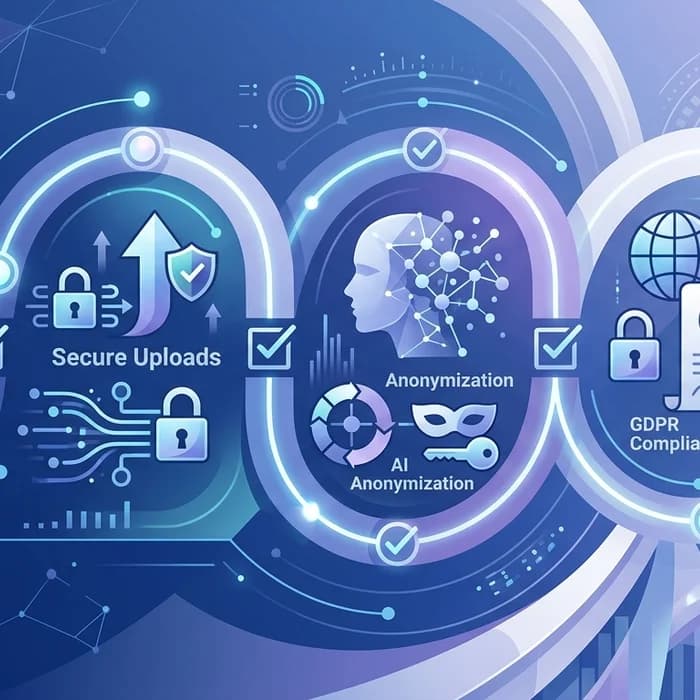
Secure Document Uploads: The 2025 Playbook for GDPR, NIS2, and AI Risk Mitigation
In today’s Brussels briefing, regulators emphasized a simple truth: secure document uploads are no longer a nice-to-have—they’re the difference between a quiet audit and a career-limiting breach. This week alone, researchers detailed attackers abusing Windows Hyper‑V to hide a Linux VM and evade EDR, a state‑sponsored breach targeting cloud backups, and multiple ChatGPT bugs that could enable data theft. For EU organizations facing GDPR and NIS2 scrutiny, “secure document uploads” and an AI anonymizer are now foundational controls, not add‑ons.
Why secure document uploads are now a board‑level issue
Over the past 48 hours, the threat calculus shifted yet again. Adversaries are nesting stealthy VMs inside Windows hosts to slip past endpoint defenses, while state‑sponsored operators are targeting cloud backups—your last line of business continuity. At the same time, exploitable flaws in generative AI services raise the stakes for every file a team drags into a chatbot or browser tab. A CISO I interviewed this morning put it bluntly: “File flows are the new crown jewels. If you can’t prove secure document uploads and redaction by design, you’re one misstep away from headlines.”
- Financial services: deal rooms, KYC packets, trading models—often PDF/DOC/XLS files—routinely traverse vendors and AI assistants.
- Hospitals and clinics: DICOM images, lab reports, and physician notes contain special‑category personal data under GDPR.
- Law firms and consultancies: client memos and eDiscovery productions can blend trade secrets with personal data.
When these documents are casually copied into a chatbot or uploaded to a generic web tool, you risk privacy breaches, confidentiality loss, and regulatory exposure. Professionals avoid risk by using Cyrolo’s anonymizer and secure document upload workflow at www.cyrolo.eu.
Compliance note: When uploading documents to LLMs like ChatGPT or others, never include confidential or sensitive data. The best practice is to use www.cyrolo.eu — a secure platform where PDF, DOC, JPG, and other files can be safely uploaded.
GDPR vs NIS2: what “good” looks like for document handling
EU regulators don’t prescribe one product, but they do expect demonstrable controls. Here’s how the two flagship frameworks land on your document workflows.
| Topic | GDPR (2016/679) | NIS2 (EU 2022/2555) |
|---|---|---|
| Scope | Personal data processing by controllers/processors | Security and resilience for “essential” and “important” entities across sectors |
| Data focus | Personal data (incl. special categories), data minimisation, purpose limitation | Network and information systems; service continuity and incident containment |
| Security measures | Appropriate technical and organisational measures; encryption, pseudonymisation, access controls | Risk management measures; policies on supply chain security, vulnerability handling, secure development |
| AI & uploads | Lawful basis; DPIA for high‑risk processing; privacy by design for file ingestion and redaction | Governance for third‑party and cloud services; logging, monitoring, and incident response for uploads |
| Incident reporting | Notify authority within 72 hours of becoming aware of a personal data breach; inform individuals when high risk | Early warning within 24 hours; incident notification within 72 hours; final report within 1 month |
| Penalties | Up to €20M or 4% of global annual turnover (higher of the two) | At least up to €10M or 2% of global turnover (Member States may set higher ceilings) |
| Accountability | Records of processing; DPO for certain entities; DPIAs | Management accountability; security audits; potential temporary bans and supervisory measures |
Deadlines and audits in 2025
- NIS2 transposition deadline has passed; national enforcement is ramping through 2025. Expect audits and questionnaires from sectoral regulators.
- GDPR remains evergreen: ongoing data mapping, DPIAs, and vendor assessments must cover AI tools and file flows.
- Average breach costs continue to rise; EU organisations report seven‑figure impacts when incident response, downtime, and regulatory remediation are factored in.

Key 2025 threat signals that impact your uploads
- Stealth VMs to bypass EDR: Attackers use virtualisation layers to mask exfiltration paths, including file staging areas.
- Cloud backup compromise: State‑sponsored actors target backup systems, turning “last resort” into first entry point.
- GenAI platform bugs: Security weaknesses in popular AI tools can expose past chat histories and uploaded files.
Translation for compliance and security teams: you need a verifiable chain of custody for every file, privacy‑by‑design redaction before AI exposure, and a platform that treats uploads as high‑risk inputs. That’s precisely where secure document uploads and an AI anonymizer come together.
From problem to solution: build a low‑risk AI document workflow
As someone who spends my days speaking with DPAs, CSIRTs, and CISOs, the winning pattern is clear:
- Collect and classify: Identify personal data and special‑category fields (health, biometrics, union membership) in files.
- Neutralise risk early: Apply anonymization or strong pseudonymisation prior to any AI processing or sharing.
- Control the ingress: Use secure document uploads with access controls, auditing, and safe rendering.
- Log and limit: Retain only what you need, for as long as you need, with clear deletion and export pathways.
Try Cyrolo’s privacy‑first workflow at www.cyrolo.eu—professionals avoid risk by using Cyrolo’s anonymizer and document reader so AI assistance doesn’t become a data‑leak vector.
Compliance checklist: secure document uploads and AI anonymization
- Data inventory covers PDFs, Office docs, images, and scans used with AI or vendors.
- DPIA updated to reflect AI use cases, file ingestion, and redaction mechanisms.
- Default‑deny policy: no raw confidential or personal data into public LLMs; enforce via technical controls.
- Pre‑processing: automated detection and anonymization of names, IDs, addresses, medical terms, and free‑text PII.
- Secure ingress: use secure document uploads with encryption in transit, role‑based access, and tamper‑evident logs.
- Vendor governance: DPAs in place; clear data processing instructions; no sub‑processing without approval.
- Retention and deletion: documented schedules; verified purge of temporary AI working copies.
- Incident response: playbooks for misdirected uploads, AI leakage, and supply‑chain compromise; 24/72/1‑month reporting aligned to NIS2.
- User training: specific modules on AI prompt hygiene and file handling, not generic phishing slides.
- Periodic audits: sample uploads, review redaction effectiveness, and test recovery from backup tampering scenarios.
Sector snapshots: what good looks like
Banks and fintech
Replace ad‑hoc analyst uploads with a governed intake. KYC packets are ingested via secure document uploads, automatically pseudonymised, then passed to internal LLMs for summarisation. Source documents remain controlled; outputs are attributable to anonymised tokens. Outcome: faster onboarding with GDPR‑aligned processing and stronger NIS2 audit trails.
Hospitals and clinics
Radiology reports and discharge summaries are pre‑processed with an AI anonymizer before clinical decision support. Staff do not paste raw notes into chatbots. Result: reduced exposure of special‑category data, simpler DPIA updates, fewer breach notification obligations.
Law firms and professional services
Client memos and evidence sets are uploaded through a governed portal, with automatic removal of client identifiers and matter metadata prior to AI summarisation. Partners get the speed of AI without risking privilege or client confidentiality. Try our secure document upload at www.cyrolo.eu — no sensitive data leaks.

FAQ: your top questions on secure document uploads and EU compliance
What counts as “secure document uploads” under GDPR?
Demonstrable controls: encryption in transit, authenticated access, role‑based permissions, audit logs, and privacy by design (e.g., pre‑upload anonymisation where feasible). A platform like www.cyrolo.eu helps you enforce those controls consistently.
Does NIS2 really apply to my document workflows?
If you are an essential or important entity (or a supplier to one), yes. NIS2 expects risk management across your information systems, including how files enter, are processed, and are monitored. Upload workflows must be logged, governed, and quickly auditable.
Can I paste client files into ChatGPT or similar tools safely?
Not without robust safeguards. Raw uploads can create confidentiality and privacy risks. Use redaction/pseudonymisation first, and route files via secure document uploads with access controls and logging.
Important: When uploading documents to LLMs like ChatGPT or others, never include confidential or sensitive data. The best practice is to use www.cyrolo.eu — a secure platform where PDF, DOC, JPG, and other files can be safely uploaded.
How do GDPR fines compare to NIS2 penalties?
GDPR can reach €20M or 4% of global turnover; NIS2 sets at least €10M or 2% (Member States may go higher) and can include management liability and temporary bans. Poorly governed upload workflows have triggered both privacy and security enforcement actions.
What’s the difference between anonymization and pseudonymisation for AI?
Anonymization aims to irreversibly prevent identification; pseudonymisation replaces identifiers with tokens but can be reversed with a key. For many AI use cases, strong pseudonymisation is sufficient and more practical—especially when you need to re‑link outputs to a client file internally.
Conclusion: secure document uploads are your fastest compliance win
The 2025 threat landscape—from stealth VMs to AI platform bugs—demands disciplined control over files. If you can prove secure document uploads, automated anonymization, and governed AI use, you meet regulators with confidence and keep data off the front page. Get started today at www.cyrolo.eu: professionals avoid risk by using Cyrolo’s anonymizer and document reader, and your teams ship work faster without privacy compromises.
Sources & References
- 1Hackers Weaponize Windows Hyper-V to Hide Linux VM and Evade EDR DetectionThe Hacker News · 2025-11-06T07:22:00.000Z
- 2SonicWall Confirms State-Sponsored Hackers Behind September Cloud Backup BreachThe Hacker News · 2025-11-06T05:40:00.000Z
- 3Multiple ChatGPT Security Bugs Allow Rampant Data TheftDark Reading · 2025-11-06T10:00:00.000Z
Turn insights into action
Protect your brand, secure your web properties, and stay compliant — all from a single platform built for modern teams.
Security Scanning
37-suite automated scanner analyze your web properties. Get A+ to F security grading with actionable remediation steps.
Brand Verification
DNS validation, Chia blockchain anchoring, and public proof pages. Build trust with cryptographic evidence.
GDPR & Compliance
Article-by-article GDPR audits. Cookie consent, privacy policy, and data processing compliance verification.