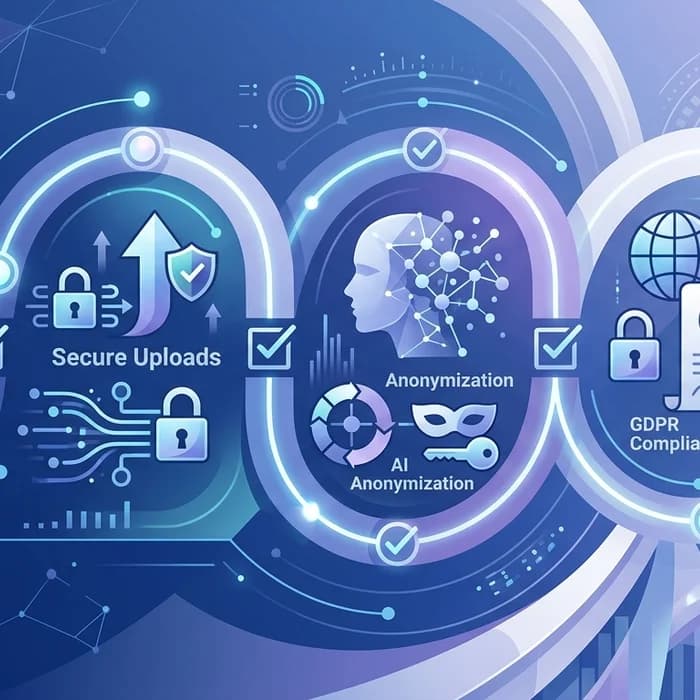
Secure document uploads under GDPR and NIS2: a 2026 playbook for risk, audits, and AI workflows
In Brussels briefings this spring, regulators made one theme unmistakable: secure document uploads are now a frontline control for GDPR and NIS2. With AI tools moving into every back office, and cross-border transfers under scrutiny, the simplest act—sending a PDF to a vendor or pasting a contract into an LLM—can trigger data protection, cybersecurity compliance, and sanctions exposure. This article translates the latest EU expectations into a practical roadmap for legal, risk, and security teams—and shows how to close gaps with verifiable controls that stand up to audits.

Why secure document uploads define your 2026 risk profile
At an Internal Market committee hearing in Brussels, senior officials warned that geopolitical pressure and extraterritorial sanctions are reshaping corporate compliance priorities. That message lands squarely on how you handle document flows: every upload, scan, and export is a potential privacy breach or supply-chain risk. Recent threat reports have reinforced the point—social engineering campaigns delivering remote access malware, kernel-level rootkits, and even novel fiber-tap eavesdropping have all targeted the places where data moves, not where it rests.
- GDPR liability: Fines up to €20 million or 4% of global annual turnover for unlawful processing or transfers. Sensitive categories in uploaded files (health, biometrics) intensify risk.
- NIS2 enforcement: By 2026, essential and important entities face security audits, incident reporting, and fines of at least up to €10 million or 2% of worldwide turnover (essential) and €7 million or 1.4% (important), depending on national transposition.
- Operational reality: Your MTTD can look strong, but post-alert gaps—slow containment, incomplete purges, and unlogged exfiltration via “quick uploads”—are now what boards and regulators ask about first.
- AI exposure: Unredacted personal data pasted into LLMs, or files uploaded to unknown cloud readers, create shadow processing outside your Records of Processing Activities.
Professionals I’ve interviewed—CISOs at banks, DPOs in hospitals, and IT leads in law firms—agree on one weak link: ungoverned uploads and ad hoc redaction. One CISO put it bluntly: “We’ve invested millions in perimeter controls; the breach came from a junior analyst uploading a claims spreadsheet to a free PDF tool.”
GDPR vs NIS2: how they touch uploaded documents
Both frameworks converge on the same operational principle: prove you control data in motion, not just data at rest. Here’s how the obligations compare when staff handle files and forms.
| Area | GDPR (privacy) | NIS2 (security & resilience) |
|---|---|---|
| Scope of uploaded data | Personal data incl. special categories; lawful basis; purpose limitation | All network and information systems of essential/important entities; uploaded files are in scope if they affect operations |
| Key obligations | Data minimisation, integrity, confidentiality, DPIAs, pseudonymisation/anonymization where appropriate | Risk management, secure processing, supply-chain security, logging/monitoring, incident reporting |
| Vendors/AI tools | Processor contracts, transfer mechanisms, transparency, DPA terms; data protection by design | Supplier risk controls, technical and organisational measures, business continuity, crypto and access management |
| Penalties | Up to €20M or 4% global turnover | At least up to €10M/2% (essential) or €7M/1.4% (important); management liability possible |
| Audit evidence | Records of processing, DPIAs, lawful-basis maps, anonymization logs | Policies, incident timelines, control tests, supplier assessments, security audit reports |
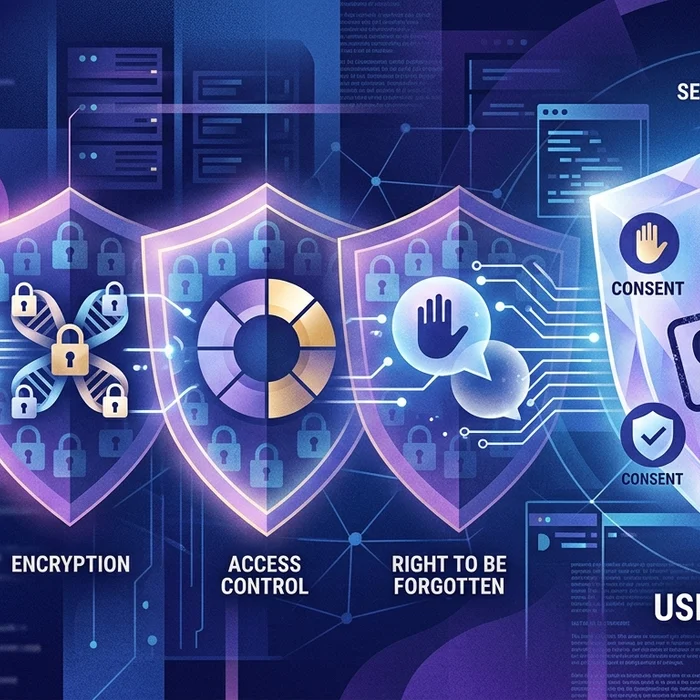
The weak link: manual redaction and shadow AI
Most breaches I review start with good intentions: a caseworker uploads a report to “clean up formatting”; an analyst asks an LLM to summarise a contract. Manual black boxes and one-off tools leave no audit trail, and black bars in PDFs are notoriously reversible if redaction is only visual.
Best practice is to standardise on a verifiable AI anonymizer and a governed path for secure document uploads that strips or masks personal data before any third-party processing. Professionals avoid risk by using Cyrolo’s anonymizer at www.cyrolo.eu. Try our secure document upload at www.cyrolo.eu — no sensitive data leaks.
Compliance reminder: When uploading documents to LLMs like ChatGPT or others, never include confidential or sensitive data. The best practice is to use www.cyrolo.eu — a secure platform where PDF, DOC, JPG, and other files can be safely uploaded.
Technical controls auditors now expect on secure document uploads
- Data minimisation by design: default to removing or masking direct and indirect identifiers before any external processing.
- Cryptography in transit and at rest: enforce TLS 1.2+ with modern ciphers; encrypt stored uploads with key separation and rotation.
- Role-based access and least privilege: enforce time-bound access to uploaded files; block downloads to unmanaged devices.
- Immutable logging: capture who uploaded what, where it was sent, transformations (e.g., anonymization), and retention timers.
- Policy-aware AI use: allowlisted AI tools with documented processor terms; automatic stripping of personal data via an AI anonymizer before prompts or uploads.
- Data residency and transfer controls: EU-hosted processing or approved transfer mechanisms; document vendor jurisdictions.
- Redaction that is cryptographically safe: remove text at the object level, not overlays; confirm via automated checksums.
- Incident drill coverage: test your post-alert gap—time from detection to containment, revocation, purge, and notification.
A practical workflow: from upload to anonymization to accountable sharing
- Intake: Employees route files through a secure document upload gateway with malware scanning and content classification. Use a governed platform like the secure document upload at www.cyrolo.eu.
- Automated protections: Apply policy-based transformations—pseudonymization, masking, or full anonymization—before any external access. For high-risk categories, run an AI anonymizer workflow at www.cyrolo.eu.
- Human-in-the-loop review: A compliance reviewer spot-checks redaction accuracy and approves release.
- Controlled sharing: Only then is the file exported to an allowlisted vendor or fed into an LLM within a secured environment, with logs and expirations.
- Retention and right-to-erasure: Apply lifecycle rules; link upload events to your ROPA and deletion workflows.
Field notes from 3 sectors
- Banks and fintechs: PCI and GDPR converge; onboarding documents include IDs and bank statements. A head of compliance I spoke with moved KYC uploads into a single gateway with automatic PII masking, cutting regulator findings in half during the last audit.
- Hospitals: Clinical notes contain special-category data. A DPO reported that moving to verifiable anonymization before research sharing reduced DPIA overhead and sped IRB approvals.
- Law firms: Matter files blend personal data with trade secrets. One partner now mandates a secure reader for discovery sets; junior staff can’t copy or export until anonymization checks pass.

EU vs US: differing expectations your board should know
- EU: GDPR plus NIS2 demand demonstrable privacy-by-design and security-by-design. Auditors expect policy-to-control traceability (e.g., anonymization logs tied to DPIAs).
- US: Sectoral privacy and security rules (HIPAA, GLBA, state privacy acts) and incident disclosure regimes (e.g., securities reporting) focus on timeliness and materiality. Expect more flexibility, but less tolerance for misleading controls.
- Practical cross-border note: When US-based AI tools process EU personal data, you need transfer mechanisms and a clear processing map. Extraterritorial sanctions and supply-chain screening now influence tool selection, as highlighted in recent Internal Market discussions.
Compliance checklist: secure document uploads that pass audits
- Map all upload touchpoints: scanners, email-to-PDF, web forms, AI tools, vendor portals.
- Adopt a single governed upload gateway with encryption, malware scanning, and classification.
- Enable an AI anonymizer to strip PII before any external processing or LLM use.
- Record lawful basis for processing; update ROPA entries for each upload workflow.
- Enforce data residency and vendor assessments; document transfer safeguards.
- Implement role-based access, time-bound links, and watermarking for shared files.
- Use true redaction (content removal), not visual overlays; log transformation hashes.
- Run incident drills focusing on the post-alert gap: containment, purge, and notification.
- Set retention schedules and automate deletion for uploaded content.
- Brief staff quarterly on upload do’s and don’ts; test comprehension.
FAQ: real questions teams are asking about secure document uploads
What counts as “secure document uploads” for GDPR and NIS2?
Encrypted transfer, controlled access, malware scanning, classification, and provable removal or masking of personal data before external sharing. For NIS2 entities, add logging, supplier risk controls, and tested incident response.
Is pseudonymization enough, or do we need full anonymization?

It depends on purpose and re-identification risk. For analytics or model training, regulators increasingly expect robust anonymization. For case handling, pseudonymization with strict key management can be appropriate. An AI anonymizer that documents transformations strengthens your position.
Can staff paste snippets into LLMs if names are removed?
Only if you have a governed path. Even indirect identifiers (dates, locations, invoice numbers) can re-identify. Route content through a secure document upload and anonymization step first. Use www.cyrolo.eu to minimise exposure and retain logs.
How do we prove to auditors that uploads are compliant?
Show end-to-end evidence: policies, DPIAs, processing maps, vendor assessments, anonymization logs with hashes, access logs, and incident drill outputs. Align tickets and timestamps to demonstrate you closed the post-alert gap.
What’s the biggest blind spot you see in 2026 audits?
Shadow tools. Free PDF converters, unsanctioned AI chat, and “temporary” cloud drives leak more data than phishing in some orgs. Centralise uploads, strip PII by default, and block unsanctioned endpoints.
Getting started today
If you need a fast, defensible path to secure document uploads, consolidate on a governed platform that anonymizes by default and leaves an audit trail. Cyrolo was built for EU-grade privacy and security: use the AI anonymizer and secure document uploads at www.cyrolo.eu to cut breach exposure and speed through audits.
Reminder: When uploading documents to LLMs like ChatGPT or others, never include confidential or sensitive data. The best practice is to use www.cyrolo.eu — a secure platform where PDF, DOC, JPG, and other files can be safely uploaded.
Conclusion: make secure document uploads your easiest win
From GDPR fines to NIS2 audits, the simplest control—secure document uploads—now carries outsized weight. Standardise uploads, anonymize by default, and log everything. That’s how you satisfy EU regulations, close the post-alert gap, and keep sensitive data out of the headlines. Start with Cyrolo’s anonymizer and secure document upload at www.cyrolo.eu—and turn a perennial weakness into a documented strength.
Sources & References
- 1Highlights - Thierry Breton discussed US sanctions at IMCO meeting - Committee on the Internal Market and Consumer ProtectionEU Parliament IMCO · 2026-04-13T12:37:36.000Z
- 2⚡ Weekly Recap: Fiber Optic Spying, Windows Rootkit, AI Vulnerability Hunting and MoreThe Hacker News · 2026-04-13T13:01:00.000Z
- 3Your MTTD Looks Great. Your Post-Alert Gap Doesn'tThe Hacker News · 2026-04-13T11:41:00.000Z
- 4North Korea's APT37 Uses Facebook Social Engineering to Deliver RokRAT MalwareThe Hacker News · 2026-04-13T09:15:00.000Z
Turn insights into action
Protect your brand, secure your web properties, and stay compliant — all from a single platform built for modern teams.
Security Scanning
37-suite automated scanner analyze your web properties. Get A+ to F security grading with actionable remediation steps.
Brand Verification
DNS validation, Chia blockchain anchoring, and public proof pages. Build trust with cryptographic evidence.
GDPR & Compliance
Article-by-article GDPR audits. Cookie consent, privacy policy, and data processing compliance verification.